Best WHS Software in Australia (2026)
The best WHS software in Australia is the one that handles contractors as well as staff, because most of the risk on your sites arrives with them. We read 12 platforms off their own sites and put them in order of five tests met. ComplyFlow, our own product, meets all 5 on what its Help Centre confirms; WHS Monitor also meets all 5. Beakon, ecoPortal, HSI Donesafe, Mitti, and Rapid Global meet 4.
 Bart CrowtherDirector of Sales
 - Published
- 15 min read

In most Australian workplaces, a large share of the hazardous work is done by people you do not employ: maintenance and trade contractors, cleaners, security, labour hire, and visitors who come to install or repair. This guide compares 12 WHS software platforms sold in Australia against that reality, not only against your own payroll.
Every capability below was read off each vendor's own website on 28 September 2026, except ComplyFlow's own pages, read on 30 September 2026. ComplyFlow is our own product. It is scored on the same five tests as every other platform, and only on what its Help Centre confirms.
What Is WHS Software?
WHS software is the system a business uses to run its work health and safety obligations: hazards and risks, incidents, inspections and audits, training and licences, contractors, and the records that prove each was done. Most platforms sold in Australia are also called safety management software, and the two terms are used for the same thing. The better ones replace the spreadsheets, shared drives, and paper sign-in books that an audit or an inspector will ask to see.
What separates them is breadth and focus. Some are broad safety systems for an organisation's own workforce. Some are built around contractors and the site gate. A few are specialists, in psychosocial risk, in critical events, or in enterprise risk. For most businesses the right choice depends less on the feature count than on who carries the risk on your sites.
Why Management or Control Changes What You Need.
Under the model WHS laws, which apply everywhere except Victoria, a worker includes a contractor, a subcontractor, and a contractor's employee.1 2 A business must look after, so far as is reasonably practicable, the workers it engages or causes to be engaged, and the workers whose activities it influences or directs.2 For a business that runs a site, that can be most of the people on it.
There is a second duty that factories rarely think about. The person with management or control of a workplace must ensure, so far as is reasonably practicable, that the workplace, the ways in and out, and anything arising from it are without risk to anyone.2 Safe Work Australia's own example names the building owner and property manager as holding that duty.3 At a shopping centre, the owner, the centre manager, every tenant business, and the cleaning, security, and trolley collection contractors are each a business with duties of their own.4
Where more than one business has a duty over the same matter, each must consult, cooperate, and coordinate with the others, so far as is reasonably practicable.2 None of it can be contracted out to the contractor.5 So WHS software for a business with contractors on site has to do three things a single-employer system often does not: hold records about people who work for someone else, show who is on which site today, and prove that the other businesses on site were told what they needed to know.
How We Chose and Ordered These Twelve.
We started from the platforms that Google and the three main AI assistants return for this search in Australia, measured on 24 September 2026, and read each one's own website on 28 September 2026. We scored each against five tests of what a WHS manager needs. A test is a Yes only when the vendor's own pages say so.
- Contractor records: its pages describe contractor prequalification, insurance, licence, or induction records tracked before work starts.
- Site sign-in: its pages describe sign-in or an attendance register that shows who is on site, contractors and visitors included.
- Permits to work: its pages name a permit capability as a module, feature, or workflow, not only in a blog or a template.
- Incidents, inspections, and hazards: its pages name all three as part of one product.
- Price or trial: it prints a price, or offers a free plan or a free trial.
The entries below run in order of tests met, most tests met first, with ties in alphabetical order, computed from the table. It is a tally of what each vendor's pages say, not a verdict: we wrote the tests, and we make ComplyFlow, so read the order as a starting point and each "Best for" line as the advice.
No capability is described unless the vendor's own site describes it. No vendor's own statistics about itself are repeated. Where we say a vendor names no feature, we mean we did not find it on the pages we read.
Other names that AI answers return for this search are not in this list. AxionSite, Kynection, HammerTech, and Procore are built for construction or transport rather than as general WHS systems. Enterprise EHS suites such as Cority, Intelex, Evotix, and Ideagen are compared in our top 10 EHS software for Australian enterprises. Sentrient, which AI answers cite often for this search, is an HR and compliance training platform that names no contractor module, and is compared in our incident management list. A handful of smaller construction and small-business tools were not assessed.
The Twelve at a Glance, Scored on Five Tests.
| Platform | Contractor records | Site sign-in | Permits | Incidents, inspections, hazards | Price or trial | Tests met |
|---|---|---|---|---|---|---|
| ComplyFlow | Yes | Yes | Yes | Yes | Yes | 5 of 5 |
| WHS Monitor | Yes | Yes | Yes | Yes | Yes | 5 of 5 |
| Beakon | Yes | No | Yes | Yes | Yes | 4 of 5 |
| ecoPortal | Yes | No | Yes | Yes | Yes | 4 of 5 |
| HSI Donesafe | Yes | Yes | Yes | Yes | No | 4 of 5 |
| Mitti, formerly SafetyCulture | Yes | No | Yes | Yes | Yes | 4 of 5 |
| Rapid Global | Yes | Yes | Yes | Yes | No | 4 of 5 |
| myosh | Yes | No | No | Yes | Yes | 3 of 5 |
| Noggin | Yes | No | Yes | Yes | No | 3 of 5 |
| Foremind | No | No | No | Yes | Yes | 2 of 5 |
| RiskWare | Yes | No | No | Yes | No | 2 of 5 |
| Safety Champion | No | Yes | No | Yes | No | 2 of 5 |
Yes means the vendor's own pages say it. No means we did not find it on the pages we read.
The Twelve, in Order of Tests Met.
ComplyFlow.
Best for: a business with several sites where most of the WHS risk arrives with contractors, and the evidence has to hold up across every site.
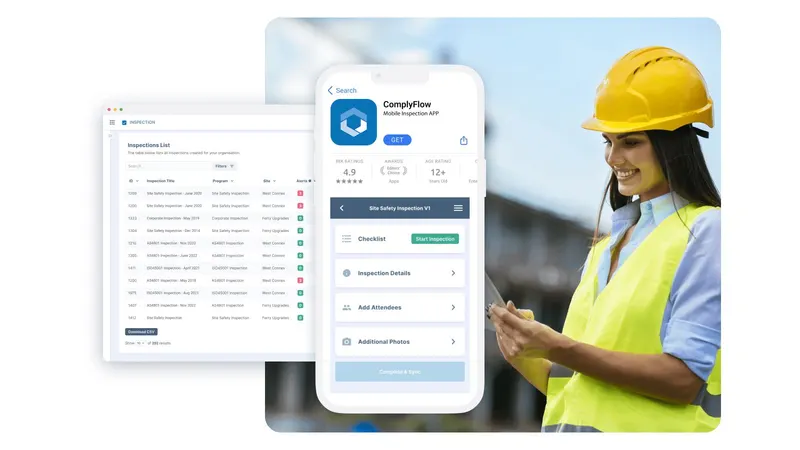
ComplyFlow is Contractor Management Software, and this is our own product. Document requirements can be assigned to a particular site, such as a high risk work licence for one site.6 Each sign-in point has its own QR code and geofence, with the site induction when due and site documents, such as an asbestos register, an evacuation diagram, or a traffic management plan, shown as the last step, and sign-ins are recorded in the Sign In Book, a live register of who is on site.7 Every site's documents are tracked by version and status, and their owners and site contacts are notified.8 Permits to work are approved in Live Access.9 Incidents, with types of your own, sit in the same system, as do inspections, including plant inspections started by scanning a QR code.1011 See how contractor prequalification works.
Where it is not the answer. It is not a psychosocial or wellbeing platform, and it does not track emissions. If your WHS risk sits mainly with your own employees on one site, one of the broad safety systems below is the better fit.
WHS Monitor.
Best for: a WHS manager who wants a broad Australian system covering contractors, visitors, plant, and chemicals.
WHS Monitor's contractor module provides online registration and prequalification, with automated prompts for licences, permits, and insurance certificates, inductions by tapping or scanning a Q-Tap label, and automated job order and permit processes.12 Its visitor module registers workers, contractors, and visitors through on-site kiosks or online pre-registration, with scannable wristbands and automated emergency management.13 Incidents are logged with corrective actions and automated notifications, and its chemical management runs on a database of 7 million records.14
Where it is weaker. Its AI claims are positioning rather than a described feature, and the only integration we found named on its own site is Zapier. No price is published, though a 14-day free trial is.
Beakon.
Best for: a multi-site operator that runs permits and contractor prequalification on one platform.
Beakon has a facilities management case study for a client that owns and operates 42 shopping centres across Australia and New Zealand.15 It names contractor registration and prequalification, permits to work, a visitor register with QR sign-in, incidents, audits, and e-learning.16
Where it is weaker. It names no psychosocial or asset module and publishes no price. Its site offers a Try for Free button without stating the terms.
ecoPortal.
Best for: a business that wants a wide set of modules, including psychosocial risk and visitor management, on one configurable platform.
ecoPortal's module catalogue includes incident reporting with investigations and actions, contractor management from prequalification to performance monitoring, permits to work, psychosocial risk, visitor management with a check-in process, hazards and risks, and assets and equipment.17 Its modules page links a free trial.
Where it is weaker. Its pages describe a check-in process for visitors only.
HSI Donesafe.
Best for: an organisation that wants safety, environment, chemicals, and psychosocial hazards on one system, with contractors registering themselves.
HSI Donesafe has offices in Sydney, Perth, Melbourne, Brisbane, and Adelaide.18 Its contractor management lets visitors and contractors self-register, automates approval, manages inductions, and links approval to site entry, with licences, insurance, qualifications, and SWMS tracked for expiry.19 Its module overview names a Control of Work module covering permit to work, and a Visitor Management module with a visitor and contractor log.20 Its EHS page names incidents, audits, risk and compliance, chemical and SDS management, environmental management including emissions, and psychosocial management aligned to ISO 45003.21 It states the platform works online and offline.
Where it is weaker. We found no AI feature named on its site, and no price is published.
Mitti, Formerly SafetyCulture.
Best for: a business that needs the same inspection done well on hundreds of sites, by people who are not safety professionals.
SafetyCulture renamed itself Mitti on 11 August 2026, which B&T reported.22 Its inspections turn checklists into mobile workflows with a time, GPS location, and user on every record, and it names contractor management covering credentials, insurance, training, and site-specific inductions.23 It also names issue reporting, permits to work, training, and asset management.
Where it is weaker. We found visitor sign-in only as a free template, and no risk register by that name. Its price is AU$24 a seat a month on annual billing, with a location-based option at one price per site for multi-site operations, free guest seats listed among its plan features, and a free plan.24
Rapid Global.
Best for: a site where access has to be physical, through turnstiles or controlled doors.
Rapid Global names facilities management as an industry, with contractor management, permits to work, incident reporting, and building access control.25 Its homepage names six AI features, including RapidCheck document verification, and its own article dated 22 September 2026 describes RapidCheck checking safe work method statements against a checklist.26
Where it is weaker. It publishes no price. We compared it in more depth in our contractor management software guide.
myosh.
Best for: a business that wants a configurable system and a price it can read before the first call.
myosh publishes its prices in Australian dollars, excluding GST: Classic from AU$228 a month plus AU$3,768 once-off licensing, for four core modules and up to 10 users.27 Its contractor module holds insurances, licences, and qualifications with expiry alerts, and a portal lets contractors populate their own records; it also names a corporate risk register and plant and equipment registers.28
Where it is weaker. We found no visitor or site sign-in module, and no permit to work module.
Noggin.
Best for: a large estate where an incident can become a critical event, run on the same system.
Noggin, now part of Motorola Solutions, integrates with Yardi, the property management system, among 40 named integrations.29 Its safety module names incidents and investigations, contractor management, inspections, an operational risk register, permits to work, and competencies.
Where it is weaker. It is a resilience platform first, and no price is published.
Foremind.
Best for: psychosocial hazards specifically, with counselling support attached.
Foremind is a psychosocial safety and employee assistance program platform: psychosocial risk assessments and hazard surveys, anonymous reporting, a compliance dashboard, and counselling for staff.30 It publishes its prices in Australian dollars, excluding GST, from AU$500 a year plus AU$200 a session, and from AU$3,500 a year for the plan with its risk portal, with unlimited employees on every plan.31
Where it is weaker. It is not a general WHS system: it names no contractor management, permits, or site sign-in, and its audit is a psychosocial audit. Its own list for this search puts Foremind first, which is fair from a psychosocial specialist; read it with that focus in mind.
RiskWare.
Best for: a listed company that wants WHS inside an enterprise risk and GRC program.
Melbourne-based RiskWare combines risk management aligned to ISO 31000, compliance, audits, incidents with ICAM investigations, and psychosocial incident reporting, with an AI copilot for risk.32
Where it is weaker. It names contractor management with compliance checks before work begins, but no permits or visitor sign-in module, and no price is published.
Safety Champion.
Best for: a mid-market business that wants a system its supervisors will actually open.
Melbourne-based Safety Champion names contractor management, and a site attendance register that signs employees, contractors, and visitors in by QR code, with native apps and offline access.33 It also names incidents, inspections and audits, risk management, chemical management, training and licences, and asset and equipment management.
Where it is weaker. Permits to work appear only in a blog article, not as a listed module. No price is published.
Worked Example: A Contractor Replacing Rooftop Plant on a Weekend.
A business that controls a 20-storey office building, built in 1998, books an HVAC contractor to replace a condenser in the rooftop plant room over a weekend. The other occupants will be in on Monday, and the cleaning contractor works nights.
Because the building went up before 2004, the exemption for newer buildings does not apply, and the person with management or control must keep an asbestos register.34 If the work carries a risk of exposure to airborne asbestos, the HVAC contractor must be given a copy of the register.34 If the lift needs a crane of a class that requires a high risk work licence, the business directing that work must see written evidence of the operator's licence before the lift.34 And the business consults the contractor, the other occupants, and the cleaners, the same way Safe Work Australia's own lift maintenance example does.3
The practical sequence is simple to write down and hard to keep across many sites. The contractor's insurance and licences are checked before the booking is confirmed, not at the loading dock. The workers are inducted to this building's site rules, emergency procedures, and access arrangements before the weekend. The isolation of the condenser circuit is permitted and closed by a named person. The other occupants' contacts and the cleaning supervisor hear about the work before it starts, and again when it is finished, so nobody walks into a plant room mid-job on Sunday night.
What the WHS manager needs on Monday morning is the proof. The contractor was prequalified, with current insurance and licences. Each worker was inducted and signed in to this building, not the one next door. The register was in the contractor's hands before the work. The permit for the isolation was issued and closed. The other occupants and the cleaners were told. Paper can hold each of those records. What paper cannot do is show all of them together, for one job, in the five minutes an inspector or a client's auditor will give you.
One more rule is easy to miss. Where a business holds management or control of a building and hands it over at the end of a contract or lease, it must ensure, so far as is reasonably practicable, that the asbestos register goes to whoever takes over.34 A register that lives in someone's inbox does not survive that handover. Our post on the role of a risk register covers the wider register, of which asbestos is one part.
Is Free WHS Software Good Enough?
For a single small site, sometimes. Mitti publishes a free plan, and most vendors publish free checklist templates.24 A free tool will record an inspection or a hazard well.
Where free tools fall short is everything between businesses. They rarely hold contractor insurance and licences with expiry alerts, sign-in across sites, permits to work, or a record that the other businesses on site were consulted. Those are exactly the records the shared-duty rules make you keep. If you run more than a handful of sites, or most of your work is contracted, budget for a system and use free tools for the checklists.
What Does WHS Software Cost?
Few vendors in this list publish a price. myosh publishes Australian-dollar plans from AU$228 a month plus AU$3,768 once-off licensing.27 Foremind publishes plans from AU$500 a year, for its specialist psychosocial product.31 Mitti publishes a per-seat price, AU$24 a seat a month on annual billing, and a per-site option. Everyone else, including the enterprise platforms, asks you to contact sales.
What drives the quote is who counts as a user. A per-seat price is simple for your own staff and can become expensive if every contractor worker who signs in needs a seat, so ask each vendor how contractors and guests are counted; some, like Mitti, offer free guest seats or a price per site.
ComplyFlow publishes a free Starter plan and its Worker licence price, AU$35 per Worker per year*, valid with every client.3536
Before comparing quotes, count the contractor workers who sign in to your sites in a year. That number decides more of the cost than any feature.
How to Choose WHS Software.
Book every shortlisted platform through the same demo, using one of your own jobs, such as the HVAC example above. Ask the vendor to run it live and answer as they go:
- Can we prequalify a contractor against our own standard, and see their insurance and licences expire before the job, not after?
- Can a contractor's worker sign in to one site by QR code, with our site induction and the right site documents at sign-in?
- Can we issue and close a permit for an isolation or hot work, tied to that worker?
- Can we show that other occupants and other contractors were told about the work?
- Can every site's registers and plans be seen on one screen, with the expired ones standing out?
- What happens to our records if a site or a contract changes hands?
- Who counts as a paid user: our staff, contractor workers, visitors?
The safety role page and the contractor prequalification page show the same questions from the contractor side. If the incidents on your sites matter as much as the contractors, our best incident management software in Australia guide compares those platforms directly.
Sources
- Legislation
- Model Work Health and Safety Act
- Model Code of Practice: WHS consultation, cooperation and coordination
- What is a person conducting a business or undertaking
- WHS duties in a contractual chain
- Compliance requirements, training requirements and site contacts
- Live Access sign-in options: confirmation sets, site inductions and site documents
- Site document permissions and feature overview
- Area supervisors' guides: Approving permits via Live Access
- Adding an incident
- Scanning a QR code to start a plant inspection
- Contractor management
- Visitor management
- Incident management
- Case studies
- Contractor management software
- Modules
- About HSI Donesafe
- Contractor management
- Donesafe module overview
- EHS solutions
- SafetyCulture rebrands to Mitti
- Contractor management
- Pricing
- Facilities management
- Automatically verify SWMS with RapidCheck
- Pricing
- Contractor management
- Integrations
- Platform
- Pricing
- For health and safety managers
- Site attendance register
- Model Work Health and Safety Regulations
- ComplyFlow pricing
- ComplyFlow for Contractors and Suppliers
See It Against Your Own Contractors, Sites & Rules.
Book a 30-minute demo. We will show ComplyFlow working with your kind of sites, your kind of contractors, and your requirements. No slides, no hard sell.
Or Speak to Us
- ISO 27001
- Hosted on AWS
- Microsoft & Okta SSO
- API & MCP
- Data in Australia
Written by
Bart CrowtherDirector of Sales, ComplyFlow
Bart leads sales at ComplyFlow and spends his week with the safety, procurement, and facilities teams deciding how to manage contractors. He writes about what buyers ask, and what separates a system that gets used from one that gets ignored.
Writes about: Choosing a compliance system, Rollout and adoption, What buyers ask
Questions
Questions People Ask About This.
Is WHS software the same as safety management software?
In Australia the two names are used for the same kind of system: software that runs hazards and risks, incidents, inspections, training and licences, contractors, and the records that prove it. WHS is the Australian legal term; EHS is the international one and usually adds environment. Our separate list compares the enterprise EHS suites.
Does WHS software need to cover psychosocial hazards?
Psychosocial hazards are part of WHS duties, so your system needs somewhere to assess and record them. HSI Donesafe and ecoPortal name psychosocial modules, myosh offers one through a partner, and Foremind is a specialist in it, read from their own sites on 28 September 2026. ComplyFlow is not a psychosocial platform.
Do we need a mobile app for WHS software?
Yes. Inspections, sign-ins, and hazard reports happen in plant rooms, car parks, loading docks, and paddocks, often with poor coverage. Check whether the platform works offline and whether contractors can sign in by QR code without installing an app.
Which WHS software is best for contractor-heavy sites?
Start with the platforms that handle contractors, site sign-in, and permits on the same system as incidents and inspections, because so much hazardous work is contracted. ComplyFlow, WHS Monitor, HSI Donesafe, and Rapid Global name all four on their own sites, read 28 September 2026, and ComplyFlow's pages were read on 30 September 2026.
How was this list put together?
Every capability was read off each vendor's own website on 28 September 2026, and ComplyFlow's own pages on 30 September 2026. The platforms are in order of five tests met, most first, ties alphabetical. No vendor's own statistics are repeated. ComplyFlow is our own product and is scored on the same tests as the rest, only on what its Help Centre confirms.