What Documents to Hold for Every Subcontractor (& When Each One Expires)
Which documents to hold for every subcontractor, where to check each one and when it expires.
 Bart CrowtherDirector of Sales
 - Published
- 13 min read
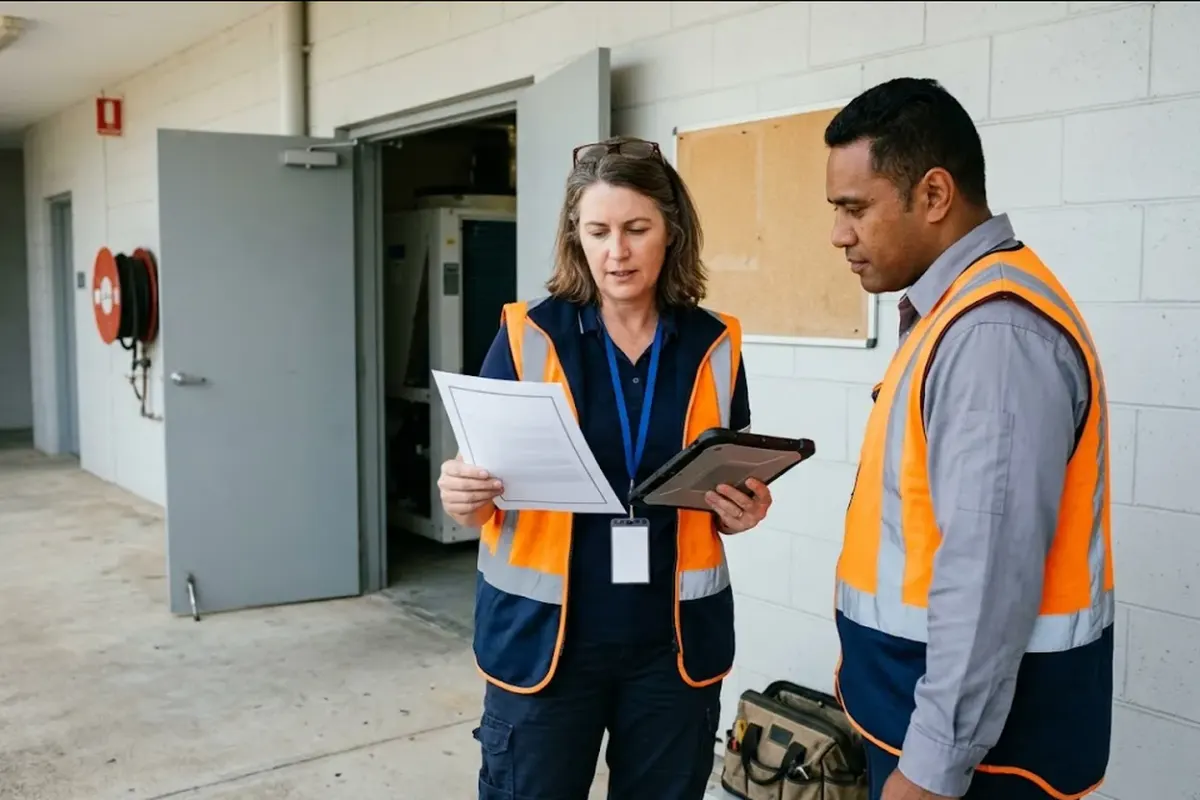
Two subcontractors arrive on a Monday to fit out a tenancy floor: an electrician to move a distribution board and a fire services technician to relocate detectors. The electrician's certificate of currency in the file was filed in March. Nobody can say whether the policy renewed in July, whether the licence on the quote covers wiring, or whether the people on the floor are the ones the file describes. The paperwork exists. What is missing is the check, and the date each piece stops being true.
This post is for the facilities manager or procurement lead at a property and facilities management provider who engages trades across several buildings. It lists the documents to hold for every subcontractor, shows how to check each one at its source, and says when each one expires. The list is a working part of contractor management, and much of it is what a prequalification process collects before a trade is approved. It is also available as a file you can edit.
The Checklist: What to Hold, How to Check It & When It Expires.
Twelve documents cover almost every trade engaged on a commercial building. The first three apply to nearly every trade; the rest depend on the work. The second column says whether the law or your contract is the reason you hold it, which decides what you can insist on and what you can only ask for.
| Document | Why you hold it | How to verify it | When it expires, and how often to check |
|---|---|---|---|
| ABN and business name | So the entity you pay and insure is the entity you engaged. A contract matter. | Search the ABN, ACN or name on ABN Lookup and match the entity name to the quote and every certificate.1 | Not an expiry document. Check at engagement, and again if a certificate shows a different name. |
| Public liability certificate of currency | Covers injury or damage to a third party caused by the subcontractor's negligence. A legal duty to carry it attaches to certain occupations in some states and territories; otherwise the limit is a contract matter.2 | Read the six lines, then confirm who issued it. See what to check on a certificate of currency. | The period of cover printed on it. Ask for a new one at each renewal and before any job that will outlast the period. |
| Workers compensation certificate of currency, or the reason there is none | State law decides who must hold cover, and in NSW a principal contractor has its own checks on its subcontractors (see the section on the law below). | Confirm with the state scheme where it allows; the certificate of currency guide has the check for four schemes. Where the certificate shows a worker count (NSW's does), compare it with the crew booked. | The policy period. South Australia's certificate is valid until 30 June each year.3 |
| Trade licence or registration | Some work is licensed. Service NSW says a licence is needed in NSW for wiring, plumbing, draining, gasfitting, and air conditioning or refrigeration work, except plug-in appliances.4 | Search the state regulator's public register and match the licence type to the work. | The expiry date shown on the register. Check at engagement and at each renewal. |
| High risk work licence, for each worker who needs one | The business that directs or allows the work must see written evidence of the licence first, and keep a record of it for at least 1 year after the work is carried out (regulation 85).5 | Sight the licence, match the class to the task, and check the register where one is public (in NSW, Verify NSW). | In NSW a licence lasts 5 years, and classes added later expire with it.6 Check before each job. |
| Refrigerant handling licence, for each technician who handles refrigerant | The Commonwealth Ozone Protection and Synthetic Greenhouse Gas Management Regulations 1995 require a person who works on equipment that uses a fluorocarbon refrigerant, including installing, servicing or maintaining it, to hold a refrigerant handling licence that covers that work, with narrow exceptions; the Australian Refrigeration Council grants it.7 | Sight the licence and match the name to the technician and the licence type to the work. | A licence is issued for a limited period and renewed through the Australian Refrigeration Council: check it is current before each job.7 |
| Safe work method statement (SWMS) for high risk construction work | The business doing the high risk construction work needs one in place before it starts (regulation 299).5 | Read it against this job and this floor, not a generic one: the hazards, the controls, who does what. | One per job. Re-read it if the work, the site or the crew changes. |
| General construction induction record | No construction work by a worker without general construction induction training, and where that training is more than 2 years old the worker must have done construction work in the past 2 years (regulation 317).5 | Sight the worker's general construction induction training card or, if the worker has applied for one that has not yet been issued, a training certification issued in the last 60 days (regulation 317), and match the name to the person on site. | No fixed expiry: the test is recent construction work. Check each new worker. |
| Subcontractor's statement (NSW) | The NSW Government's form says that, completed in accordance with the provisions it names, it relieves a principal contractor of liability for the subcontractor's workers compensation premiums, payroll tax and remuneration.8 | Check it is signed, covers the dates of the work, and has the certificate of currency attached where the form requires one. | It covers a stated period; sequential statements should give continuous cover. Keep a copy for the period the legislation sets.8 |
| Signed subcontract or order terms | Sets the insurance minimums and who does what. | Read the insurance limits first, then the roles, incident reporting and notice-of-arrival clauses that WorkSafe Tasmania's guidance says a contract should cover.9 | Review at renewal and whenever the scope changes. |
| Site induction and sign-in record | Shows each person was told your site rules before they started.9 | Your own record: who, which site, which date. | Each person at each site; repeat when the site rules change. |
| Safety record and any regulator notices | The selection evidence for choosing a trade, including incidents and any notices or prosecutions.9 | Ask in prequalification and ask for notices to be listed. | At engagement, then yearly. |
Download the checklist as a PDF to print and fill in or a spreadsheet to edit. Both add columns for the date you checked each document and who checked it, which is the record a regulator or an owner's insurer will ask for after an incident.
Subcontractor Insurance Requirements: What the Law Sets & What Your Contract Does.
What the WHS Regulations Fix.
Three rows of the table rest on the model WHS Regulations; the others come from your contract, from regulator guidance, or from other law on trade licences, refrigerant handling, workers compensation and the NSW subcontractor's statement. Every state and territory except Victoria has made the model laws its own, with variations, so the regulation numbers in the table are the model's.10 In NSW the instrument is the Work Health and Safety Regulation 2025 (NSW).11 SafeWork NSW's own guidance says high risk work needs a licence,6 construction work needs a white card12 and high risk construction work needs a safe work method statement before it starts.13 Who owes what in a building, and when a building owner becomes the principal contractor, is covered in PCBU responsibilities for property owners and FM companies.
Where Insurance Is a Contract Matter.
Insurance is the part most people assume is mandatory. It mostly is not. A duty to carry public liability cover attaches to certain occupations in some states and territories, and workers compensation follows each state's scheme wherever the business has employees.2 In NSW, icare says an employer that pays AU$7,500 or less in wages in a financial year, employs no apprentice or trainee and is outside a group of businesses is exempt from taking out a workers compensation policy.14 We found no provision in the model WHS Act or Regulations that makes checking a subcontractor's public liability insurance a legal duty, so the limit you require is whatever your contract and your own insurer say it is. SafeWork NSW goes further on workers compensation: a principal contractor must also make sure its subcontractors hold appropriate cover, keep their premiums up to date, are classified correctly, declare an appropriate amount of wages and sign a statement.15 For the statement, the form defines a principal contractor widely: anyone who has entered into a contract with a subcontractor whose workers perform the work, where the work is connected to the principal's business (form Note 2).8
The Duty You Cannot Hand Over.
None of this moves your own safety duty. You cannot hand your duty over: a contract term that tries to move it to the subcontractor is void (model WHS Act, sections 14 and 272).16 Holding the documents is how you show what you did to meet it, so far as is reasonably practicable.
How Do You Verify Subcontractor Insurance & Licences?
A certificate is a document the subcontractor gives you, so verifying it means checking it against something the subcontractor does not control. Read it against the job, ask who issued it, and confirm the policy with that issuer. The six lines to check, why a broker's version needs a second look and why a certificate only proves cover on the day it was issued are in the certificate of currency guide.
For workers compensation, the check depends on the scheme; WorkSafe Victoria, for example, lets you request a certificate as evidence that another business has current WorkCover insurance.17 The same guide sets out what a certificate shows and how to check it for four state schemes. For public liability, the check is a message to the insurer or broker named on the certificate, asking them to confirm the policy, the period and the limit. Keep the reply with the certificate.
Licences have a register for each state and for each class of work, so check each one against the register of the body that issued it.
When Each Document Expires & How to Diary It.
Expiry is where files go wrong, because the dates are all different and none of them is yours. These are the patterns worth building the diary around:
- Insurance expires on the date printed, and proves cover only to the day it was issued. A certificate on file for six months says little about today. Ask for a fresh one at each renewal.
- South Australian workers compensation certificates run to 30 June. Every South Australian subcontractor's certificate lapses on the same day, so chase them in June, when the new ones become available from 1 June.3
- NSW workers compensation renewals come with a notice. icare sends a renewal pack, including a copy of the certificate, six weeks before the policy renews, so ask for the renewed certificate as soon as the policy renews.18
- A NSW high risk work licence runs for 5 years. A class added later falls due with the original licence, so one date governs every class a worker holds.6
- A SWMS and a subcontractor's statement belong to a job or a period, not to a year. They do not expire so much as become the wrong document when the work, the site or the dates change.
Put every date in one place and set a reminder 30 days ahead, which is our suggestion rather than a rule. Decide in advance what happens on the day a document expires: access paused, or a recorded grace period for low-risk work. Making that decision once, in the subcontract, is far easier than making it at the gate.
What to Collect First & What Can Wait.
Not every document blocks the start, so collect them in three passes. Before the subcontractor is approved: the ABN check, both certificates of currency, the trade licence and the signed subcontract, because these decide whether you engage them at all. Before access is booked: the safe work method statement for any high risk construction work, the licence for each high risk work or refrigerant task, and a list of the people who will attend, because those decide who may come through the door. On the day: the induction card or certification of each worker and the site induction and sign-in record, because only the person at the gate can check them.
A document that fails in the first pass costs a phone call. The same document failing in the third pass costs a day of idle labour and a decision made under pressure. The safety record and any regulator notices belong to the first pass for a new trade and to the yearly review for one you already use. That order also fits a prequalification process, which takes the first pass off the facilities manager's desk.
A Tenancy Fit-Out With Electrical and Fire Subcontractors.
This is an illustration, not a customer story, but each step is one a property team will recognise.
A property manager looks after 14 office buildings across Sydney for three owners. A tenant is fitting out a floor, and the manager engages an electrical contractor to move two distribution boards and a fire services contractor to relocate detectors and sprinkler heads. Three weeks before the work, the facilities manager opens the file.
The electrician's ABN matches its certificates, and a Service NSW licence check by ABN shows a current licence for wiring work. Its public liability certificate ends in week 3 of a five-week job, so she asks for the renewal before booking access. The fire contractor's workers compensation certificate lists 3 workers; the roster names 5. Two are labour hire, so she asks for the labour hire firm's certificate too, and for each worker a general construction induction card or, where a card has been applied for and not yet issued, a training certification issued in the last 60 days.
A fit-out is construction work: the model WHS Regulations define it to include the fitting-out of a structure (regulation 289). The boards are isolated before they are moved, but circuits beside them stay live, so the work is carried out near energised electrical installations. That makes it high risk construction work (model regulation 291(k)), so a safe work method statement has to exist before it starts. The first one the electrician sends is written for a different building, and she sends it back. The fire contractor brings its own labour hire firm for the two extra workers, so the file also holds that firm's certificate and a note of who it supplied: second-tier documents are the ones that usually go missing.
For each document the file holds the item, the source it was checked against and the date, and a diary entry for the date it stops being true. A month later, when the owner's insurer asks how the electrical work was controlled, the answer is a record rather than a recollection.
Where ComplyFlow Fits.
ComplyFlow does not replace any of those checks. It keeps the record and the clock. A document requirement can be assigned to a particular site, and adding one moves people on active profiles to Documents Pending until it is supplied.19 With AI document review switched on for a category, each upload is checked against criteria you wrote, the expiry date, the name and the document number are read from the document, and the reviewer sees which criteria passed and a recommendation. A person approves it; the AI never does.20
One report lists every document in the account, including rejected, expired and awaiting upload, and can be filtered to those due to expire within a set number of days and exported to CSV.21 Contractors answer the mandatory insurance questions and upload the documents listed on their dashboard as part of the prequalification form.22 See the pages on contractor management, prequalification and AI document review.
The point of the list is simple. On the day something goes wrong on site, you can show, for each subcontractor, what you held, what you checked it against and when it was due. Everything above is a way of making that sentence true.
Sources
- Format of the ABN
- Types of business insurance
- Certificate of registration (currency)
- Check a builder or tradesperson licence
- Model Work Health and Safety Regulations
- High risk work licences
- Help Centre
- New South Wales Subcontractor's Statement regarding worker's compensation, payroll tax and remuneration
- Contractor management
- Legislation
- Legislation
- White cards
- Prepare safe work method statement
- Who needs a policy?
- Contractors and labour hire
- Model Work Health and Safety Bill
- Request a Certificate of Currency for your WorkCover insurance
- Download a Certificate of Currency
- Compliance Requirements, Training Requirements and Site Contact
- Release Notes 16-09-2026 P1: AI Document Categories and Document Review
- Reporting on all documents in the system
- Form Prequalification Process
See It Against Your Own Contractors, Sites & Rules.
Book a 30-minute demo. We will show ComplyFlow working with your kind of sites, your kind of contractors, and your requirements. No slides, no hard sell.
Or Speak to Us
- ISO 27001
- Hosted on AWS
- Microsoft & Okta SSO
- API & MCP
- Data in Australia
Written by
Bart CrowtherDirector of Sales, ComplyFlow
Bart leads sales at ComplyFlow and spends his week with the safety, procurement, and facilities teams deciding how to manage contractors. He writes about what buyers ask, and what separates a system that gets used from one that gets ignored.
Writes about: Choosing a compliance system, Rollout and adoption, What buyers ask
Questions
Questions People Ask About This.
What insurance does a subcontractor need?
Most of it is set by your contract, not by statute. A legal duty to carry public liability cover attaches to certain occupations in some states and territories, so check the trade's regulator; workers compensation follows each state's scheme wherever the business has employees, and the state regulator decides whether a contractor you engage counts as your worker; and professional indemnity is worth asking for where the subcontractor designs or advises. Write the minimums into the subcontract so there is a clause to point to.
Do sole traders working under an ABN need insurance to be engaged?
Not always by law. Whether a sole trader needs cover depends on the work and the state. One with no employees may have no workers compensation certificate to give you (check the state scheme's rules for workers who may be deemed employees), and a legal duty to carry public liability attaches only to certain occupations. Whether you insist on public liability is a contract decision, and it should be the same rule for every sole trader you engage. Record the reason when a document is not held.
What should you do when a document expires in the middle of a job?
Decide before the job starts, and write it into the subcontract. The usual options are to pause access until a current document arrives, or to allow a short, recorded grace period for low-risk work. Do not let it pass silently: a certificate that has run out proves nothing about the days after its end date.
Do you need documents from a subcontractor's own subcontractors?
Ask for them, or require your subcontractor to hold and produce them. The NSW subcontractor's statement form says a business that engages its own subcontractors is to obtain subcontractor's statements from them, and your own safety duty reaches workers you cause to be engaged, so far as is reasonably practicable (model WHS Act, section 19). A clause that second-tier documents are held and available on request is the simplest way to do it.