What Is a SWMS? Meaning, When One Is Needed & Required Contents
What is a SWMS? It is a safe work method statement: a short written document, prepared before high risk construction work starts, that identifies that work, its hazards and risks, the controls, and how those controls will be put in place, monitored, and reviewed. The model WHS Regulations require one for 18 kinds of high risk construction work; Victoria's list has 19.
 Mitchell BourneManaging Director
- Published
- 11 min read
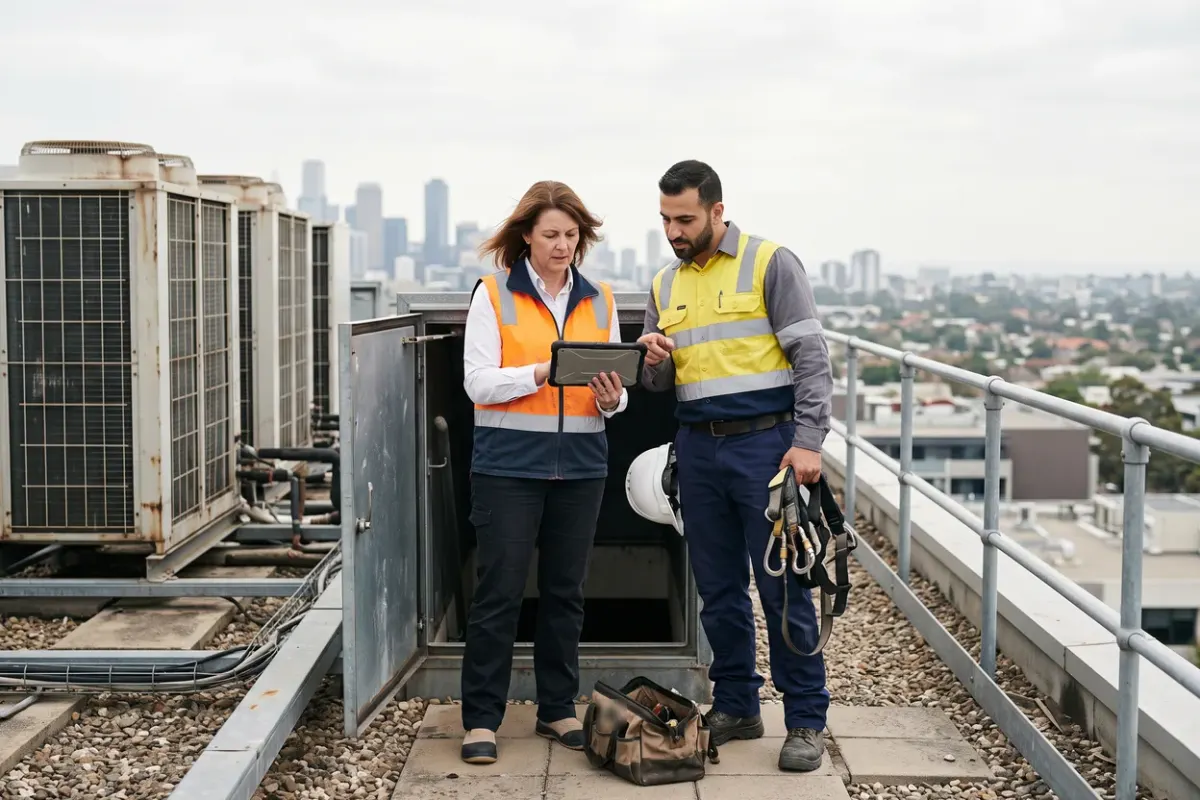
Most guides to the SWMS are written for the builder who has to fill one in. This one is for the person on the other side of the clipboard: the facilities manager or site manager who books the roof plumber, the electrician, or the racking crew, and receives a safe work method statement in their inbox the night before. You do not write it. You do need to know whether the job needs one, whether the one you were sent is real, and what happens if nobody follows it.
The examples come from an office building in property and facilities management and a distribution centre in transport and logistics. They are illustrations, not customers.
What Is a SWMS?
SWMS stands for safe work method statement. Safe Work Australia's information sheet describes it as a document that sets out the high risk construction work activities to be carried out at a workplace, the hazards arising from them, and the measures to be put in place to control the risks.1 It is an administrative control: it supports the higher order controls, such as a guardrail or an isolation, rather than replacing them.1
Its job is practical. The same sheet says a SWMS is not intended to be a procedure; it is a tool to help supervisors and workers confirm and monitor the controls needed at the workplace.1 That is why it should be short. Safe Work Australia warns that a lengthy, overly detailed SWMS can be difficult to understand, apply, monitor, or review.1
People say "swims", "swams", and "S-W-M-S". They all mean the same document.
When Is a SWMS Required?
Before any high risk construction work starts. Under regulation 299 of the model WHS Regulations, a business whose work includes high risk construction work must ensure, before that work commences, that a SWMS for the proposed work is prepared or has already been prepared by someone else.2 That rule has no "so far as is reasonably practicable" in it. The statement exists before the work, or the work does not start.
The catch for anyone managing buildings is the meaning of construction work. The model definition covers work connected with the alteration, fitting-out, renovation, repair, maintenance, refurbishment, or demolition of a structure, and the installation, testing, or maintenance of an essential service in relation to a structure.2 A tenancy fit-out, a roof repair that is more than minor, or a new switchboard in an occupied building is construction work, even though nobody would call the building a construction site.
Testing, maintenance, or repair work of a minor nature is excluded.2 Safe Work Australia's code gives inspecting a building's fire equipment or lifts, servicing an air-conditioning system, and replacing individual roof tiles as examples, and its test is whether the work needs little or no pre-start preparation and minimal control measures.3 Minor work can still be hazardous, and its risks are still managed; it just does not need a SWMS.4
The 18 Kinds of High Risk Construction Work.
The model list in regulation 291 has 18 items.2 In a building or a warehouse, the ones that come up most are in the first column below.
| Often met in buildings and warehouses | Less common, still on the list |
|---|---|
| Risk of a person falling more than 2 metres | Work on a telecommunication tower |
| Disturbance of asbestos, or likely disturbance | Demolition of a load-bearing element |
| In or near a confined space | Structural alterations needing temporary support |
| On or near energised electrical installations or services | Shafts or trenches deeper than 1.5 metres, or a tunnel |
| On or near chemical, fuel, or refrigerant lines | Use of explosives |
| On or near pressurised gas distribution mains or piping | Tilt-up or precast concrete |
| In an area where powered mobile plant moves | Contaminated or flammable atmospheres |
| Next to a road or traffic corridor in use | Artificial extremes of temperature |
| Near water with a risk of drowning, and diving work |
Two of those catch facilities and logistics teams out. Any construction work in an area where powered mobile plant moves is high risk construction work, so if a racking repair is construction work, doing it in an aisle where forklifts are moving makes it high risk, and it needs a SWMS. And work on or near refrigerant lines makes a refrigeration replacement high risk even at ground level.2
Victoria's list has 19 items. It covers any demolition rather than only load-bearing elements, and lists a tunnel as its own item.56
What Must a SWMS Include?
Four things, under regulation 299(2): it must identify the work that is high risk construction work; specify the hazards and the risks to health and safety from them; describe the measures to be put in place to control those risks; and describe how the control measures are to be implemented, monitored, and reviewed.2
It must also be prepared taking into account the circumstances at the workplace that may affect how the work is done, and be set out and expressed in a way that is readily accessible and understandable to the people who use it.2 Safe Work Australia's code adds that it should contain no statements that leave a decision to the worker, giving "use appropriate PPE" as an example of a line that does not describe a control.3 It should also suit the literacy and language of the crew; the information sheet suggests pictures or diagrams.1
What it does not need is everything else. Safe Work Australia says hazards such as noise and manual tasks do not need to be in it, and WorkSafe Victoria says to leave out risk matrices and risk scores, which are not legally required, and references to standards, which may change.15 A 30-page SWMS is usually a sign that nobody on site will read it.
For a starting point, Safe Work Australia's construction code includes SWMS template guidelines in Appendix E and a completed sample in Appendix F.3 A template is a layout, not a SWMS: it becomes one only when it describes this job, on this site.
SWMS vs JSA: What Is the Difference?
A SWMS is a legal document for high risk construction work. A JSA, or job safety analysis, is a useful practice with no legal standing of its own: "job safety analysis" and "JSA" appear nowhere in the model WHS Act, the model Regulations, or the November 2024 construction code (counted 16 October 2026).237
The regulators say the same in plain words. WorkSafe Victoria says a SWMS is not the same as a risk assessment or a job safety analysis, and that risk assessments and JSAs are not required under legislation but can be useful for identifying hazards, including for work that is not high risk construction work.5 WorkSafe Tasmania and Safe Work Australia both describe a SWMS as generally different from documents focused on specific tasks or processes, such as a JSA or a safe operating procedure.18
So the practical answer for a facilities manager is this. If the job is high risk construction work, a JSA does not satisfy the law unless it contains everything regulation 299 requires of a SWMS; ask for the SWMS. If the job is not, a JSA or a risk assessment may be exactly the right document, and a SWMS is not required.
Who Writes It & What the Client Must Do.
The business doing the high risk construction work is responsible for the SWMS. Safe Work Australia says the person responsible for carrying out the work is best placed to prepare it, in consultation with workers, which generally means the builder for its workers or the subcontractor for its own.1 Where two contractors share the work, such as a roof plumber and a crane crew, both must have a SWMS and consult, cooperate, and coordinate.3
The client who commissions the work keeps duties too. Section 46 of the model WHS Act requires everyone who has a duty in relation to the same matter to consult, cooperate, and coordinate activities with each other, so far as is reasonably practicable.7 Safe Work Australia's code says that the person who actually commissions the work remains the duty holder for the commissioning duties, such as consulting the designer and passing hazard information to the principal contractor, even when a project manager coordinates it.3
On a construction project, which under the model Regulations is construction work costing AU$250,000 or more, the principal contractor must take all reasonable steps to obtain a copy of each SWMS before the high risk work starts. Victoria's principal contractor threshold is AU$350,000, and Western Australia defines a construction project by 5 or more people working at once rather than by cost.269 The client that commissions a construction project is the principal contractor unless it engages another business as principal contractor and authorises it to have management or control of the workplace and to discharge the principal contractor's duties.2 If you are the principal contractor, the model Regulations also require you to prepare a written WHS management plan before work on the project starts, setting out how SWMS are collected, assessed, monitored, and reviewed.2
How Long Must a SWMS Be Kept & When Is It Reviewed?
Under the model rules, keep a copy until the high risk construction work is finished. If a notifiable incident occurs in connection with the work, keep it for at least 2 years after the incident. While it is kept it must be readily accessible to the workers doing the job and available for inspection.2 Safe Work Australia, SafeWork NSW, and WorkSafe Tasmania all say it can be kept electronically.1810
It is reviewed when the controls are reviewed. The model Regulations require a SWMS to be reviewed, and revised as necessary, when relevant control measures are revised, and Safe Work Australia's code says every revised version should be kept.23 If the work is not being done the way the SWMS says, it must be stopped immediately or as soon as it is safe to do so, and resumed only in line with the statement.2
The model penalties are set in tiers. As at 1 July 2026, Safe Work Australia lists tier E, which covers having no SWMS before the work and not following it, at up to AU$9,900 for an individual and AU$50,000 for a body corporate.11 Each state sets its own amounts; Western Australia's Regulations, for example, write theirs in dollars.9
A Worked Example: A Roof in the CBD & a Racking Repair.
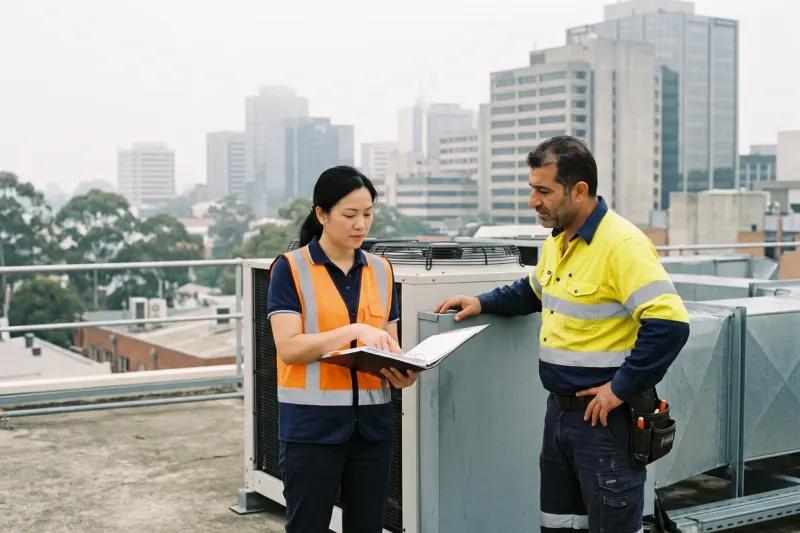
The office building. A facilities manager books a refrigeration mechanic to replace two condensers on the roof of a 12-storey office building. The roof edge has a guardrail on one side only, and the new units come up by crane. That is three items on the list: a risk of a fall of more than 2 metres, work near refrigerant lines, and work in an area where powered mobile plant, the crane, moves. Lifting new condensers by crane needs real pre-start preparation, so this is not the minor servicing the code excludes. The mechanic's SWMS arrives two days before. The facilities manager checks that it names this roof, not "client site", that the open edge is addressed with a specific control rather than "use harness as required", and that the crane company has its own SWMS or is covered in a combined one. The mechanic's crew reads it on the roof before the first lift, the scene in the photograph at the top of this page.
The distribution centre. A racking contractor is booked to replace damaged uprights in aisle 14 of a distribution centre that will keep running. Forklifts keep moving in the same area, so if replacing the uprights is construction work, it is high risk construction work, and the SWMS has to deal with the plant movement, not only the lifting. The warehouse manager checks how the aisle will be isolated, who controls the barrier, and what happens if a forklift needs to pass. When the contractor's crew starts to work inside the barrier without the spotter the SWMS names, the supervisor stops the job until the spotter is in place, which is exactly what the regulations require.2
Checking the SWMS You Receive.
You do not have to be a safety professional to catch the common faults. Four questions cover most of them: is this the right document for high risk construction work, or a JSA with a new title; does it name your site and this job; does every control say what, who, and where; and does it deal with your hazards, such as tenants, live plant, or traffic in the dock?
Our SWMS review checklist goes through each check in order with what a pass looks like, and our guide to why SWMS review becomes a bottleneck covers what to do when 40 of them arrive in a week.
In ComplyFlow, a SWMS can be collected as an upload question on a form. Where a client turns on AI SWMS review for that question, the contractor can check their document against the client's criteria before submitting; the help article says it does not replace human review and does not block submission.12 The reviewer can then approve the form or send it back with Save & Request More Information.13
Start With the Next Job That Leaves the Ground.
Look at the work booked for the next fortnight and mark every job that touches the 18 items: anything at height, near live electrics or refrigerant lines, in a plant area, or near asbestos. For each one, ask for the SWMS before the start date, not on the morning, and read it against the four questions above.
Expect to send at least one back. The first time a contractor sees you read the SWMS, the next one improves. To see SWMS collection and review set up for a portfolio of sites, book a demo.
Sources
- Safe work method statement for high risk construction work: information sheet
- Model Work Health and Safety Regulations (as at 5 December 2025)
- Construction work: Code of Practice
- Construction work: work of a minor nature, information sheet
- Safe Work Method Statements (SWMS)
- Occupational Health and Safety Regulations 2017 (Vic), version 017
- Model Work Health and Safety Bill (as at 5 December 2025)
- Safe work method statements (SWMS)
- Work Health and Safety (General) Regulations 2022 (WA)
- Prepare safe work method statement
- Maximum monetary penalties under WHS laws
- AI-Powered Review in Forms
- Reviewing a Form
See It Against Your Own Contractors, Sites & Rules.
Book a 30-minute demo. We will show ComplyFlow working with your kind of sites, your kind of contractors, and your requirements. No slides, no hard sell.
Or Speak to Us
- ISO 27001
- Hosted on AWS
- Microsoft & Okta SSO
- API & MCP
- Data in Australia
Written by
Mitchell BourneManaging Director, ComplyFlow
Mitchell has run ComplyFlow since 2009 and has spent that time inside the contractor, site, and safety problems of Australian operators. He writes about where compliance actually fails, and what the people responsible for it can do about it.
Writes about: Contractor compliance, WHS duty and proof, Running a compliance program
Questions
Questions People Ask About This.
Who is responsible for writing the SWMS?
The business carrying out the high risk construction work. Safe Work Australia's information sheet says the person responsible for carrying out the work is best placed to prepare it, in consultation with workers, which usually means the builder for its workers or the subcontractor for its own. A facilities manager who commissions the job does not write it, but should receive it and check it before work starts.
Does a SWMS need to be signed?
The model WHS Regulations on SWMS do not mention signatures (regulations 299 to 303, read 16 October 2026). They require it to be prepared before the work, followed, kept, and reviewed, and Safe Work Australia's construction code says workers and their health and safety representatives must be consulted when it is prepared. Many businesses record that workers have read it, because that is simple evidence the consultation happened.
Can a SWMS be digital?
Yes. Safe Work Australia, SafeWork NSW, and WorkSafe Tasmania all say a SWMS can be kept electronically. Under the model WHS Regulations a copy must still be readily accessible to the workers carrying out the high risk construction work, and available for inspection. WorkSafe Victoria also says hand-written amendments can be made on site.
Can we use a SWMS template or a generic SWMS?
Yes, once it has been reviewed for the specific workplace. Safe Work Australia's construction code includes SWMS template guidelines in Appendix E and a completed sample in Appendix F. Safe Work Australia's construction code says a generic SWMS may be prepared for regular work but must be reviewed to take into account the hazards and risks at the specific workplace. WorkSafe Victoria adds that it must be reviewed on site before the work starts, and that anything not relevant to the site should be removed, however the generic version was produced.
Do I need a SWMS for an air-conditioning service?
Usually not, if it is genuinely minor. Safe Work Australia's code lists servicing or repair of an air-conditioning system as an example of minor work, which is not construction work, so no SWMS is required. Replacing the whole system is construction work, and if it involves a risk of a person falling more than 2 metres, or work on or near refrigerant lines, it is high risk construction work that needs one.