Annual Fire Safety Statement: Due Dates, Penalties & a 12-Month Plan
An annual fire safety statement (AFSS) is a NSW building owner's yearly declaration that, within the previous 3 months, an accredited practitioner (fire safety) assessed each essential fire safety measure against its required standard and inspected the building's fire exits. It goes to the council within 12 months of the last one or a later fire safety certificate, with copies to Fire and Rescue NSW and on display in the building. Each late week can draw a penalty notice.
 Bart CrowtherDirector of Sales
- Published
- 12 min read
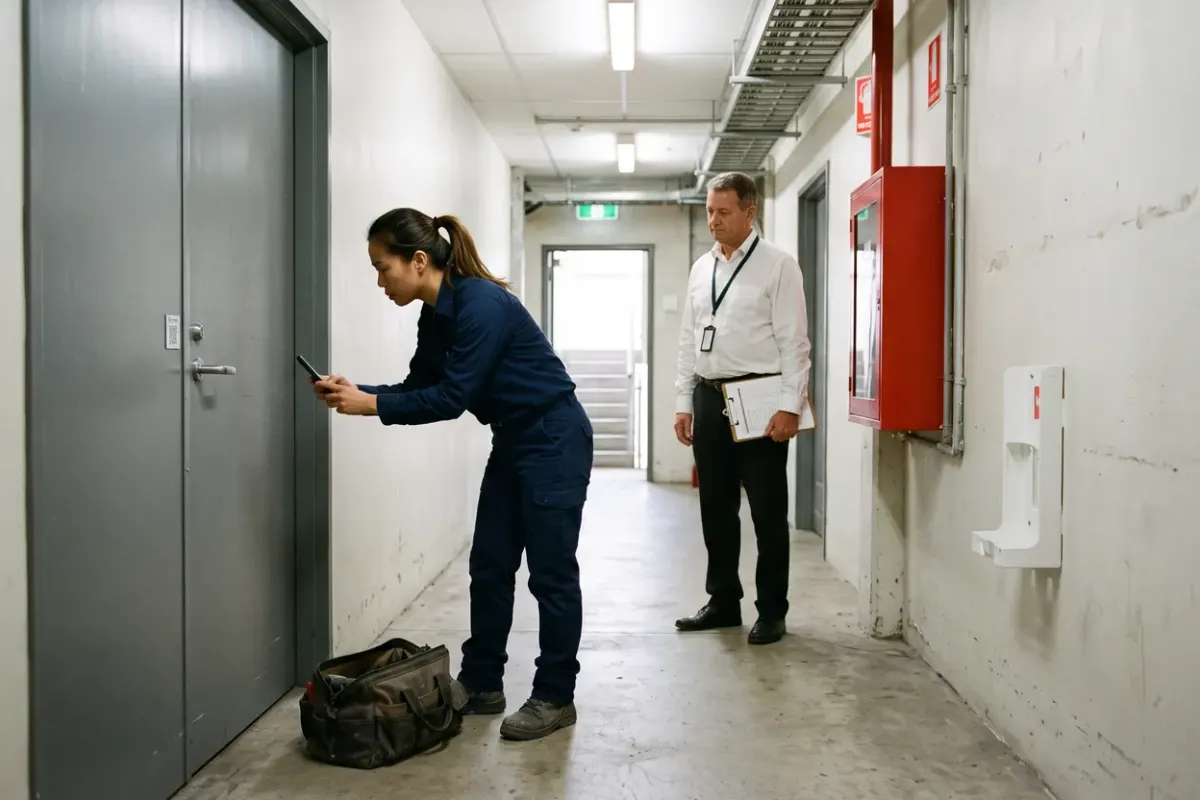
Every commercial building in New South Wales with essential fire safety measures has one date a year that the council will notice if it slips. The annual fire safety statement is the paper that proves the sprinklers, detectors, exit signs, fire doors, and hydrants were checked by someone accredited to judge them. For a facilities manager looking after more than one building, it is also a project with a hard deadline, a fixed window, and a contractor in the middle of it.
This guide sets out what the law asks for, who signs, when it is due, what lateness costs, and how to plan the year so the statement is never the thing you are chasing in the final week.
What Is an Annual Fire Safety Statement?
An annual fire safety statement is a statement issued by or on behalf of the owner of a building. It says two things: that each essential fire safety measure listed has been assessed by an accredited practitioner (fire safety) as capable of performing to the standard in the building's fire safety schedule, and that the building has been inspected by an accredited practitioner and found in a condition that did not disclose grounds for a prosecution under the Part of the Regulation covering fire exits, fire exit doors, and fire safety notices.1
The rules sit in the Environmental Planning and Assessment (Development Certification and Fire Safety) Regulation 2021, a NSW instrument.1 Older guides talk about a "competent fire safety practitioner". The current Regulation says accredited practitioner (fire safety), meaning someone holding an accreditation under the Building and Development Certifiers Act 2018 for that function.1 The NSW Government approved the Fire Protection Association Australia accreditation scheme in July 2020, and only practitioners accredited under it can carry out the functions it covers.4
Which Buildings Need One?
The duty falls on the owner of a building to which an essential fire safety measure applies. An essential fire safety measure is one that is or was in the building's fire safety schedule, or that was listed as an essential service on an older council approval or order from before mid-1997.1 The Part of the Regulation on fire safety statements applies to all buildings except class 1a and class 10 buildings and temporary structures, which in practice takes in almost every office, shop, warehouse, and industrial unit in a commercial property portfolio.1
If a building has no fire safety schedule because it predates them, the measures still apply. The owner can ask the council for a schedule of the original measures, and the council must provide one as soon as practicable.1 For a landlord who has bought an older building, that request is a sensible first step before the first statement under new ownership.
Who Signs the Statement, and Who Must Not?
The building owner issues the statement, or an agent does it on the owner's behalf with the owner's authority, and the owner signs the declaration in section 8 of the annual form.2 Where a building has several owners, one may issue the statement only if each of the others has authorised them to act as their agent. An agent can include an authorised employee of the company that owns the property.2
The person who must not make the owner's declaration is the accredited practitioner who did the assessment or inspection. The NSW Planning FAQ says the accredited practitioner who carried out the assessment or inspection, and any employer, employee, or direct associate of theirs, must not make the owner's declaration.2 That separation is the point of the document: one party tests, another party with something to lose says the testing happened.
Signing is something an owner can delegate. Maintenance is not. The FAQ is blunt that an agent cannot be made responsible for the owner's duty to maintain the measures.2 A managing agent or a facilities management provider can run the whole program, but the owner still carries the duty if a measure fails.
When Is the Annual Fire Safety Statement Due?
The owner must give the statement to the council within the later of 12 months after the last statement was given to the council, or, where a fire safety certificate was issued in the previous 12 months, 12 months after that certificate.1 Inner West Council, for one, counts 12 months from the final fire safety certificate or the date the last statement was signed, whichever is more recent, which can fall earlier than the Regulation's date, so check how your council counts.8
The second date that matters sits 3 months earlier. A person must not issue an annual fire safety statement unless the assessment and inspection were carried out within the previous 3 months, and the assessor must inspect and verify the performance of every measure being assessed.1 Book the practitioner too early and the statement cannot be issued from that visit. Book them too late and any defect they find has to be repaired, and the measure seen working, before the due date passes.
Plan the Year Backwards From the Due Date.
A late statement is often not neglect but a defect found in the last fortnight: a fire door that will not latch, a detector loop fault, a hydrant booster valve that needs a part on back order. The fix is to put the assessment early enough inside the 3-month window that a repair and a recheck both fit before the due date.
Here is a calendar for one building whose statement is due on 1 June, built backwards from that date.
| When | What happens | Who owns it |
|---|---|---|
| 12 months before | Last statement lodged; check the schedule on file is the current one | Facilities manager |
| Through the year | Routine testing and servicing to AS 1851, logbook kept on site | Fire services contractor |
| 4 months before | Book the accredited practitioner for a date early in the window | Facilities manager |
| 3 months before | Window opens; assessment and exit inspection | Accredited practitioner |
| 10 weeks before | Defects listed, quotes approved, repairs booked | Facilities manager and contractor |
| 4 weeks before | Repairs done; practitioner rechecks the affected measures | Accredited practitioner |
| 2 weeks before | Owner reviews and signs; lodged with council and Fire and Rescue NSW; new statement and current schedule displayed in the building | Owner or authorised agent, with the facilities manager |
The table is a planning guide, not a legal timetable. Its one fixed rule is that the assessment and inspection fall within the 3 months before the statement is issued; everything else is there to leave room for the defect you did not expect.
What Happens If the Statement Is Late?
Failing to give the council an annual fire safety statement on time is a separate offence for each week the failure continues.1 Schedule 1 of the Regulation sets the penalty notice for each of those weeks: AU$1,000 in the first week after the due date, AU$2,000 in the second, AU$3,000 in the third, and AU$4,000 in the fourth or any later week, the same amount for an individual or a corporation.1 Inner West Council's page, updated 23 September 2026, describes the same scale as on-the-spot fines from AU$1,000 to AU$4,000 per week.8
The maximum penalty a court can impose for not giving the statement is 800 penalty units for a corporation and 400 for an individual.1 Failing to keep the statement and schedule displayed in the building carries a penalty notice of AU$580.1 The bigger exposure is not the paperwork at all. Failing to maintain an essential fire safety measure carries a penalty notice of AU$3,000 for an individual and AU$6,000 for a corporation.1 In court, the maximum for failing to maintain a measure is 600 penalty units for a corporation and 300 for an individual.1 Building Commission NSW quotes fines of AU$33,000 for individuals and AU$66,000 for corporations for the maintenance requirements in sections 81 and 81A.6
If a statement is going to be late, say so early. Building Commission NSW advises owners to tell the council immediately when they become aware they may be late, and to work with the council on a solution.6
Lodge It Twice and Display It Once.
The statement goes to the council. As soon as practicable after it is issued, the owner must also give a copy of the statement and a copy of the current fire safety schedule to the Commissioner of Fire and Rescue NSW, and make sure copies of both are prominently displayed in the building.1 Fire and Rescue NSW takes its copy through its own online lodgement form.3 Councils run their own lodgement, often through a customer portal, so check your council's page for its process and any fee.8
The form itself is fixed. It must be the approved form, and the NSW Planning FAQ says no changes can be made to the standard form on the NSW Planning Portal, and that adding a letterhead or logo may breach the Regulation.2 It must list each essential fire safety measure with its minimum standard of performance, give the assessment and inspection dates, name the owner, the issuer, and the accredited practitioner, and travel with the fire safety schedule.1
How Is a Supplementary Fire Safety Statement Different?
Some measures cannot wait a year between checks. A fire safety schedule can name a critical fire safety measure and set an interval of less than 12 months for it, and the owner then gives the council a supplementary fire safety statement for that measure at that interval.1 A supplementary statement covers only the critical measures it lists, and its assessment must have been done within the previous month, not the previous 3.1 Late supplementary statements draw the same weekly scale of penalty notices as annual ones.1
Read the schedule for every building before you build the calendar. A supplementary interval buried in a schedule from an old fit-out is the easiest deadline in the portfolio to miss.
A Tenant Fit-Out Changes the Fire Safety Schedule.
Whoever issues a construction certificate for building work must issue a fire safety schedule, with limited exceptions for some hydraulic system work, the schedule must deal with the whole building and not only the part the approval covered, and a later schedule supersedes the earlier one.1 Put plainly, a tenant's fit-out approved by a construction certificate will usually change the list of measures your next statement has to cover, in parts of the building the tenant never touched.
Here is how that plays out. A shared warehouse in a NSW industrial estate has two tenants and one fire safety schedule. In March, the tenant in the northern half completes a fit-out for a mezzanine office under a construction certificate, which adds emergency lighting, exit signs, and an extra smoke detection zone. The certifier issues a new schedule for the whole building.
The building's statement is due in June. The facilities manager's checks are short. Is the schedule on file the new one, dated March, and has the old one been taken off the wall? Has the fire services contractor's AS 1851 program been updated to include the extra detection zone, and are the new emergency lights and exit signs on its testing schedule too, since emergency exit lighting sits outside AS 1851? Has the accredited practitioner been sent the new schedule before the assessment, and is access to both tenancies, including the mezzanine, booked for the same visit?
Each of those is a small task. Missed, any one of them produces a statement that lists the wrong measures, or a practitioner who cannot reach half the building inside the window.
Check the Statement Before You Sign It.
The owner's signature is a declaration, so read what you are signing. These are the checks worth running on every statement before it is signed and lodged:
- The schedule matches. Every measure on the current fire safety schedule appears on the statement, with the same standard of performance.
- The dates fit the window. The assessment and inspection dates both fall within the 3 months before the date you sign.
- The practitioner is named. Their name, address, and telephone number are on the form, and their accreditation covers the measures assessed.
- The form is untouched. It is the approved form, with no added letterhead, logo, or rewording.
- The signer is independent. The person signing for the owner is not the practitioner who assessed the measures or inspected the exits, or their employer, employee, or direct associate.
- The defects are closed. Anything the practitioner found has been repaired and rechecked, with evidence on file.
What we recommend: keep this list with the building's records and tick it at signing each year. It is quick, and it is the easiest step to skip when the deadline is close.
The Records That Prove the Year Was Run.
The statement is one page. The evidence behind it is the year of testing. Building Commission NSW says that from 13 February 2026, essential fire safety measures in class 1b and class 2 to 9 buildings must be inspected and tested in accordance with AS 1851-2012, unless a performance solution nominates another standard; this covers measures in the building's fire safety schedule, and some measures, such as emergency exit lighting, fall outside AS 1851.5 6 Owners must keep records in the manner AS 1851 prescribes for at least 7 years, make them available for inspection, and keep a physical record on site; an electronic register cannot yet replace the hard copy logbook.6
Routine servicing and the annual assessment are different jobs. No accreditation is needed to install, maintain, test, or service essential fire safety measures, but accreditation is needed to assess their ongoing performance and endorse the annual statement.7 Many buildings use one firm for both, which is fine, as long as you know which person is acting in which capacity and the signer for the owner is neither.
For each building, the file should hold the current schedule, last year's statement with proof of lodgement at the council and Fire and Rescue NSW, the logbook, the practitioner's assessment, and the repair evidence for each defect. The contractor records behind those jobs, such as licences and insurance, belong in the same place; our guide to contractor management software for facilities management covers that side of a portfolio.
Where ComplyFlow Fits in a Fire Safety Year.
ComplyFlow does not issue or lodge fire safety statements, and nothing replaces the accredited practitioner or the owner's signature. What it can do is hold the year together across a portfolio. Scheduled inspections recur at the interval you set and can be assigned to a person, a site, or a staff category, with an overdue status once the due date passes.9 Documents can be reported on across the system, including searching for those due to expire within a set number of days.10 Each defect becomes an action that is closed out with a comment, a completion date, and an uploaded photograph or document as evidence.11
For a facilities manager running dozens of anniversaries, that means the 3-month window, the supplementary intervals, and the open defects sit on one screen rather than in a calendar and an inbox. Setting the intervals themselves is covered in how to build an inspection schedule that holds, and the wider picture for property and facilities management is on our industry page.
Start With Your Next Due Date.
Pick the building in your portfolio with the next statement due. Count back 3 months and check whether the accredited practitioner is booked early in that window, whether the schedule on file is the current one, and whether every supplementary interval on it has its own date in your calendar. If any of the three is missing, you have found this year's late statement before it happens.
If you would like to see a portfolio of fire safety dates, defects, and contractor documents kept in one place, book a demo.
Sources
- Environmental Planning and Assessment (Development Certification and Fire Safety) Regulation 2021 (NSW)
- Fire safety statements: Frequently asked questions
- Lodge a fire safety statement
- Fire safety certification
- Reforms to building fire safety regulation
- Responsibilities of building owners under AS 1851-2012
- Fire safety practitioner requirements and accreditation
- Annual Fire Safety Statements (AFSS)
- Scheduled Inspections
- Reporting on All Documents in the System
- Closing Out Actions
See It Against Your Own Contractors, Sites & Rules.
Book a 30-minute demo. We will show ComplyFlow working with your kind of sites, your kind of contractors, and your requirements. No slides, no hard sell.
Or Speak to Us
- ISO 27001
- Hosted on AWS
- Microsoft & Okta SSO
- API & MCP
- Data in Australia
Written by
Bart CrowtherDirector of Sales, ComplyFlow
Bart leads sales at ComplyFlow and spends his week with the safety, procurement, and facilities teams deciding how to manage contractors. He writes about what buyers ask, and what separates a system that gets used from one that gets ignored.
Writes about: Choosing a compliance system, Rollout and adoption, What buyers ask
Questions
Questions People Ask About This.
How long does an annual fire safety statement last?
It covers one year. The next statement is due 12 months after the last one was given to the council, or 12 months after a fire safety certificate issued in the meantime, whichever is later. The copy displayed in the building stays up until every measure on it is covered by a later certificate or statement.
Can the fire services contractor sign the annual fire safety statement?
Not if they assessed the measures or inspected the exits for that statement. The statement is issued by or on behalf of the building owner, and the NSW Planning FAQ says that practitioner, and anyone who employs, works for, or is directly associated with them, must not make the owner's declaration. An authorised employee of the company that owns the building can sign as its agent.
Can the council give more time to lodge an annual fire safety statement?
Do not plan on it. Inner West Council, for one, says the Regulation does not give it the power to grant an extension of time, though it offers a case-by-case process for a little more time. Building Commission NSW advises owners to tell the council as soon as they know a statement may be late and work out a solution with it.
Is there a template for the annual fire safety statement?
Yes. The statement must be on the approved form published on the NSW Planning Portal, and the NSW Planning FAQ says no changes can be made to it, and that adding letterheads or logos may breach the Regulation. Download the current form from the portal each year; version 4 became mandatory on 1 September 2022.
Is AS 1851 mandatory in NSW?
For most buildings, yes. Building Commission NSW says that from 13 February 2026 essential fire safety measures in class 1b and class 2 to 9 buildings must be inspected and tested in accordance with AS 1851-2012, unless a performance solution nominates another standard. It applies to measures in the building's fire safety schedule, where AS 1851 covers the measure. AS 1851 testing and the annual statement are separate processes, though the assessor may use the test results.