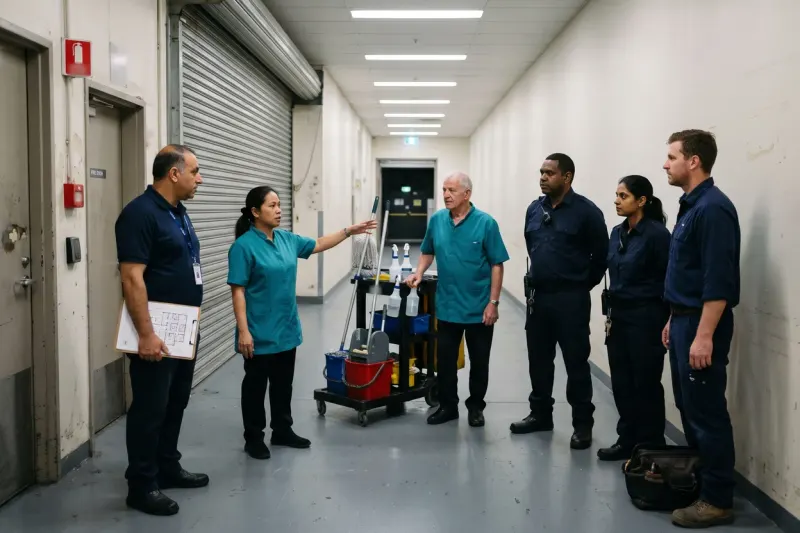
Health and Safety Representative: Role, Powers & Elections
A health and safety representative (HSR) is a worker elected by their work group to represent them on work health and safety. Under the model WHS Act, when a worker asks for an election, the business must facilitate the setting up of work groups, take all reasonable steps to start negotiating them within 14 days, and, if an HSR asks, let them attend approved training.
 Mitchell BourneManaging Director
- Published
- 13 min read
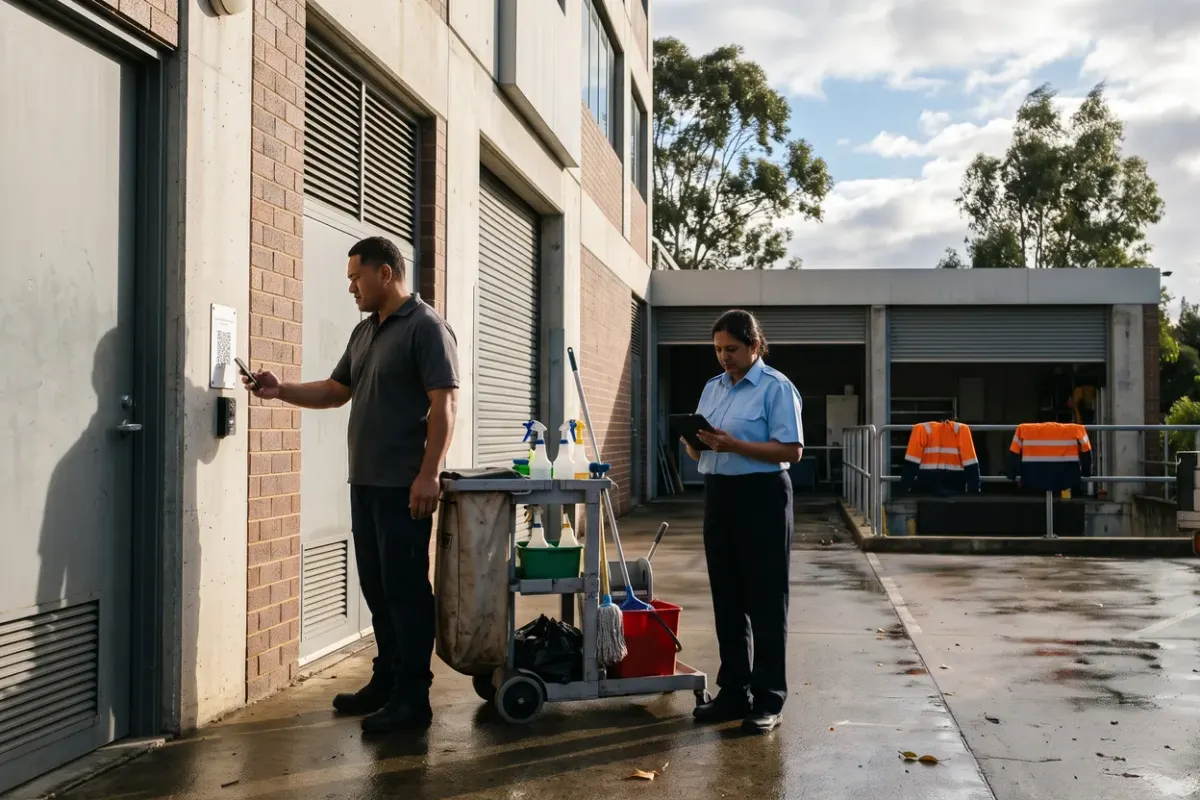
A cleaner on the night shift at an office tower notices that the extraction fan in the chemical store has stopped and the eyewash station has been dry for a month. She tells her supervisor, who tells the contract manager, who means to raise it with the building. Six weeks later nothing has changed. A health and safety representative is the person the WHS laws give the standing to make sure it is not ignored: someone her own work group elected, with the right to inspect, to receive information, and, once trained, to issue a notice the business has to deal with.
This guide is for facilities managers and WHS managers in property and facilities management: the businesses that own and run commercial buildings, and the facilities services companies whose cleaners, security officers, and maintenance technicians work inside them. It covers what a health and safety representative (HSR) is, when a business has to hold an election, how to set up work groups when the workforce is spread across many buildings and shifts, what an HSR can and cannot do, and what the business owes them. It follows the model WHS Act. Each state and territory has its own Act, the details differ, and Victoria's law is separate, so check yours. The example is an illustration, not a customer.
What Is a Health and Safety Representative?
A health and safety representative is a worker elected by the workers in their work group to represent them in matters relating to work health and safety. Under the model WHS Act the role has four functions: to represent the group, to monitor the measures the business takes to comply with the Act, to investigate complaints from the group about health and safety, and to inquire into anything that appears to be a risk to the group's health or safety arising from the business's work.1
The HSR is not a manager, a safety adviser, or the person responsible for safety. The Act says nothing in it imposes a duty on an HSR in that capacity, and an HSR is not personally liable for anything done or not done in good faith in the role.1 The business keeps every one of its duties. What changes is that the workers now have someone with legal standing to make sure their view reaches the business, and that the business answers it.
Do You Have to Have a Health and Safety Representative?
Not until someone asks. Under the model WHS Act, a worker who carries out work for a business may ask it to facilitate the conduct of an election for one or more HSRs, and the business must then facilitate the determination of one or more work groups.1 The business must take all reasonable steps to start negotiating those work groups with the workers within 14 days of the request.1
Fourteen days is not long. The request can come from any worker, including a night-shift cleaner the WHS manager has never met, by email, through a supervisor, or through a union. What we recommend: decide now who in the business receives a request, how fast it is acknowledged, and who runs the negotiation, so the clock is not half gone before anyone notices.
How to Set Up Work Groups Across a Property Portfolio.
A work group is the set of workers an HSR represents, and it can cover workers at more than one workplace.1 The negotiation settles the number and make-up of the work groups, the number of HSRs and deputies, and the workplaces each group covers, and the business must tell the workers the outcome as soon as practicable once it is done.1 If the negotiations fail, including when the business has not taken all reasonable steps and they have not started within 14 days, any party can ask the regulator to appoint an inspector, who may decide the work groups.1
The model Regulations list the matters to take into account. Among them are the number of workers, the nature of each type of work, the areas or places where it is done, the extent to which workers move from place to place, whether each worker is engaged as an employee or as a contractor, the pattern of their work, the times it is done, and any shift arrangements.2
That list reads as if it was written for facilities management. A facilities services business might employ 300 cleaners, security officers, and technicians across 30 buildings, on day, night, and weekend shifts, many of whom never set foot in head office. One HSR for all of them would be an HSR nobody could reach. Three ways to draw the groups:
- By building or precinct. Every worker in one building or a cluster of nearby buildings, across all shifts. Simple, but a day-shift HSR may never see the night shift working.
- By trade. Cleaning, security, and technical services carry different hazards: chemicals and manual handling, aggression and lone work, heights and electricity.
- By shift. Night-shift cleaners and security officers share hazards and hours, and often a supervisor.
One workable answer is a mix: trade groups, split by region, with a deputy on nights. The test is whether the cleaner on level 30 at 2am can find their HSR without asking a manager.
How an HSR Is Elected, and How Long They Serve.
The workers run the election, not the business. The workers in a work group may decide how it is conducted, subject to any procedures the regulations prescribe, and, if a majority of the group decides, it may be run with the help of a union or another person or organisation.1 Only a member of the work group can stand, and every worker in the group is entitled to vote.1
Under the model WHS Act, an HSR holds office for 3 years. Deputy HSRs are elected in the same way, and step in when the HSR is away.1 The business's part is practical: time and a way to vote for people on every shift and at every building, and no thumb on the scale for any candidate.
What Can a Health and Safety Representative Do?
To carry out those four functions, an HSR may, among other things:1
- Inspect the workplace where a worker in the group works, at any time after giving the business reasonable notice, or at any time without notice in the event of an incident or a situation involving a serious risk from an immediate or imminent exposure to a hazard.
- Accompany an inspector from the regulator during an inspection.
- Request a health and safety committee for the business.
- Receive information about the work health and safety of the workers in the group.
- Ask for help from any person whenever necessary.
A trained HSR has two further powers. The first is to direct a worker to stop work. The HSR must have a reasonable concern that the work would expose the worker to a serious risk from an immediate or imminent hazard, and can give the direction only if the matter is still not resolved after consulting the business and trying the issue resolution procedure. The HSR can skip those steps only if the risk is so serious and immediate or imminent that consulting first is not reasonable, and must then consult as soon as practicable afterwards.1
The second is a provisional improvement notice. An HSR who reasonably believes the business is contravening the Act, or has contravened it in a way likely to continue or be repeated, may issue one, but only after first consulting the business. The notice must be in writing, require the business to remedy or prevent the contravention, and give at least 8 days to comply. The business must comply in that time unless, within 7 days of the notice being issued, it asks the regulator to appoint an inspector to review it; the notice is then on hold until the inspector decides.1 Both powers require the HSR to have completed the prescribed initial training, or equivalent training under another Australian WHS law.1
None of that removes a worker's own right. Any worker may cease, or refuse to carry out, work if they have a reasonable concern that it would expose them to a serious risk from an immediate or imminent exposure to a hazard.1
What the Business Must Give an HSR.
The obligations run both ways. The business must consult any HSR on work health and safety matters, so far as is reasonably practicable, and confer with them whenever reasonably requested. It must give the HSR access to the information it has about hazards and the group's health and safety, and provide the resources, facilities, and assistance reasonably necessary for the role. It must let the HSR accompany an inspector, and let a person assisting the HSR into the workplace where that is necessary, though it can refuse that access on reasonable grounds.1 The consultation code adds that, where HSRs have been elected, they must always be included in any consultation that affects, or is likely to affect, the health and safety of their work group.3
Training. If an HSR asks, the business must allow them to attend an approved course the HSR chooses (in some states, in consultation with the business), give them time off to attend as soon as practicable within 3 months of the request, pay the course fees and other reasonable costs, and pay them as normal for the time off.1 Under the Commonwealth Regulations the course is an initial 5 days, then 1 day of refresher training each year; the model Regulations say up to 5 days and up to 1 day, so check your state's Regulations.210
The list. The business must keep an up-to-date list of every HSR and deputy for each work group, and display it at its principal place of business and at any other workplace that is appropriate given how the work groups are made up, in a manner readily accessible to the workers in those groups. Under the Commonwealth Act, and in states whose Acts require it, it must also give a copy of the list to the regulator as soon as practicable; the December 2025 model Act has no such step.19
That list is easy to get wrong in property and facilities management. For a cleaner or a security officer the workplace is a client's building, not the head office, so a list pinned up at the depot is no use to a guard who signs on at a shopping centre loading dock.
HSRs at a Building You Share With Other Businesses.
A commercial building is rarely one business's workplace. The owner, the property manager, the tenants, the cleaning contractor, the security contractor, and the lift and fire services contractors all have workers there. The model WHS Act allows work groups to be set up for workers carrying out work for two or more businesses, with the details, including which businesses and workplaces the groups apply to, settled by negotiation and agreement between each of the businesses and the workers.1 A party can later withdraw by giving reasonable written notice, and where several businesses share an HSR they split the training costs equally unless they agree otherwise.1
Even where each business keeps its own HSRs, the consultation code expects them to work together. It says a landlord or managing agent should consult, cooperate, and coordinate activities with the tenant, and its worked example is a multi-tenanted office block in which the property manager consults the maintenance contractor, the tenants, and the cleaning contractor about lift maintenance.3 In practice, the owner's facilities manager should know who the contractors' HSRs are, and should agree in advance how an HSR inspects a plant room or chemical store the owner controls. Our guide to the duty to consult, cooperate, and coordinate covers the rest of that duty.
Victoria is different. Its Occupational Health and Safety Act 2004 uses designated work groups rather than work groups, and they can also represent employees of more than one employer.4 WorkSafe Victoria says an amending Act received Royal Assent in 2026, so check its current guidance before relying on any detail of Victorian HSR powers.5
A Worked Example Across a 14-Building Office Portfolio.
A facilities services business holds the cleaning, security, and building maintenance contracts for a property owner's portfolio of 14 office buildings. It employs 160 cleaners, 45 security officers, and 22 technicians across them, on three shifts. Until this year it had no HSRs.
In March, the night-shift cleaner from the opening of this guide emails the WHS manager asking for an HSR election. The WHS manager acknowledges it the same day and opens negotiations within the week, proposing four cleaning groups by region, one security group across the portfolio with a deputy for nights, and one technical group. The night cleaners push back: two of the proposed regions share a night supervisor and a van. The groups are redrawn to follow the supervisor rather than the map, and the outcome is sent to every worker. Her email also mentions the dry eyewash station. The WHS manager has it refilled within 24 hours and logs it.
Each group runs its own election over two weeks, with the cleaners' union helping, as a majority of each group had decided, and voting by paper at shift sign-on and by text message, so nobody has to travel to the depot. Six HSRs and four deputies are elected. Within the month the business books all six on an approved 5-day course they chose, at its cost, on paid time.
Then comes the part that is easy to miss. The list of HSRs goes to the regulator and onto the wall of every building's cleaners' room and security office, not only the depot, and into the site information each new starter reads when they first sign in. The property owner's facilities manager gets a copy too, because the owner's buildings are the workplaces and the HSRs will want to inspect plant rooms and stores the owner controls.
In August, the cleaning HSR for the northern region gives notice, inspects the chemical store at the same tower, and finds the eyewash station dry again: it was refilled in March, but nobody owned the weekly check. She raises it with the contract manager and the owner's facilities manager at the same time. It is refilled that day, and the weekly check gets a named owner and a due date. Nobody needed a provisional improvement notice. The date raised, the person responsible, and the date closed are on the record, which is what the business will want if the regulator ever asks how it consulted its workers.
A Health and Safety Representative Checklist for Facilities Managers.
Use this whether your business employs the workers or engages the contractor who does. Each line should have an answer in writing and a name against it.
- The request. Who receives a request for an HSR election, and how the business takes all reasonable steps to start negotiations inside 14 days.
- The work groups. Drawn so every worker, on every shift and at every building, can reach their HSR.
- The election. Run by the workers, with a way for night-shift and site-based workers to vote.
- Training. Attended as soon as practicable, and within 3 months of a request, at the business's cost, on paid time.
- The list. Current, displayed at each building where the group works, and sent to the regulator where your state's Act requires it.
- Consultation. HSRs included whenever their group is consulted, with the record kept.
- Shared buildings. Agreed with the owner, the tenants, and other contractors: who the HSRs are and how inspections happen.
- Issues raised. Each one logged with the date raised, an owner, and the date closed.
For the short, regular conversations that sit alongside the HSR, our guide to running a toolbox talk explains how a talk can count as consultation.
Keeping HSR Issues on One Record in ComplyFlow.
ComplyFlow does not run HSR elections, and nothing in it replaces the HSR. Where it helps is the list and the follow-through. In site documents, a document such as the current HSR list can be set to display in Live Access at a site's sign-in, or made visible to contractors, rather than staying hidden by default.6 An issue an HSR raises can be recorded as a corrective action, usually against the incident or inspection that found it, assigned to one staff user, who receives the email and dashboard notifications, and marked Closed once the issue is resolved.7 A follow-up check can be set as a scheduled inspection for a site, with overdue inspections flagged and dashboard notifications emailed weekly.8
Start With the List on the Wall.
Pick three buildings in your portfolio this week and check, at each one, whether a cleaner or a security officer starting a shift could find the name of their HSR without asking anyone. If they could not, you have found the first gap, whether or not any HSRs have been elected yet. Fix that, then agree with your contractors and the building owners whose HSRs cover whom. To see issues, inspections, and actions on one record across every building, book a demo.
Sources
- Work Health and Safety Act 2011 (Cth), Compilation No. 16
- Work Health and Safety Regulations 2011 (Cth), Compilation No. 28
- Work Health and Safety (Work Health and Safety Consultation, Co-operation and Co-ordination) Code of Practice 2015
- Summary of the OHS Act 2004: Representation of employees
- Health and safety representatives
- Site Document Advanced Settings (including Live Access)
- Corrective Actions
- Scheduled Inspections
- Model Work Health and Safety Bill
- Model Work Health and Safety Regulations
See It Against Your Own Contractors, Sites & Rules.
Book a 30-minute demo. We will show ComplyFlow working with your kind of sites, your kind of contractors, and your requirements. No slides, no hard sell.
Or Speak to Us
- ISO 27001
- Hosted on AWS
- Microsoft & Okta SSO
- API & MCP
- Data in Australia
Written by
Mitchell BourneManaging Director, ComplyFlow
Mitchell has run ComplyFlow since 2009 and has spent that time inside the contractor, site, and safety problems of Australian operators. He writes about where compliance actually fails, and what the people responsible for it can do about it.
Writes about: Contractor compliance, WHS duty and proof, Running a compliance program
Questions
Questions People Ask About This.
Is a health and safety representative the same as a safety officer?
No. A safety officer or WHS adviser is appointed by the business to help it manage safety. An HSR is elected by the workers in their work group to represent them. The business keeps its duties either way, and the HSR carries no duty in that capacity.
Can a contractor's workers be in the same work group as our staff?
Yes, if the businesses and the workers agree. The model WHS Act allows work groups to be set up for workers carrying out work for two or more businesses, with the details settled by negotiation and agreement between each of the businesses and the workers. Any party can later withdraw by giving reasonable written notice.
Who pays for HSR training?
The business does. Under the model WHS Act, if an HSR asks, the business must let them attend an approved course the HSR chooses (in some states, in consultation with the business), give them time off to attend as soon as practicable and within 3 months of the request, pay the course fees and other reasonable costs, and pay them as normal for the time off. Where several businesses share an HSR, the costs are split equally unless they agree otherwise.
How many health and safety representatives does a business need?
There is no fixed number in the model laws. The number of HSRs and deputies is one of the things the business negotiates with the workers when it sets up the work groups, weighing the number of workers, where and when they work, and the hazards. The aim is that every worker can reach their representative.
What is the difference between an HSR and a health and safety committee?
An HSR is one worker, elected by a work group, who represents that group. A health and safety committee is set up for the business, or for part of it, and brings workers and management together. Under the model WHS Act, an HSR can ask the business to establish a committee, and the business must then do so within 2 months; a request from 5 or more workers at the workplace has the same effect.