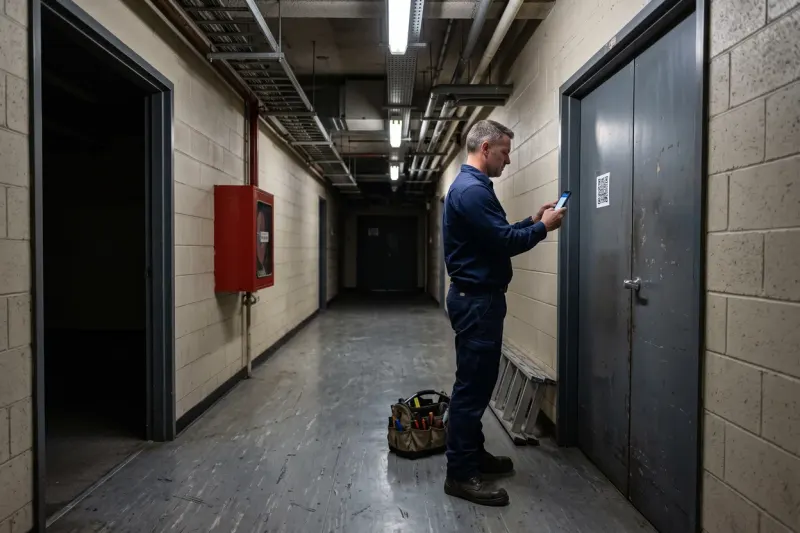
Consult, Cooperate & Coordinate: The WHS Duty When You Engage Contractors
The duty to consult, cooperate, and coordinate, known as the three Cs, is section 46 of the model WHS Act: where more than one business has a duty for the same matter, each must, so far as is reasonably practicable, consult, co-operate and co-ordinate activities with the others. With contractors, that means agreeing the hazards, who controls each one, and the timing before work starts, then keeping each other informed.
 Mitchell BourneManaging Director
- Published
- 9 min read

Many contractor incidents in shared workplaces have the same back story. Each business assumed another one had the hazard covered. The lift contractor thought the building had told the tenants. The building thought the cleaning contractor knew the floor was closed. The duty to consult, cooperate, and coordinate exists to close exactly that gap, and it applies to almost every contractor job a safety manager signs off.
This guide explains what the duty asks, who it involves, and what a record of it looks like. The examples come from an office building in property and facilities management and a cross-dock in transport and logistics. They are illustrations, not customers.
What Is the Duty to Consult, Cooperate, and Coordinate?
The duty to consult, cooperate, and coordinate is section 46 of the model WHS Act. Where more than one person has a duty in relation to the same matter, each person with the duty must, so far as is reasonably practicable, consult, co-operate and co-ordinate activities with all other persons who have a duty in relation to the same matter.1
Safe Work Australia's code of practice puts it in plain terms: there is often more than one business with responsibility for the same health and safety matters, because they are involved in the same activities or share the same workplace, and each should exchange information to find out who is doing what and work together so risks are eliminated or minimised so far as is reasonably practicable.2
Two other rules make it bite. A duty cannot be transferred to another person, and each duty holder must comply with its duty to the standard the Act requires even if another duty holder has the same duty.1 Engaging a contractor shares the duty. It never hands it over.
What Are the Three Cs in WHS?
The three Cs are consult, cooperate, and coordinate: the three things the duty asks of businesses that share a duty. The name is shorthand used by safety professionals, not a term in the Act, and it is easy to confuse with the separate duty to consult the workers who carry out work for you, which sits in sections 47 and 48.1
The difference matters. Consulting workers is about the people doing the work having a say. The three Cs are about businesses agreeing between themselves who controls which risk, so that no hazard falls between them. Both apply on a typical contractor job, and the code says you must, so far as is reasonably practicable, agree with the contractor how the workers will be consulted, so it is done once and properly.2
Who Are the Other Duty Holders on a Contractor Job?
More than most people list. Safe Work Australia says businesses might share a duty when they are involved in the same activities, such as a supply chain; have a duty to the same workers, such as a labour hire agency, a host, and a building owner; or share the same workplace, such as the foyer of a multi-tenanted building.3
The code's first step is to identify them.2 On a typical job that means:
- You, as the business engaging the contractor or controlling the workplace.
- The contractor, and any subcontractor it brings.
- Whoever manages or controls the building or site: the owner, the managing agent, or the FM company.
- Other businesses whose people are in the same space: tenants, cleaners, security, other trades.
- A labour hire provider, if any of the workers are on hire.
- Carriers and their drivers, wherever the work is in a yard or at a dock.
The code's own logistics example is a useful check for a warehouse operator. It says the consignor and consignee, the operator of a warehouse, the trucking company, and subcontracted drivers should consult, cooperate, and coordinate with each other on the timing and process for collecting and delivering goods.2
What Each of the Three Words Asks You to Do.
Consult. Share what you know and agree what happens. The code says consultation should give everyone a shared understanding of the risks, which workers are affected, and how the risks will be controlled, and it sets out the questions to ask: what each business will be doing, who else may be affected, what plant or substances each will use, who has control or influence over each part of the work, and what each will provide for health and safety.2
Cooperate. Do what was agreed and do not get in the way. Safe Work Australia's fact sheet says cooperating means engaging in a productive way, sharing information, and responding to reasonable requests from other duty holders to help them meet their duties.4 The code adds that it means not obstructing communication.2
Coordinate. Plan the work together so the controls fit. The code says coordinating requires duty holders to work together so each can meet its duty effectively without leaving gaps, and that it may mean scheduling work so each business does its part separately or at the right time, or arranging work so precautions are in place before particular work starts.2
Timing is where most businesses go wrong. The code says to start when you become aware another duty holder is or will be involved, which may be during contract negotiations or when you engage another business, and that consultation should start during the planning of the work.2 A toolbox talk on the morning of the job is the last chance to coordinate, not the first.
Two Jobs, Worked Through.
A sprinkler valve replacement in an office tower. The FM company engages a fire services contractor to replace a valve, which means isolating part of the sprinkler system on three floors for most of a day. Before booking it, the facilities manager lists the other duty holders: the building owner, the tenants on those floors, the security contractor who monitors the fire panel, and the cleaning contractor whose night shift uses the same riser.
Consultation settles what each needs to know: the floors and hours affected, the extra fire watch the contractor will run, and the panel alarms security should expect. Cooperation is the tenants keeping the impaired floors clear of hot work and the cleaners avoiding the riser that night. Coordination is the date: a weekend, when two of the three floors are empty, with the fire panel monitoring confirmed before the valve is closed. None of it is complicated. All of it fails if the contractor assumes the building told everyone.
Racking repairs at a cross-dock. A logistics operator engages a racking contractor to replace damaged uprights in two aisles while the dock keeps running. Its pickers are partly labour hire, and two carriers' drivers use the dock every shift. The other duty holders are the racking contractor, the labour hire provider, the carriers, and the building owner if the racking is part of the lease.
Consultation covers which aisles close and when, the forklift routes that change, and what the labour hire provider tells its workers. Cooperation is the contractor working within the barricades agreed and the pickers' supervisors keeping their people out. Coordination is sequencing: one aisle at a time, after the evening outbound wave, with the carriers told which doors move. The same permit to work system that controls the contractor's work also tells everyone else where it is.
What Happens When It Is Not Done?
Two recent prosecutions show how the charge arises. In Queensland, a cardboard manufacturer pleaded guilty in July 2025 and was fined, with no conviction recorded, after a worker was burned when LPG ignited during forklift refuelling: it had failed to consult, cooperate, and coordinate with another duty holder about keeping other vehicles away from the refuelling station while one was refuelling, about training, and about markings around the area.5
In New South Wales, after workers fell through the roof of a cool room in October 2022, one of the businesses involved in the work was convicted in October 2025 of failing to consult, cooperate, and coordinate, alongside a breach of its primary duty, and fined AU$20,000 on that count, against AU$480,000 on the primary duty charge.6 In the model WHS Act, the breach is a tier C offence; Safe Work Australia puts the model maximum at AU$33,000 for an individual and AU$165,000 for a body corporate for the year from 1 July 2026, and each state sets its own amounts.7
New South Wales raised the stakes in a second way. SafeWork NSW says that from 1 July 2026, when section 26A of the NSW WHS Act commenced, codes of practice became the minimum performance standard: a business must comply with an approved code, or manage the hazards and risks in a different way that gives an equivalent or higher standard.89 In New South Wales, the approved consultation code (SafeWork NSW's December 2022 edition) is now the minimum performance standard, not just guidance.8
How Victoria Differs.
Victoria runs its own Occupational Health and Safety Act 2004 and Regulations 2017, and neither has a general version of section 46. In the Act, the only provision that imposes a duty to consult, co-operate, and co-ordinate is section 35A, and it applies between labour hire providers and host employers who have duties to the same worker.10 WorkSafe Victoria says the section 35A duty is not intended to apply outside labour hire arrangements.12 The Regulations add co-ordination duties in two narrow places: a principal contractor's health and safety co-ordination plan for a construction project (regulations 335 to 337), and the co-ordination of major hazard facility safety cases (regulation 386).11
That does not leave Victorian sites without shared duties. Under section 21(3), an employer's duty extends to independent contractors it engages, and their employees, for matters over which the employer has control or would have control if not for any agreement purporting to limit or remove that control.10 Agreeing with the contractor who controls what is still the practical way to meet it.
What Records Show You Did It.
The model laws do not require consultation to be written down unless a regulation says so. The code calls a record good practice, because it shows you complied and makes disputes less likely, and it says the record can be brief: the safety matter, who is affected, who was involved, the key issues raised, the decision, why it was made, who acts by when, and when the action was completed.2
Use those eight lines as the template for every shared job, and keep them where the next person can find them. Add a clause to your contractor agreements as well. The code suggests contracts require the other party to consult, cooperate, and coordinate on safety, which makes them aware of the duty and gives you a contractual right to enforce it, though no clause can transfer the duty itself.213
Where Software Helps.
Software cannot have the conversation for you. It can make sure the conversation's outcome reaches the people at the door. In ComplyFlow's contractor management software, document and training requirements can be assigned to each site, so a contractor's workers are checked against what that building or depot needs, not just the account-wide list.14 On a site using Live Access, an active hazard can be set against an area with a location, and a hazard notification is shown when it is submitted, so a closed aisle or an impaired floor is in front of everyone who signs in there.15
Start With the Next Job That Touches a Shared Space.
Pick the next contractor job booked for a space other businesses use: a lift lobby, a riser, a dock, a yard. Before it is confirmed, list every other business with people in that space, ask each the code's questions about who controls what, and write the eight-line record. It will take less time than the conversation after an incident would, and it is the evidence an inspector will ask for. For the duties each party holds in a managed building, our guide to PCBU responsibilities for property owners and FM companies goes further. To see site requirements and hazards on one record, book a demo.
Sources
- Model Work Health and Safety Bill (as at 5 December 2025)
- Model Code of Practice: Work health and safety consultation, cooperation and coordination
- Consulting, cooperating and coordinating activities with other duty holders
- Duty to consult, cooperate and coordinate with other duty holders (fact sheet)
- Court report: Cardboard business fined (Ipswich Magistrates Court)
- Prosecutions, October 2025
- Maximum monetary penalties under the WHS laws
- Codes of practice
- Work Health and Safety Act 2011 (NSW)
- Occupational Health and Safety Act 2004 (Vic), Authorised Version No. 045
- Occupational Health and Safety Regulations 2017 (Vic), version 017
- Duty for labour hire providers and host employers to consult, cooperate and coordinate
- Principles that apply to work health and safety duties
- Compliance Requirements, Training Requirements and Site Contact
- Hazards in Live Access
See It Against Your Own Contractors, Sites & Rules.
Book a 30-minute demo. We will show ComplyFlow working with your kind of sites, your kind of contractors, and your requirements. No slides, no hard sell.
Or Speak to Us
- ISO 27001
- Hosted on AWS
- Microsoft & Okta SSO
- API & MCP
- Data in Australia
Written by
Mitchell BourneManaging Director, ComplyFlow
Mitchell has run ComplyFlow since 2009 and has spent that time inside the contractor, site, and safety problems of Australian operators. He writes about where compliance actually fails, and what the people responsible for it can do about it.
Writes about: Contractor compliance, WHS duty and proof, Running a compliance program
Questions
Questions People Ask About This.
Does a contract clause satisfy the duty to consult, cooperate, and coordinate?
No. A contract cannot transfer or reduce a WHS duty, and Safe Work Australia says any contractual term that tries to will be invalid. A clause is still worth having: the code suggests contracts require the other party to consult, cooperate, and coordinate on safety, which makes them aware of it and gives you a contractual right to enforce it. The duty itself is met by what the businesses actually do together.
What is the penalty for failing to consult, cooperate, and coordinate?
In the model WHS Act it is a tier C offence. Safe Work Australia puts the model maximum at AU$33,000 for an individual and AU$165,000 for a body corporate for the year from 1 July 2026. Each state sets its own amount, so check your jurisdiction. Courts have dealt with this offence in Queensland, where a business pleaded guilty and was fined with no conviction recorded, and in New South Wales, where a business was convicted and fined AU$20,000 on that charge alongside a primary duty charge.
Is the duty only for construction sites?
No. Safe Work Australia's code names shopping centres, construction projects, labour hire, and multi-tenanted office buildings as typical places where businesses share duties, and gives a logistics example: the consignor, consignee, warehouse operator, trucking company, and subcontracted drivers should coordinate the timing and process for collecting and delivering goods.
Do I also have to consult the contractor's workers?
Yes, where they are or are likely to be directly affected. Under the model WHS Act a contractor and its employees are your workers for WHS purposes, so the separate duty to consult workers reaches them too, so far as is reasonably practicable. The code says you must, so far as is reasonably practicable, consult, cooperate and coordinate with the contractor on how that consultation will be done, so the workers are not consulted twice or not at all.
Who should start the conversation?
Every business with the duty, as soon as it knows another duty holder is or will be involved. In practice the business with the most influence over the work usually leads, but none can wait for another to start. Safe Work Australia says to start as soon as you are aware another duty holder is or will be involved. If another business will not engage, the code says not to simply accept it: check they know about the duty and what you think is needed.
Keep Reading