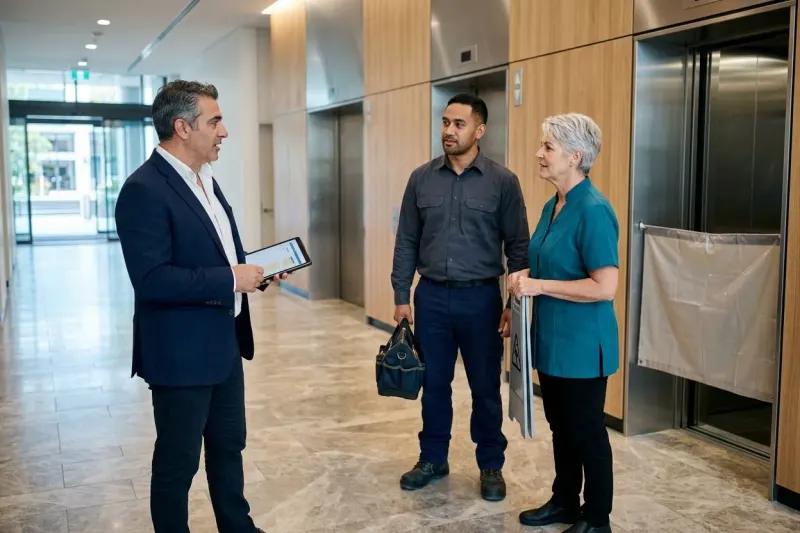
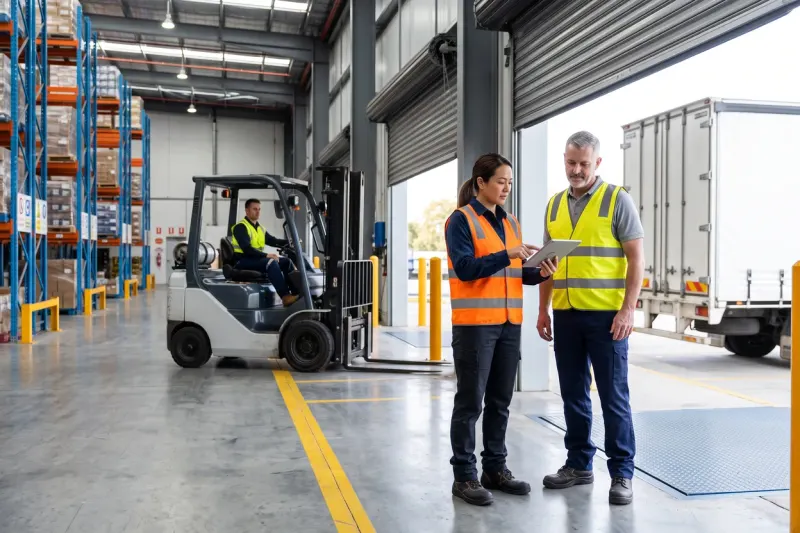
Toolbox Talk: How to Run One and Keep a Record That Counts
A toolbox talk is a pre-shift safety meeting. Model WHS laws never require one by name; they require consulting workers who are, or are likely to be, directly affected by a health or safety matter, so far as is reasonably practicable. A talk can be that consultation when workers get the information, can raise issues and contribute to decisions, have their views taken into account, and are told the outcome in a timely manner, involving any health and safety representative.
 John McCannHead of Product
- Published
- 16 min read
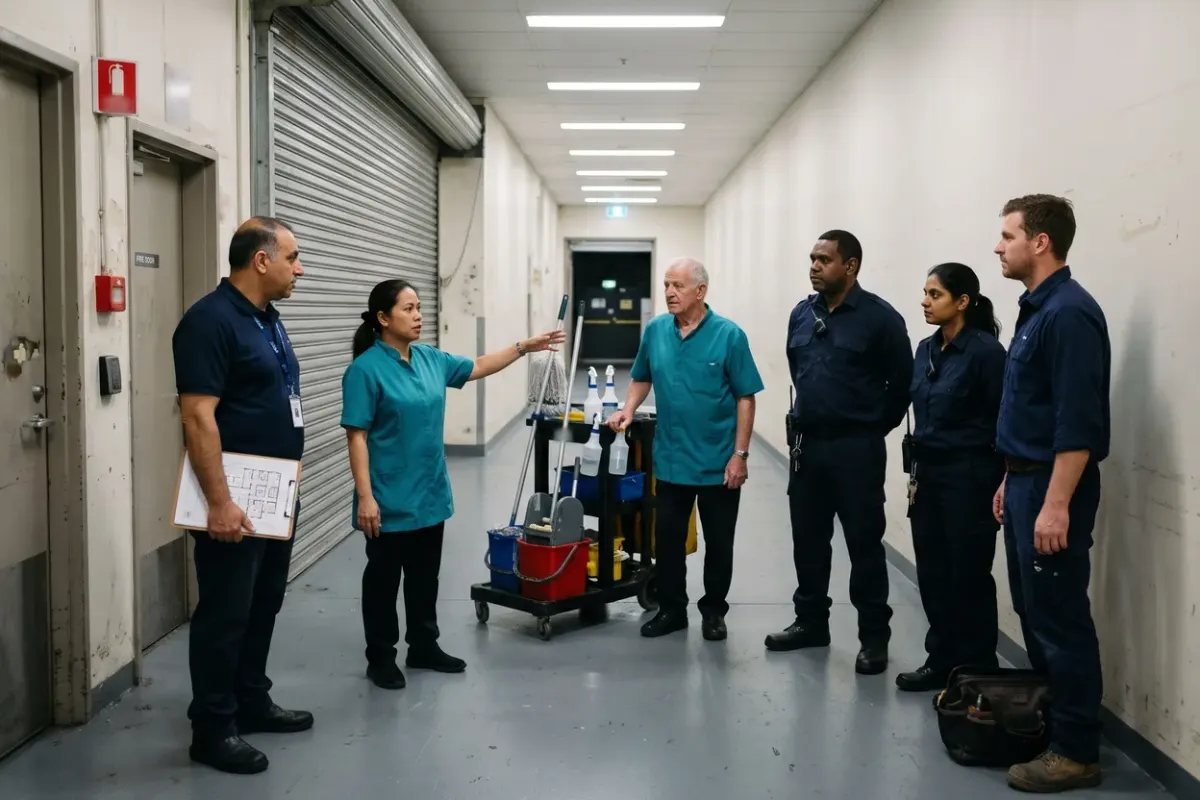
A toolbox talk is the few minutes before a shift when a supervisor gathers the crew beside a forklift or a cleaner's trolley and talks about one thing that could hurt someone today. Done well, it is the cheapest consultation a business will ever run. Done badly, it is a signature sheet proving that people stood in a loading bay for five minutes.
This guide is for the supervisor who runs toolbox talks, and the WHS manager who sets how they are run, across depots and distribution centres in transport and logistics, or across shopping centres and office buildings in property and facilities management. It covers what a toolbox talk is, how to run one in 10 to 15 minutes, what the record should hold, what Australian law actually asks for, who has to be there, and how long to keep it. The two worked examples are illustrations, not customers.
What Is a Toolbox Talk?
A toolbox talk is a short safety meeting, held at the start of a shift or before a job, where a supervisor and the people doing the work discuss one health and safety matter and decide what to do about it. The National Heavy Vehicle Regulator describes it as a formal or informal meeting to communicate and exchange safety and operational information, and as an opportunity to hear the views and insights of employees, generally short and held before a job or work shift starts.1
The second half of that description is the part most talks skip. A toolbox talk is two-way by design: the supervisor brings one topic, and the people on the floor say what really happens there.
It is not the same as a pre-start briefing, an induction, or a review of a safe work method statement, even though all four can happen in the same half hour. Safe Work Australia lists pre-start briefings and toolbox talks as separate ways consultation might occur, alongside regular team meetings and health and safety representatives.2 In practice a pre-start covers today's plan and equipment, an induction covers the site rules once for a new arrival, and a toolbox talk takes one hazard or one change and opens it up for discussion.
How to Run a Toolbox Talk in 10 to 15 Minutes.
Ten to 15 minutes is our recommendation: long enough for one topic and a real discussion, short enough that the shift still starts on time. The NHVR's guide says to allow enough time to get through the topics and for employees to provide input, and to ask for comments before moving on.1 SafeWork SA tells employers to advertise the upcoming topic beforehand, promote discussion by asking questions, record who attended and any suggestions, and follow up on actions at the next talk.7
A running order that fits those points:
- Minutes 0 to 2: report back. Close out what was raised last time: what was done, what is still open, and why. The NHVR's guide says to be prepared to discuss the status of issues raised at previous talks.1
- Minutes 2 to 5: one topic. Say what has changed or what went wrong, and show it: the new floor marking, the photo of the near miss, the revised roster.
- Minutes 5 to 10: the floor's turn. Ask how the work really happens, then wait. If the labour hire workers or contractors are quiet, ask them by name.
- Minutes 10 to 13: decide and write it down. Each issue gets an action with an owner and a date, a reason it will not change, or a promise to come back with an answer.
- Minutes 13 to 15: who is missing. Name the people on other shifts, on the road, or off sick, and who will brief them and by when.
Regulation 39 of the model Regulations requires information, training, and instruction given to a worker to be suitable and adequate, and, so far as is reasonably practicable, readily understandable by any person it is provided to.4 On a site with several first languages, that can mean a translated summary, a picture in place of a procedure, or a team member restating the point. The NHVR's guide notes that some people prefer to talk to you afterwards, so stay a few minutes.
What Should a Toolbox Talk Record Include?
A toolbox talk record should show who was consulted, what they said, and what happened as a result. SafeWork NSW's guide asks for who attended, with signatures, what was discussed, what was decided to fix hazards, and who is responsible for fixing them, followed by a manager's check of the record and making sure everyone knows how to work safely if work processes change.6 The NHVR's guide asks for the topics discussed, any follow-up actions, the feedback given to attendees, and attendance.1 The consultation code says records can be brief and simple and should include the outcomes of discussions.5
Put those together, add the fields contractors need, and a record template looks like this:
- topic, date, start time, and the site and area;
- who ran it, and the health and safety representative involved, if the workers have one;
- who attended, with each person's employer, whether your business, a contractor, or a labour hire provider;
- the information shared, including any plan, document, or photo shown;
- the issues raised, and by whom;
- the response to each issue: the decision and the reason for it;
- each action, its owner, and the date it is due;
- who was absent, who will brief them, and the date they were briefed;
- how and when the outcome was reported back, and to whom;
- the date each action was completed.
The last two lines are the easiest to forget, and they are the ones that show workers were told the outcome.
Is a Toolbox Talk a Legal Requirement in Australia?
Not under the model laws. The model Work Health and Safety Act and the model Regulations never mention toolbox talks; the words do not appear in either.34 What the law requires is consultation. Under section 47 of the model Act, a business must, so far as is reasonably practicable, consult workers who carry out work for it and who are, or are likely to be, directly affected by a matter relating to work health or safety.3
Section 49 says when. Consultation is required when identifying hazards and assessing risks, when deciding how to eliminate or minimise those risks, when making decisions about welfare facilities, when proposing changes that may affect workers' health or safety, and when deciding procedures for consulting, resolving issues, monitoring, and providing information and training.3 A new racking layout before peak season, a new forklift route, and a change to after-hours access in a shopping centre are all changes of that kind.
Toolbox talks come in through guidance. Safe Work Australia's model Code of Practice on consultation, cooperation and coordination (July 2023) gives using toolbox talks to discuss specific health and safety issues as one way to support ongoing consultation, and names toolbox talks among the ways agreed consultation procedures can say consultation will happen.5 Agree with your workers that toolbox talks are one of the ways you consult, and section 47 then requires your consultation to follow that agreed procedure.3
The model Act and Regulations have no legal effect by themselves, and the model code has legal effect in a jurisdiction only once it is approved there.35 Victoria has not adopted the model laws and has its own Occupational Health and Safety Act 2004, covered further down.
What Makes a Toolbox Talk Count as Consultation.
Section 48 of the model Act sets out what consultation requires, and it reads like a running order for a good toolbox talk. Relevant information about the matter is shared with workers. Workers get a reasonable opportunity to express their views, raise health and safety issues, and contribute to the decision. Their views are taken into account, and they are told the outcome in a timely manner. Where workers are represented by a health and safety representative, the consultation must involve that representative.3
The code adds two points every supervisor should know. Consultation does not require consensus or agreement, but workers' views must be taken into account before the decision is made, and workers must be told the final decision as soon as possible, and should be given information to help them understand the reasons.5
In our view, and it is ours rather than a regulator's, a signed attendance sheet on its own shows who was present, not that anyone was consulted. A talk where the supervisor reads out a notice, nobody speaks, and everyone signs has shared information and stopped there. The record that shows consultation is the one that captures what people said, what was decided, and how they heard about it afterwards.
Do Contractors and Labour Hire Workers Have to Be Included?
Yes, where they are or are likely to be directly affected. The model Act's definition of a worker, in section 7, includes a contractor or subcontractor, an employee of a contractor or subcontractor, and an employee of a labour hire company assigned to work in the business.3 The consultation code spells out the consequence: a business must consult, so far as is reasonably practicable, with contractors, subcontractors and their employees, on-hire workers, and others working for it who are or are likely to be directly affected.5
For a distribution centre that means the agency pickers on the early shift and the contract forklift mechanic. For a shopping centre it means the cleaners, the security officers, and the HVAC technician. The code goes further: where contractors or on-hire workers are engaged for specific tasks, toolbox talks on topics relevant to the task may be the most practical way of consulting them.5
Their own employer owes them the same duty. The code says the business and the contractor, subcontractor, or labour hire company both have a duty to consult these workers, and must consult, cooperate, and coordinate on the arrangements, so far as is reasonably practicable.5 That is section 46 at work, and our guide to the duty to consult, cooperate, and coordinate explains how it plays out between businesses. For a toolbox talk, agree with each contractor and labour hire provider who runs it, who attends, and who briefs the people who miss it.
Shift work is the other gap. The code says consultation should, so far as is reasonably practicable, reach shift workers, mobile workers, labour hire workers, workers with diverse language or literacy needs, and contractors, and that it may mean staggering the times you consult.5 Under the heading "Don't leave anyone out", the NHVR's guide says it is important to consider including contractors, subcontractors, and other relevant third parties, to use an attendance form, and to catch up with anyone absent when they return, or by phone or email if the matter is urgent.1
How Long Should You Keep Toolbox Talk Records?
The model laws set no period for keeping a toolbox talk record. The consultation code says consultation with workers does not have to be documented unless the WHS Regulations specifically require it, though keeping records is good practice to show the requirements were met, and can make disputes less likely.5 Where a talk also delivers training a regulation says to record, that regulation sets the period: model regulation 445 requires a record of the asbestos training given to a worker who may be involved in asbestos removal or asbestos-related work to be kept while the worker carries out that work and for 5 years after they stop working for you.4
We recommend keeping toolbox talk records for at least five years, or for as long as the hazard or control they discuss is still in place, whichever is longer. The record of the talk that agreed a forklift exclusion zone is evidence for as long as the zone exists, and it is what you will want to find if something goes wrong there. That is our recommendation, not a legal period, so check whether a regulation or an industry scheme you work under sets one.
A Distribution Centre's Early Shift Talk Before Peak Season.
A regional distribution centre runs three shifts, and in the run-up to Christmas about half of its pickers come from a labour hire provider. Two weeks before peak, the operations team plans to stage overflow pallets at the ends of the pick aisles to speed up dispatch. That is a proposed change that may affect workers' health or safety, so it is a matter to consult on before it happens.
At 5:45am on Monday the early shift supervisor gathers the pickers, the forklift operators, and the two carrier drivers already at the dock. The topic is forklift and pedestrian separation once the staging starts. She shows the new floor plan, points out where the pedestrian walkways run, and asks what will go wrong.
A labour hire picker answers. At the end of aisle 14, the staged pallets will sit across the painted pedestrian crossing, so pickers walking to the packing benches will have to step into the forklift aisle. Two operators agree, and one adds that reversing out of aisle 14 he cannot see the crossing at all. The supervisor records the issue against the picker's name and employer, and the decision: no staging within 3 metres of any crossing, the staging bay at aisle 14 moved to the opposite wall, and a convex mirror at the aisle end. The site maintenance lead owns the action, due Wednesday.
On Wednesday the bay is moved and the mirror fitted. At Thursday's early shift talk the supervisor reports back first, before the new topic, and the record shows the action closed with the date. The labour hire provider's on-site coordinator gets the same summary for the afternoon and night shift pickers, and the night shift supervisor runs the item at the start of that shift and notes who heard it. A month later, a new picker asks why the staging at aisle 14 sits on the wrong wall. The record answers her, and shows the change came from a picker on the floor.
A Facilities Team's Monthly Talk With Cleaning, Security, and HVAC Contractors.
A shopping centre's facilities team holds a toolbox talk on the first Tuesday of each month at 10pm, after trading, so the night cleaning crew, the security officers on the overnight roster, and the HVAC contractor's after-hours technician can all attend. Each works for a different business. The centre's facilities manager runs the talk, because the centre controls the building they all work in.
This month the topic is after-hours access and lone work. A new loading dock entry system goes live next week, and the facilities manager walks through how each contractor will get in, where the duress points are, and how security keeps track of who is in the building overnight.
The issues come quickly. A cleaner says she works alone in the back-of-house corridors behind the food court for two hours each night and nobody knows when she has finished. A security officer says the patrol route skips that corridor between 1am and 3am. The HVAC technician says that when he is called to a rooftop unit after hours, he signs in at the dock but nobody checks when he comes back down.
The record lists each attendee with their employer, the three issues, and three actions. The security contractor's supervisor changes the patrol route to pass the corridor every hour. The facilities manager sets up a check-in call to the security control room at the start and end of any lone work in back-of-house or on the roof. The cleaning and HVAC contractors brief their own workers who were not there, and each supervisor confirms it by Friday. The facilities manager sends the record to all three contractors the next morning, and next month's talk opens with whether the check-in calls are happening.
That record does two jobs. It shows the centre consulted the workers who carry out work for it, and it shows four businesses consulted, cooperated, and coordinated on a shared risk, which section 46 requires of each of them so far as is reasonably practicable.3
Toolbox Talk Topics for Depots, Distribution Centres, and Managed Buildings.
The best topic is the one your workers raised last time, or the hazard that changed this week. The NHVR's guide suggests incidents and hazards that have been reported and the actions taken, new tools and equipment, and the upcoming work schedule.1 Take the rest from your hazard register and last month's incident reports, not from a generic list of a hundred topics.
For depots, warehouses, and distribution centres:
- forklift and pedestrian separation, especially when layouts change for peak;
- loading dock safety: trailer creep, dock plates, and who controls a truck's departure;
- manual handling during peak picking, and job rotation;
- fatigue on long or rotating shifts, for drivers as well as the floor;
- heat in sheds and trailers in summer;
- carrier drivers on foot in the yard.
For shopping centres, office towers, and other managed buildings:
- after-hours access, lone work, and how to raise the alarm;
- roof and plant room access for maintenance contractors;
- cleaning chemicals and wet floors while the centre is trading;
- what contractors must read and confirm when they sign in;
- evacuation for people working outside trading hours;
- dealing with aggressive members of the public, for security and cleaning staff.
How Victoria Differs.
Victoria runs its own Occupational Health and Safety Act 2004, and its duty to consult sits in section 35. An employer must, so far as is reasonably practicable, consult employees who are or are likely to be directly affected when identifying or assessing hazards or risks, making decisions about measures to control risks, making decisions about procedures including providing information and training to employees, and proposing changes that may affect their health or safety, among other matters.8
Independent contractors are inside that duty. Subsection (2) extends it to an independent contractor the employer engages, and the contractor's employees, in relation to matters over which the employer has control or would have control but for an agreement that tries to limit it. Subsection (3) sets out how: share information about the matter, give employees a reasonable opportunity to express their views, and take those views into account. Section 36 was repealed in 2018, so a guide that still cites it is out of date.8
WorkSafe Victoria's summary says the duty extends to independent contractors engaged by the employer, and that information must be shared with employees, including independent contractors and any health and safety representatives.9 Section 5A treats a worker supplied by a labour hire provider as the host's employee for the purposes of the Act, unless a prescribed exception applies, so a host's section 35 duty to consult covers its agency workers directly, and where the employees have a health and safety representative, section 35(4) says the consultation must involve that representative.8 Between the businesses, section 35A requires the provider and the host, where both owe duties to the same worker, to consult, co-operate, and co-ordinate with each other, so far as is reasonably practicable.8
Where ComplyFlow Fits.
ComplyFlow does not run your toolbox talk; a supervisor and a crew do. It helps with the contractors around it. In ComplyFlow's prequalification for small businesses, the Communication and Consultation section asks a contractor to describe how they communicate about health, safety, and environmental issues, and the Help Centre guidance on that section gives taking part in safety briefings and toolbox talks as part of a good answer.10 You learn before the first shift whether a contractor's people expect to be consulted.
At the site, each sign-in point in site access can present confirmation sets, a site induction, and site documents. The Help Centre guide to sign-in options describes confirmation sets as checkboxes a person must tick to sign in, such as hazard acknowledgements, and site documents such as a traffic management plan as shown and downloadable at sign-in, with what was displayed logged in the Sign In Book PDF export.11 So when a toolbox talk changes a forklift route, the revised plan can be in front of the contractor who missed the talk the next time they sign in. That shares the information; they still need the briefing, and the chance to raise issues, that the talk gave everyone else.
Run Next Week's Talk on One Real Change.
Pick the change your sites will feel next: a peak season layout, a new contractor on the after-hours roster, a new access system. Run one talk on it with the template above, ask the contractors and labour hire workers by name, and open the following talk with what was done. Within a month your records will show consultation rather than attendance, and your crews will have a reason to speak up. To see contractor prequalification and site sign-in on one record, book a demo.
Sources
- SMS How to Run a Toolbox Talk: Quick Guide
- How to consult with workers
- Model Work Health and Safety Act (model WHS Bill, as at 5 December 2025)
- Model Work Health and Safety Regulations (as at 5 December 2025)
- Model Code of Practice: Work health and safety consultation, cooperation and coordination
- Toolbox Talks: Communicating with Workers (guide and record form)
- Toolbox safety talks
- Occupational Health and Safety Act 2004 (Vic), Authorised Version No. 045
- Summary of the OHS Act 2004: consultation with employees
- Communication and Consultation
- Live Access Sign-In Options: Confirmation Sets, Site Inductions and Site Documents
See It Against Your Own Contractors, Sites & Rules.
Book a 30-minute demo. We will show ComplyFlow working with your kind of sites, your kind of contractors, and your requirements. No slides, no hard sell.
Or Speak to Us
- ISO 27001
- Hosted on AWS
- Microsoft & Okta SSO
- API & MCP
- Data in Australia
Written by
John McCannHead of Product, ComplyFlow
John has led ComplyFlow’s product since 2021, including its AI document review, its AI agents, and its MCP server. He writes about what AI can and cannot be trusted to do in safety and compliance work, from building it.
Writes about: AI in compliance, Product and integrations, Data and reporting
Questions
Questions People Ask About This.
How often should toolbox talks be held?
No model WHS law sets a frequency. SafeWork NSW's guide suggests choosing a quiet time, maybe once a week or once a month. We recommend weekly on a busy depot or site, plus a talk whenever you propose a change that may affect workers' health or safety, because the model WHS Act requires consultation with the workers directly affected, so far as is reasonably practicable, when such a change is proposed.
What is a 5-minute safety talk?
It is another name for a very short toolbox talk, usually one reminder at the start of a shift. Five minutes can carry a simple point, but it leaves little room for workers to raise issues or for the supervisor to record a response. If the talk is meant to show consultation, we recommend 10 to 15 minutes.
Who should run a toolbox talk?
Usually the supervisor or team leader closest to the work, because they can answer questions about it and act on what is raised. Where the workers are represented by a health and safety representative, the model WHS Act requires the consultation to involve that representative. Where a contractor's supervisor co-runs a talk for their own crew, we recommend both businesses agree who records it and who reports back, because each has its own duty to consult those workers.
Can drivers and other mobile workers be consulted without attending?
Yes. The NHVR's toolbox talk guide says to catch up with anyone absent when they return to work, or to phone or email them if the matter is urgent. Safe Work Australia's consultation code names mobile workers and shift workers among the people a business should, so far as is reasonably practicable, make sure can take part. Record who was briefed, by whom, and when.
Is there an official toolbox talk template?
SafeWork NSW's toolbox talk guide includes a record form with spaces for the workplace, date, presenter, time, the people present with their signatures, the topics discussed, and comments or feedback. It is a sound start, but it has no line for actions, owners, due dates, or how the outcome was reported back, so add those. SafeWork SA's toolbox safety talks page offers a presenter poster template for advertising the topic in advance.