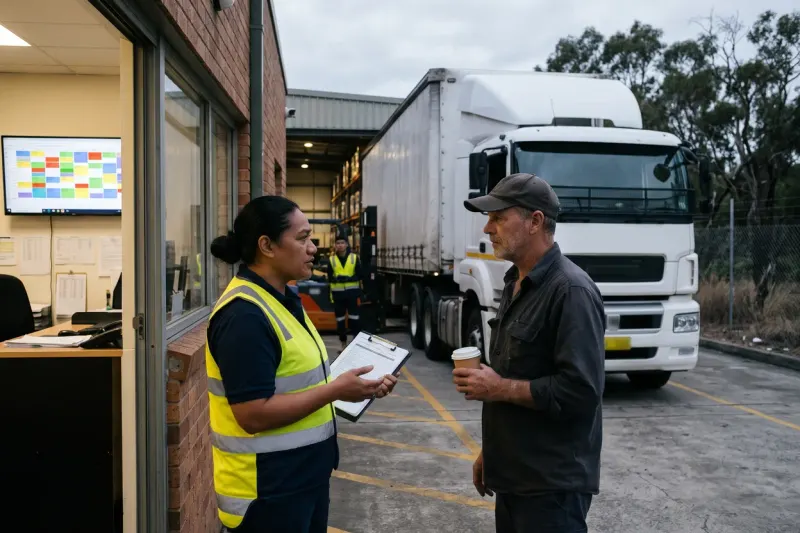
Emergency Evacuation Plan: A Guide for Distribution Centres
An emergency evacuation plan sets out how everyone at a workplace gets out safely and is accounted for. Under the model WHS Regulations it must cover emergency procedures, how often they are tested, and training, and in preparing it the business must have regard to the work, the hazards, the size and location of the workplace, and the people there.
 John McCannHead of Product
- Published
- 15 min read

When the alarm sounds in a distribution centre, the route out is rarely the problem. Exits are marked, wardens know the doors, and the walk out takes minutes. The problem starts at the assembly point, when the chief warden has to say whether everyone is out and is holding a roster, a labour hire list, a gatehouse clipboard, and a contractor book that do not agree.
This guide is for safety managers, WHS managers, and site managers in transport and logistics: distribution centres, cross-docks, cold stores, and depots. It covers what an emergency evacuation plan is, what Australian WHS law requires it to contain, why a distribution centre is harder to evacuate than an office, who does what on the day, how often to test the plan, and how to make the headcount honest. The example is an illustration, not a customer.
What Is an Emergency Evacuation Plan?
An emergency evacuation plan is the written set of procedures for getting everyone at a workplace to safety in an emergency and accounting for them once they are there. It says who raises the alarm, who does what, which routes and exits people use, where they assemble, how they are counted, who calls the emergency services, and how the plan is practised.
The words get used loosely, so it helps to separate three things. The emergency plan is the whole document, covering every kind of emergency the site could face. The evacuation procedures are the part of it that moves people out. The evacuation diagram is the map at each exit that shows people where they are and where to go. A diagram on the wall without the plan behind it tells people where the door is, and nothing about who checks that they came out of it.
In the WHS laws the document is called an emergency plan, and evacuation procedures are one of the things it must provide for. Whichever name you use, it is the same document.
Is an Emergency Evacuation Plan a Legal Requirement in Australia?
Yes, in the states and territories that use the model WHS laws. Under regulation 43 of the model WHS Regulations, quoted here from Queensland's version, a person conducting a business or undertaking at a workplace must ensure that an emergency plan is prepared for the workplace.1 The plan must provide for emergency procedures, including an effective response to an emergency, evacuation procedures, notifying emergency service organisations at the earliest opportunity, medical treatment and assistance, and effective communication between the person authorised to coordinate the emergency response and all persons at the workplace. It must also provide for testing of the emergency procedures, including the frequency of testing, and for information, training, and instruction to relevant workers in relation to implementing them.1
The same regulation says the plan must be maintained so that it remains effective, and implemented in the event of an emergency. In preparing and maintaining it, the business must have regard to all relevant matters, including the nature of the work, the nature of the hazards, the size and location of the workplace, and the number and composition of the workers and other persons at the workplace.1
NSW, where the example below is set, has remade its rules: SafeWork NSW says the Work Health and Safety Regulation 2025 (NSW) commenced on 22 August 2025. SafeWork NSW puts the duty plainly: it is a legal requirement that all workplaces have an emergency plan.23 Behind the regulation sits the primary duty in section 19 of the model WHS Act, quoted here from Queensland's Act: a person conducting a business or undertaking must ensure, so far as is reasonably practicable, the health and safety of workers it engages or causes to be engaged, and of workers whose work it influences or directs, and that the health and safety of other persons is not put at risk from its work.4 An emergency plan is one of the ways that duty is met for the day something goes wrong.
Victoria works differently, under its own Occupational Health and Safety Act 2004. WorkSafe Victoria's compliance code on workplace facilities says employers need to ensure that every workplace under their management and control has an emergency management plan; a compliance code is guidance, but following it counts as complying with the duties it covers.5
What an Emergency Evacuation Plan Must Include.
The regulation sets the minimum. The NSW-approved code of practice on the work environment and facilities adds that the plan must be based on an assessment of the hazards at the workplace, and gives examples of the types of emergency: fire or explosion, a dangerous chemical release, a medical emergency, a natural disaster, bomb threats, and violence or robbery.6 A plan that works on the day turns each of those into decisions with names against them.
The emergencies the site could face. At a distribution centre that means battery charging bays, chemical and aerosol stock, refrigerant or ammonia plant in the cold store, vehicle collisions in the yard, medical emergencies on a long shift, and severe weather. The plan says which ones lead to an evacuation and which to sheltering in place.
The response and the evacuation. Who raises the alarm and how, the routes and exits for each zone, what people do with plant and vehicles, and where they assemble. The site's safety management system should point to the plan rather than repeat it.
The emergency services. Who calls Triple Zero (000), who meets the fire brigade at the gate, and what they are handed: a site plan, the location of hazardous chemicals, and the names of anyone unaccounted for.
Medical help. First aiders on every shift, where the first aid kits and defibrillator are, and how an injured person in a freezer or on a mezzanine is reached.
Communication. How the chief warden talks to wardens across a building of several hectares, how the alarm reaches people wearing hearing protection, and how the yard and the roof are told.
Testing and training. How often the procedures are tested and how every shift is trained, covered in their own section below.
Who Does What When the Alarm Sounds.
The code of practice says that, where relevant, the procedures should address the allocation of roles and responsibilities to people with the right skills, for example by appointing area wardens, and should cover how alarms are activated and how staff and other people are alerted. It also names people who are easy to forget: the safety of everyone who may be at the workplace in an emergency, including visitors, shiftworkers, and tradespeople, and workers or others who will need special assistance to evacuate.6
At a distribution centre the roles that matter are these:
- Chief warden. Runs the response, decides whether to evacuate, meets the emergency services, and owns the count at the assembly point.
- Area wardens. One per zone per shift, with a deputy, sweeping the aisles, the freezer, the amenities, and the mezzanine before they leave.
- Yard controller. Stops every truck movement, clears the dock apron, and brings drivers to the assembly point by the walkway.
- Gatehouse. Holds the gate for fire appliances and brings the sign-in list to the chief warden.
- First aiders. Named on every shift, not only on days.
The code also says evacuation procedures should be displayed in a prominent place, and that workers must be instructed and trained in them.6 The code says the procedures should address, where relevant, the display of a site plan showing the location of fire protection equipment, emergency exits, and assembly points; a diagram at each exit is one way to do that.6
Why a Distribution Centre Is Harder to Evacuate Than an Office.
An office evacuation is mostly a walk. People stand up, follow the green signs, and gather on the footpath. A distribution centre has all of that and five things an office does not.
- Moving plant. Forklifts, reach trucks, and order pickers are in the aisles when the alarm sounds. An operator who simply jumps off leaves a machine in an aisle, forks raised, blocking the route everyone else needs.
- Trucks in the yard. Prime movers are reversing onto docks, drivers are in cabs or in the driver lounge, and the assembly point may sit across the same hardstand the trucks use.
- Noise and distance. Racking blocks sight lines, freezer rooms and mezzanines are closed off, and pickers wearing hearing protection may not hear a single siren.
- People who are not on your payroll. Labour hire pickers, a refrigeration technician on the roof, an electrician on a scissor lift, a racking inspector, a cleaner, and visiting drivers are all on site, and some of them have never practised your drill.
- Shifts. The people who were trained at the last drill may all be on the other shift.
Each of those is a line the plan has to answer in writing before the day it is needed. An emergency evacuation plan bought as a template for an office will not answer any of them.
Who Is on Site When the Alarm Goes?
At a site without one list, the honest answer is a guess. The roster says who should be on shift, the labour hire agency knows who it sent, the gatehouse has a clipboard of drivers, and contractors signed a book at reception, if they came through reception at all. At the assembly point a warden is trying to reconcile four lists from memory.
That is where an evacuation goes wrong: not on the route, but on the count. A warden who cannot say whether everyone is out either sends someone back into a building that may be on fire, or tells the fire brigade that everyone is accounted for when someone is still inside. The code's own checklist asks the question directly: is someone responsible for ensuring workers and others in the workplace are accounted for in the event of an evacuation?6
What we recommend: make one list the list. Every person who comes through the gate, whether staff, labour hire, contractors, drivers, or visitors, signs in to the same register and signs out of it when they leave. The warden takes that list to the assembly point, not the roster. If a person is on the list and not at the assembly point, they are missing, and the fire brigade is told who they are and where they were last working. Our guide to replacing a paper sign-in book covers how to make that switch at a gatehouse.
How Often Should You Test an Emergency Evacuation Plan?
The regulation sets no number. It requires the plan itself to provide for testing of the emergency procedures, including the frequency of testing, so the business sets the frequency itself, having regard to the nature of the work, the hazards, the size and location of the workplace, and the number and composition of the people there.1 The guidance does give a figure. The NSW-approved code of practice says the procedures should address regular evacuation practice drills at least every 12 months, and regular review of procedures and training.6 WorkSafe Victoria says the Australian Standard AS 3745-2010, Planning for emergencies in facilities, recommends an evacuation drill at least annually, and reminds readers that a standard is not law unless legislation adopts it.7
What we recommend for a distribution centre: treat once a year as the floor for the site, and aim for at least one drill on every shift each year, plus another after any change to how people get out, such as new racking, a new mezzanine, a new dock layout, or a new assembly point. Run some unannounced. Time how long it takes to account for the last person, not how long it takes the first person to reach the assembly point.
Review the plan after every drill and every real emergency, and write down what changed. The code says workers and their health and safety representatives must be consulted when the plan is reviewed and, if necessary, revised.6 A plan that has never changed after a drill has usually not been tested properly.
An Evacuation Worked Through at a Western Sydney Distribution Centre.
A third-party logistics provider runs an ambient and chilled distribution centre in Western Sydney for a grocery retailer. At 10:40am on a Tuesday the sign-in list shows 118 people on site: 71 staff, 29 labour hire pickers, 6 contractors, 9 visiting drivers, and 3 visitors from the retailer.
A forklift operator sees smoke from the battery charging bay and presses the manual call point. The alarm sounds through the building and the yard.
The plan has already decided what happens next. Forklift operators lower their forks, park clear of the aisle and any exit, apply the brake, turn the key off, and walk to the nearest exit. The yard controller stops all truck movements and sends drivers from the dock and the driver lounge to the assembly point along the marked walkway, not across the dock apron. Wardens sweep their zones, including the freezer and the amenities, and the chief warden goes to the assembly point beside the main gate, where the fire brigade will arrive.
At the assembly point the chief warden opens the on-site list on a phone. Within 8 minutes, 116 people are checked off. Two are not. One is a retailer visitor who left at 10:20am without signing out; reception saw her go, and the chief warden marks her off site. The other is a linehaul driver who signed in at the gatehouse at 9:05am, dropped a trailer, and went to the holding bay to take a rest break in the sleeper berth of his prime mover. The chief warden tells the fire brigade that a driver is in a truck in the holding bay, gives them the registration and his mobile number, and sends the yard controller to the cab. The driver is found asleep, having heard nothing.
The safety manager also checks whether the fire has to be reported. Under the WHS Act, quoted here from Queensland's, an uncontrolled fire that exposes a worker or any other person to a serious risk to health or safety from an immediate or imminent exposure to it is a dangerous incident, and the business must ensure that notice is given to the regulator immediately after becoming aware that a notifiable incident arising out of the conduct of the business or undertaking has occurred.4 In NSW that means SafeWork NSW.
The debrief turns the two gaps into four changes: the holding bay added to the yard controller's sweep, a strobe at the holding bay, drivers asked at the gatehouse for a mobile number and where they will rest, and visitors signed out at reception rather than left to sign themselves out. None of those came from a template. All of them came from running the plan against the list. Our guide to fatigue management explains why drivers resting in their cabs on site are a normal part of a logistics day, not an exception.
Shared Sites, Tenants, and Neighbours.
If your distribution centre sits on a logistics estate, it shares roads, gates, and walls with its neighbours. Each business has its own duty to ensure there is an emergency plan. Under section 46 of the WHS Act, where more than one person has a duty in relation to the same matter, each must, so far as is reasonably practicable, consult, cooperate, and coordinate activities with all the other persons who have a duty in relation to the same matter.4
The guidance goes further on who leads. The facilities code says the plan for a workplace shared by a number of businesses should be coordinated by the person with management or control of it, such as the property manager, principal contractor, or landlord, in consultation with all the tenants.6 SafeWork NSW names business estates among shared workplaces and suggests a master emergency plan for the tenants.3 The NSW-approved consultation, cooperation, and coordination code gives emergency plans and procedures as an example of what a landlord or managing agent should coordinate with commercial tenants.8
In practice that means agreeing in writing whose alarm triggers whose evacuation, which assembly points belong to whom, how shared roads are kept clear for fire appliances, and who tells the neighbour when your cold store has an ammonia leak. Our guide to the duty to consult, cooperate, and coordinate covers the rest of that duty.
An Emergency Evacuation Plan Checklist for Distribution Centres.
Use this to check your plan against the site, not against a template. Each of the 12 lines should have an answer in writing, with a name against it.
- The emergencies. Fire, a chemical spill or gas leak at the charging bay or chemical store, a refrigerant or ammonia leak in the cold store, a vehicle collision in the yard, a medical emergency, a bomb threat, and severe weather.
- The warning. How the alarm reaches every zone, including freezers, the roof, the yard, and people wearing hearing protection.
- Plant and vehicles. What forklift operators do with their machines, and who stops truck movements in the yard.
- Routes and exits. Primary and secondary exits for each zone, kept clear of pallets and stock, and shown on diagrams at the exits.
- The assembly point. Somewhere people can reach without crossing a truck route, with a second one if the first is downwind of the emergency.
- The count. One sign-in list covering staff, labour hire, contractors, drivers, and visitors, taken to the assembly point by a named warden.
- The wardens. A chief warden and wardens for every zone on every shift, with a deputy for each.
- People who need help. Anyone who would need help to evacuate, with an individual plan agreed with them.
- The emergency services. Who calls Triple Zero (000), who meets the brigade at the gate, and what they are handed.
- Neighbours and tenants. Who on a shared estate tells whom, and whose alarm triggers whose evacuation.
- The tests. How often each shift drills, who observes, and how lessons reach the plan.
- The review. After a drill, after an incident, after a change to the building or the work, and on a fixed date, with workers consulted.
Keeping the Sign-In List Honest in ComplyFlow.
The count is only as good as the sign-out, and ComplyFlow does not run the evacuation for you. What its site access gives the warden is the list. Each sign-in point at a site has its own QR code, which people scan, or they sign in through the Live Access app, and every sign-in and sign-out is recorded in the Sign In Book, giving the site a live register of who is on site. Evacuation diagrams can be among the site documents that staff and contractors see when they sign in; site documents are not shown at visitor sign-in.9 Visitors can sign in with the same QR code, where the sign-in point allows visitor sign-in.10 The Live Access dashboard's list view shows every signed-in staff user, worker, and visitor, with manual sign-out of workers and staff for forgotten sign-outs, and a CSV export.11 How the warden uses that list at the assembly point is for your plan to decide.
Run the Next Drill Against the List, Not the Roster.
Pick one shift this month and run an unannounced drill. Before anyone walks out, open the sign-in list for that moment. At the assembly point, check every name against it, including the drivers in the yard and the contractor nobody mentioned, and time how long it takes to account for the last person. Then change one line of the plan because of what you found. To see staff, contractors, drivers, and visitors on one list across every site, book a demo.
Sources
- Work Health and Safety Regulation 2011 (Qld), section 43
- Legislation (WHS Regulation 2025)
- Emergency plans
- Work Health and Safety Act 2011 (Qld)
- Workplace facilities and the working environment compliance code, Edition 1
- Code of Practice: Managing the work environment and facilities
- Office health and safety: A guide for employers
- Code of Practice: Work health and safety consultation, cooperation and coordination
- Live Access Sign-In Options: Confirmation Sets, Site Inductions and Site Documents
- QR Code Visitor Site Sign in
- Live Access Dashboard
See It Against Your Own Contractors, Sites & Rules.
Book a 30-minute demo. We will show ComplyFlow working with your kind of sites, your kind of contractors, and your requirements. No slides, no hard sell.
Or Speak to Us
- ISO 27001
- Hosted on AWS
- Microsoft & Okta SSO
- API & MCP
- Data in Australia
Written by
John McCannHead of Product, ComplyFlow
John has led ComplyFlow’s product since 2021, including its AI document review, its AI agents, and its MCP server. He writes about what AI can and cannot be trusted to do in safety and compliance work, from building it.
Writes about: AI in compliance, Product and integrations, Data and reporting
Questions
Questions People Ask About This.
Is an evacuation diagram the same as an emergency evacuation plan?
No. The diagram is the map on the wall at each exit, showing where you are, the exits, the fire equipment, and the assembly point. The emergency plan is the whole document: the procedures for each kind of emergency, who does what, how people are accounted for, how the procedures are tested, and the training people get. The diagram is one way of putting part of the plan in front of people.
Do contractors and visitors need to be included in an emergency plan?
Yes. The model WHS Regulations require the business, in preparing the plan, to have regard to the number and composition of the workers and other persons at the workplace, and the NSW-approved code of practice says the procedures should address the safety of everyone who may be there, including visitors, shiftworkers, and tradespeople. In practice they are told what to do when they arrive, and they appear on the list used at the assembly point.
Who writes the emergency plan when several businesses share a site?
The person who manages or controls the site should coordinate it. The NSW-approved code of practice Managing the work environment and facilities says the plan for a shared workplace should be coordinated by the person with management or control of it, such as the property manager, principal contractor, or landlord, in consultation with all the tenants. Each tenant still has its own duty to ensure there is an emergency plan for its own workplace, and on a shared logistics estate each business with a duty in relation to the same matter must, so far as is reasonably practicable, consult, cooperate, and coordinate with the others.
What should forklift operators do when the evacuation alarm sounds?
Whatever the plan says, and it should say it plainly. A workable rule, and the one in this guide's worked example, is to lower the forks, park clear of the aisle and any exit, apply the brake, turn the key off, and walk to the nearest exit. A machine abandoned in an aisle with its forks raised blocks the route for everyone else, so this is worth practising at every drill.
What records should we keep of evacuation drills?
The plan must provide for testing and be maintained so that it remains effective, and your records are how you show both. For each drill, keep the date and shift, the scenario, who observed, how long it took to account for the last person, anyone not accounted for and why, and what changed in the plan as a result, with the revised plan's date. Keep warden and first aider training records beside them.
Can we write the emergency plan ourselves?
Yes, and the people who run the site are well placed to, because in preparing the plan the business must have regard to its work, its hazards, the size and location of the site, and the people there, which a template cannot see. Outside help earns its place for a fire engineer's view of the building or for training wardens. The decisions in this guide's checklist still need names from your own site.
Keep Reading