Contractor Management Software for Facilities Management
Contractor management software for facilities management checks every trade against the requirements of the building they are about to work in, before they start, and keeps the proof by building for the owner. Across a property portfolio it has to handle different owners' standards, tenants' contractors, after-hours sign-in at unmanned buildings, and the asbestos register, and it works beside the CAFM system that raises the job rather than replacing it.
 Bart CrowtherDirector of Sales
 - Published
- 11 min read
A facilities manager does not run one workplace. They run 20, or 200, each owned by someone else, each with tenants whose own trades come and go, and most of them empty after 6pm. A contractor process built for a single construction site or a factory gate assumes a workplace the facilities manager does not have.
This post sets out what a property portfolio asks of contractor management software, starting with who carries the legal duty when a trade works on a building you manage. It ends with five tests to put to any system, including the one most demos skip: a trade arriving at an unmanned building at 7pm.
Who Carries the Duty When a Trade Works on a Managed Building?
Usually several businesses at once, and none of them can hand the duty to another. Safe Work Australia's own example of a workplace with many duty holders is a multi-tenanted shopping centre: the owner, the centre manager, each shop, and the cleaning, security, and trolley businesses are all separate persons conducting a business or undertaking.1
Under the model WHS Act, a contractor, a subcontractor, and a contractor's employee are all workers of the business they carry out work for.2 A business with management or control of a workplace must also ensure, so far as is reasonably practicable, that the workplace, the means of entering and exiting it, and anything arising from it are without risks to the health and safety of any person.2 In the worked example in Safe Work Australia's code of practice on consultation, lift maintenance in an office block, it is the building owner and the property manager who hold duties as persons with management or control of the building.3
Three rules then shape everything a facilities team does with contractors. A duty cannot be transferred to another person.2 Where several businesses share a duty, each discharges it to the extent it has the capacity to influence and control the matter, or would have had that capacity but for an agreement or arrangement that tries to limit or remove it. A contract cannot shrink the duty.2 And each must, so far as is reasonably practicable, consult, co-operate, and co-ordinate with the others who share it.2 Safe Work Australia's fact sheet on contractual chains puts the consequence plainly: WHS duties cannot be contracted out to another party, such as a subcontractor.4
Victoria runs its own Occupational Health and Safety Act 2004 instead of the model WHS Act. WorkSafe Victoria says the person who manages or controls a workplace can include the building or site owner and the property management of a building,5 and that person must ensure the workplace, including entering and exiting it, is safe and without risks to health so far as is reasonably practicable.6
Why a Property Portfolio Breaks the Usual Contractor Process.
Most contractor processes grow up around one site with one gate and someone standing at it. A portfolio of managed buildings breaks that in five ways, and each one is a place where a spreadsheet or a sign-in book quietly stops working.
The first is owners. An FM company may run buildings for several owners, and each owner can set its own list of what a trade must hold before starting work. When the list lives in a spreadsheet per building, one electrician's documents are checked several times over, the versions drift apart, and nobody can say which copy is current.
The second is tenants. A tenant's fit-out crew works on your floors and uses your lifts, your loading dock, and your fire stairs. Safe Work Australia's code says a landlord or managing agent should consult, cooperate, and coordinate with commercial tenants, and with a contractor carrying out maintenance or repair work.3 Its worked example is a property manager who, before lift maintenance, consults the maintenance contractor, the tenants, and the cleaning contractor so each knows what they need to do.3
The third is the empty building. A great deal of property maintenance happens outside business hours, when nobody from the building team is on site. WorkSafe Tasmania's guidance says the contract with a contractor should include the requirement for contractors to tell you when they are on site.8 At an unmanned building, that has to happen without a person there to tell.
The fourth is that the job and the trade are different records. The CAFM or maintenance system raises a work order and tracks the asset. Nothing in the work order proves the technician who turns up is licensed, insured, and cleared for that building.
The fifth is change. FM contracts move between providers, and the records have to move with them. When management or control of a workplace changes, the model regulations require the outgoing party, so far as is reasonably practicable, to give the asbestos register to whoever takes over.7
A Fire Services Call at 7pm: What Gets Checked and What Gets Kept.
Take an office tower in Parramatta, built in the 1980s and managed by an FM company for an institutional owner. At 6.40pm a fault on the fire indication panel raises a work order in the CAFM system, and the fire services contractor sends a technician. The building manager left at 5.30pm. The fault traces to a detector in a ceiling void on level 9.
Before the technician starts, three duties are live. The owner and the FM company, each to the extent it manages or controls the building, have to ensure so far as is reasonably practicable that the building and anything arising from it are without risk.2 The asbestos register duty applies to buildings whenever constructed, with an exemption only for a building constructed after 31 December 2003 where no asbestos has been identified and none is likely.7 The register must be readily accessible to a business that carries out work at the workplace, and a copy must go to any business whose work involves a risk of exposure to airborne asbestos.7 A ceiling void in a 1980s tower is exactly where that question comes up.
This building's own rules add one more: no fire detection zone is isolated without an isolation permit, so a fault or a test does not send the fire brigade out, and the zone goes back into service afterwards.
On paper, the evening goes like this. The technician collects the after-hours key from the lockbox, lets themselves in, and writes a name in the sign-in book at the loading dock. The isolation permit is a carbon pad in the building manager's office, so the zone is isolated without one. The asbestos register is in a folder in the building manager's office, which is locked. Nobody checks whether the fire contractor's insurance renewed last month. By morning the job is closed in the CAFM system, and the only record that the technician was in the ceiling void is a line in a book.
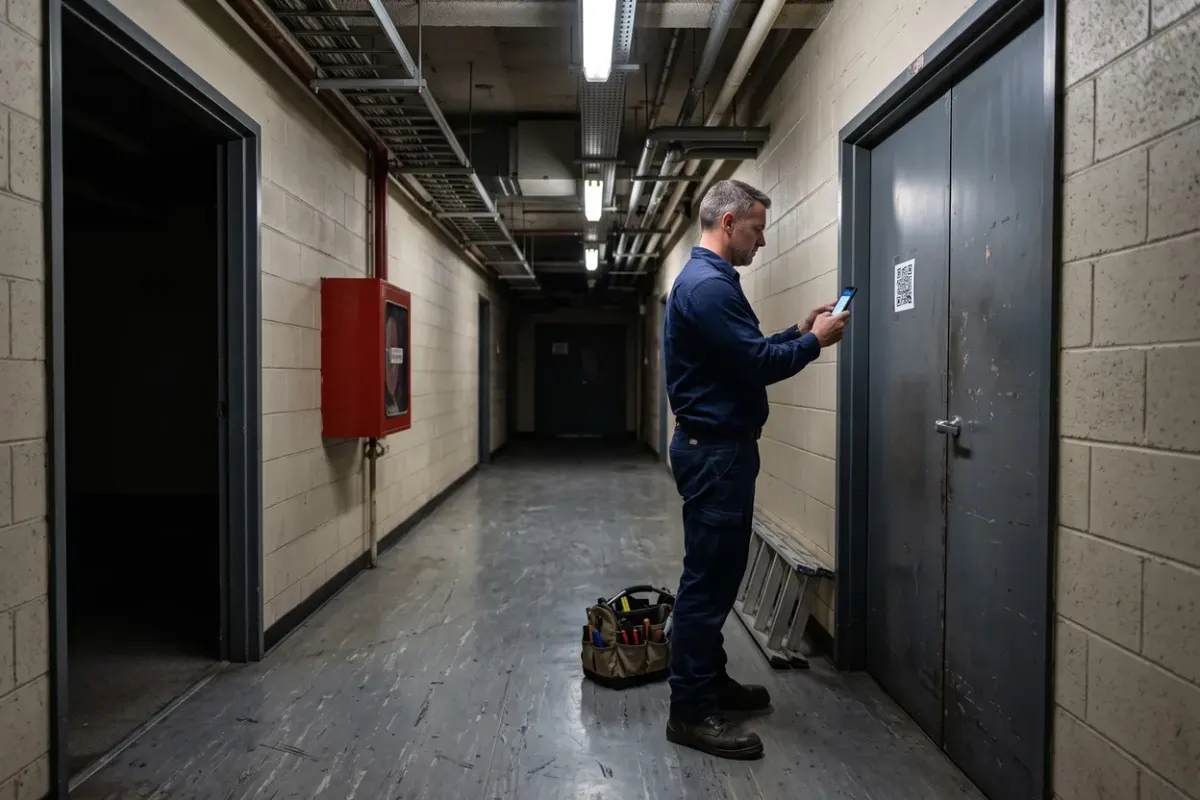
With a system, the technician scans a QR code at the dock. The check runs against this building's requirements rather than a generic list: the company's insurance current, the technician's own licences and documents current, and whatever else this owner asks of a trade. Cleared, they go in. Not cleared, they do not, and the after-hours contact sees why on their phone. The asbestos register for level 9 is shown at sign-in, the isolation permit is raised on the phone and closed when the zone is restored, and the technician has both before touching a ceiling tile.
What gets kept is the part that matters months later: who arrived, when, what they held at that moment, what they were given, and when they left. When the owner asks which trades worked in that ceiling void this year and whether each was cleared, one answer is a hunt through a book and the other is a search.
What Should Contractor Management Software Do for a Facilities Manager?
It should check every trade against the requirements of the building they are about to enter, at the door, whether or not anyone is there, and keep the proof by building. Everything else follows from those two jobs.
It starts with one standard for the portfolio, with extra requirements per building and per owner laid on top. The trade uploads each document once, and each building measures it against its own list. The trade keeps its own insurances, licences, and qualifications current and is reminded before anything runs out, so nobody on the facilities team sends the chasing email. WorkSafe Tasmania expects a business to ask for evidence of workers' safety qualifications, licences, and certificates when choosing a contractor.8 For high risk work the check is law under the model WHS Regulations: a business must not direct or allow a worker to carry out high risk work that needs a licence unless it sees written evidence of that licence.7
The check at the door has to work unattended. That means site access and sign-in on the trade's own phone, a clear answer before they start, and a live list of who is in each building, which is also the roll call if the building is evacuated. Tenants' contractors should come through the same door against the same building requirements, so there is one list rather than two.
The record has to be searchable by building and by owner: who was on site, what they held on the day, and which corrective actions are still open. Safe Work Australia also calls it good practice to keep a record of consultation between businesses sharing a duty,4 such as the note that the owner, the tenant, and the lift contractor agreed how Saturday's shutdown would run. It belongs on the same building record as the sign-ins.
Where a building has electronic access control or key cabinets, the contractor record should feed them, so a card or a key only goes to a trade who is cleared. Otherwise the door and the record disagree, and the door wins.
For the questions to put to any vendor, whatever the industry, 10 questions for contractor management software, and the answers that should worry you covers the ground. The tests below are the ones a portfolio adds.
Five Portfolio Tests to Run in Any Demo.
A generic demo shows one contractor arriving at one site. A portfolio needs to see these five, on your own buildings, with the vendor driving.
- The two-owner test. One electrician, two buildings, two owners with different requirements. The documents go in once. Does each building give its own answer, and can the electrician see what is missing for which building?
- The 7pm test. An unmanned building and a trade whose insurance lapsed yesterday. What happens at the door, who is told, and what does the record show the next morning?
- The tenant test. A tenant's fit-out contractor who has never been on your panel. How are they cleared for your floors, and do they appear on the same live list as your own trades?
- The handover test. A new building joins the portfolio next month with its trades and its asbestos register. How do they come across, and how long before the first sign-in is checked?
- The owner's audit test. Pick one building and ask for every trade on site last quarter, what each held on the day, and which actions are still open. Time it.
A system that passes all five on your own data is worth a trial. If a vendor would rather show a different scenario, that is worth noting too.
Does Contractor Management Software Replace a CAFM System?
No. A CAFM or maintenance system raises and tracks the job: the work order, the asset, and the service schedule. Contractor management software answers a different question, which is whether the person turning up to do that job is cleared for this building today. The two should be connected, so the system that raises the job can see whether the trade is cleared, but neither does the other's work.
That distinction matters when reading lists of the best facility management software. Those lists rank maintenance, bookings, and asset systems, and most give contractors a line. Contract management software is a third category again: it stores the legal agreements with suppliers, not a record of the trades who arrive. A facilities manager usually needs a maintenance system and a contractor system, and should judge the second on the portfolio tests above rather than on the first one's feature list.
How ComplyFlow Handles a Property Portfolio.
ComplyFlow is contractor management software. Australian Catholic University brought contractor management for its Facilities Management team into one system with it in 2015, from invitation and prequalification to document approvals and expiry notices, integrated with its Access ID system, its help desk, and its purchase order systems. Read the ACU story. CBRE, a client since 2011, automated its internal and third-party audits across its portfolio, replacing spreadsheets kept at each site. Read the CBRE story.
Requirements are set once as a bundle, and ComplyFlow sends the invitations, the reminders, and the renewals when a document expires.9 Extra document requirements can be assigned to a single site, so one building can ask for more than another.10 Each sign-in point has its own QR code, and documents assigned to the site can be shown and downloaded at sign-in, so a building can put its asbestos register there, with what was displayed logged in the sign-in book export.11 Contractors sign in with their own phone camera, and the property team sees every site's sign-ins live on one dashboard.12 Data is hosted on AWS in Australia, ComplyFlow has been ISO 27001 certified since 2019, and it connects to property management systems and to key cabinets through its API and partners.13
Run the 7pm Test Before Anything Else.
Pick one building in the portfolio, ideally the oldest one with the least cover after hours. Ask what would happen tonight if a trade with lapsed insurance arrived at 7pm to work in a ceiling void. Who would know, what would they be given, and what would the record show tomorrow?
If the honest answer is a sign-in book and a locked folder, that building is where contractor management software earns its keep first. It is also the scenario to hand every vendor you talk to, because it is the one a property portfolio lives with every night.
Sources
- What is a person conducting a business or undertaking
- Model Work Health and Safety Act
- Model Code of Practice: Work health and safety consultation, cooperation and coordination
- Fact sheet: WHS duties in a contractual chain
- General duties relating to health and safety
- Summary of the OHS Act 2004: general OHS duties
- Model Work Health and Safety Regulations
- Contractor management
- Onboarding Requirements
- Compliance Requirements, Training Requirements and Site Contact
- Live Access Sign-In Options: Confirmation Sets, Site Inductions and Site Documents
- Live Access Dashboard
- Platform Architecture and Hosting
See It Against Your Own Contractors, Sites & Rules.
Book a 30-minute demo. We will show ComplyFlow working with your kind of sites, your kind of contractors, and your requirements. No slides, no hard sell.
Or Speak to Us
- ISO 27001
- Hosted on AWS
- Microsoft & Okta SSO
- API & MCP
- Data in Australia
Written by
Bart CrowtherDirector of Sales, ComplyFlow
Bart leads sales at ComplyFlow and spends his week with the safety, procurement, and facilities teams deciding how to manage contractors. He writes about what buyers ask, and what separates a system that gets used from one that gets ignored.
Writes about: Choosing a compliance system, Rollout and adoption, What buyers ask
Questions
Questions People Ask About This.
Does a facilities manager have to keep an asbestos register for every building?
The duty sits with whoever has management or control of the workplace. Under the model WHS Regulations the register applies to buildings whenever constructed, except a building constructed after 31 December 2003 where no asbestos has been identified and none is likely. The register must be readily accessible to businesses that work there, a copy must go to any business whose work involves a risk of exposure to airborne asbestos, and, so far as is reasonably practicable, it must be handed to whoever takes over management or control.
Do our tenants' contractors have to meet the building's requirements?
The owner, the manager, and each tenant can all hold duties for the same building, and the model WHS Act requires duty holders who share a matter to consult, cooperate, and coordinate so far as is reasonably practicable. Safe Work Australia's code of practice says a landlord or managing agent should do this with commercial tenants. Putting tenants' trades through the same sign-in and requirements as your own panel gives one record of who is in the building.
Does this apply to property in Victoria?
Yes, under Victoria's Occupational Health and Safety Act 2004 rather than the model WHS Act. Employers owe independent contractors and their employees the same duty as their own employees for matters they have, or should have, control over (section 21), and a person who manages or controls a workplace must ensure it is safe so far as is reasonably practicable, including entering and exiting it (section 26). WorkSafe Victoria says that person can include the building owner and the property management.
Can one trade's documents count across buildings for different owners?
In a contractor management system that sets requirements per site, yes. The trade uploads each document once, and the extra requirements assigned to each building decide whether they are cleared there, so a building that asks for more gives a different answer from one that asks for less. On ComplyFlow a Worker licence is AU$35 a year* per Worker and is valid with every Client on ComplyFlow.
What should a facilities manager ask to see in a first demo?
Your own buildings, not the vendor's example site. Ask to see one trade checked against two buildings with different owners' requirements, a trade with lapsed insurance arriving at an unmanned building after hours, a tenant's contractor being cleared, a new building brought across with its trades, and a report of every trade on one site last quarter with what each held on the day.