Permit to Work System: How It Works & When the Law Requires One
A permit to work system is a written process for authorising high-risk work: a competent person checks the hazards and controls, issues a permit for a set job, place, and time, and signs the area back once the work is done. The model WHS Regulations require one outright only for confined space entry; for hot work and roof access, codes of practice and regulators recommend one.
 Mitchell BourneManaging Director
- Published
- 11 min read
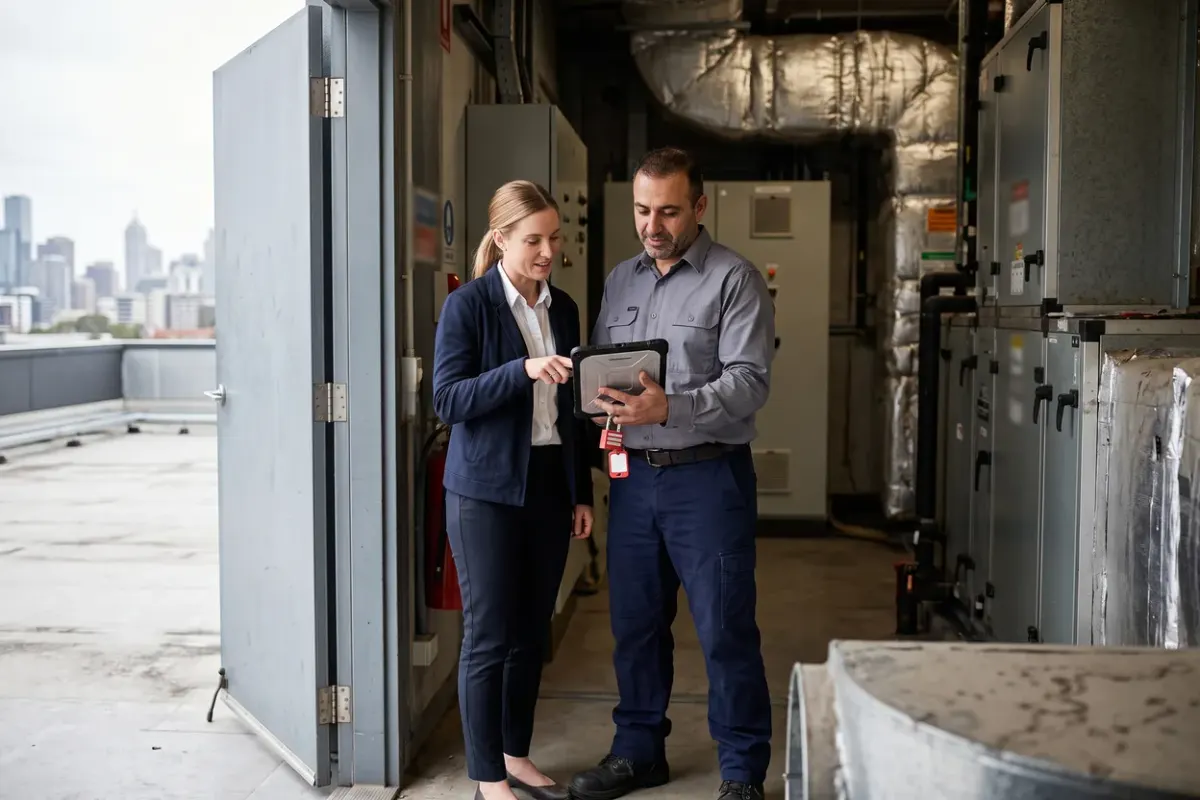
A permit to work is the moment a business says yes to a dangerous job, in writing, with its name on it. Done properly, it is the last check that the plant is isolated, the space is safe, and the right people know the work is happening. Done badly, it is a form signed on a car bonnet that nobody reads again.
This guide is for the operations managers and facilities managers who issue permits or sign them off. It covers what a permit to work system is, which jobs need one, what Australian law actually requires, and how a permit should run from request to hand-back. The examples come from an office building in property and facilities management and a distribution centre in transport and logistics. They are illustrations, not customers.
What Is a Permit to Work System?
A permit to work system is a written process for authorising high-risk work before it starts. A competent person checks the hazards and the controls, issues a permit for a defined job, place, and period, and signs the area back into normal use when the work is finished. The system is the whole cycle, not the form.
Safe Work Australia describes the confined space version in terms that fit every permit: it provides a formal check that all elements of a safe system of work are in place before people go in, and a means of communication between site management, supervisors, and those doing the work.1 The nationally recognised training unit for issuing permits puts the same idea in plain words: it covers understanding the permit system and the limits of each permit, and deciding when a permit is needed and how it is used.2
Permits sit low on the hierarchy of control. Safe Work Australia's electrical code lists the use of permits as an administrative control, and its risk code says administrative controls are the least effective because they rely on human behaviour and supervision, so they should be used only as a back-up to higher-level controls, as a short-term measure, or as a last resort.34 A permit that says "isolate the pump" does nothing until someone locks the isolator.
Is a Permit to Work a Legal Requirement in Australia?
For confined spaces, yes. For most other work, no, though codes of practice and regulator guidance recommend one for some high-risk jobs, and Victoria requires permit to work systems for one kind of electrical isolation. We searched the full text of the model WHS Regulations as at 5 December 2025: the only permit they require outright is the confined space entry permit, and the phrase "permit to work" appears once, as the last option for controlling access to automatically energised plant.5
Under regulation 67, a business must not direct a worker to enter a confined space to carry out work unless it has issued a confined space entry permit for the work.5 The permit must be completed by a competent person and be in writing; specify the space, the names of the people permitted to enter, the period of the work, and the risk controls; and contain space to acknowledge that the work is complete and everyone has left.5 Regulation 77 requires a copy to be kept at least until the work is completed and, if a notifiable incident occurs in connection with the work, for at least 2 years after the incident.5
Every state and territory except Victoria has implemented the model laws as its own law, and some have made variations.6 Victoria's OHS Regulations have their own confined space entry permit under regulation 63, and go further than the model in one place: regulation 114 requires appropriate permit to work systems to avoid inadvertently energising plant that has been isolated but not physically disconnected from the electrical supply.7
Outside confined spaces, a permit is one way a business can show it controlled a high-risk job so far as is reasonably practicable. Courts may rely on an approved code of practice to decide what was reasonably practicable.6 The model codes describe permits as an administrative control for confined spaces and electrical work, and recommend a hot work permit for welding in hazardous areas; the plant code describes lock-out and tag-out without mentioning permits.3810
Which Jobs Need a Permit to Work?
A job needs a permit to work when its controls must be in place, and confirmed by someone other than the person doing it, before anyone starts, and when a mistake would be hard to undo. The national training unit lists the common permit types: cold work, excavation, vehicle entry, minor repairs, working at heights, hot work, confined space, electrical, and increased hazard permits.2 In a building or a warehouse, that usually means:
| Work | Why it needs a permit | Example |
|---|---|---|
| Confined space entry | Required by law under the model Regulations | A stormwater pit, a fire water tank, a sewage pump well |
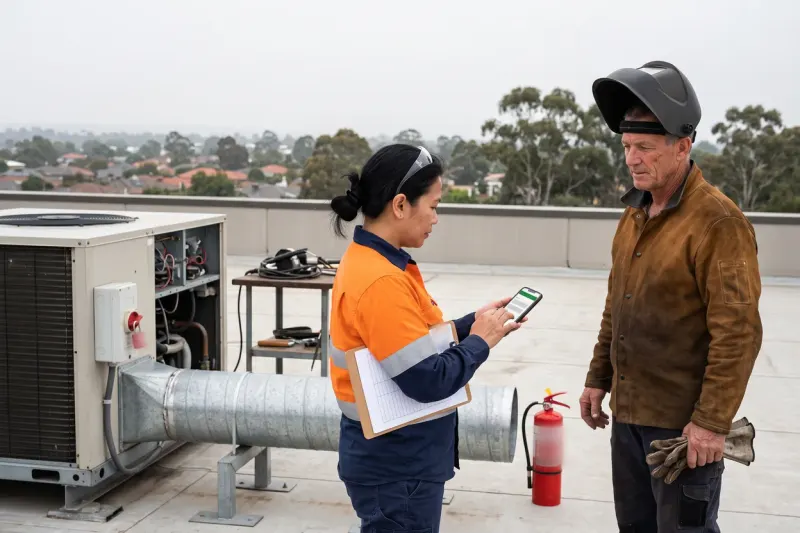
| Hot work | Fire risk beyond the work area, often hours later | Welding a handrail, cutting a beam, grinding near a dock |
| Electrical isolation | Plant must stay dead while someone works on it | A switchboard upgrade, a dock leveller repair |
| Plant and mechanical isolation | Stored energy and unexpected start-up | A conveyor, a chiller, a lift motor |
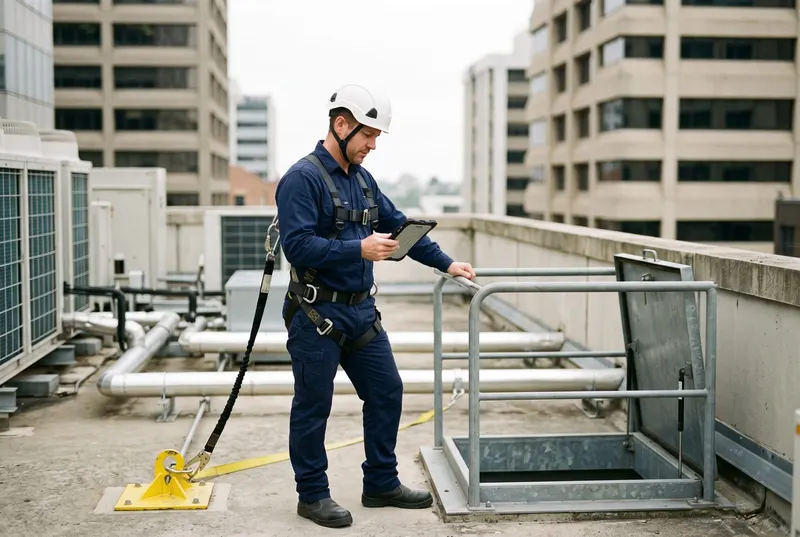
| Roof and height access | Falls, fragile roofs, and edges | Roof plant servicing, gutter work, skylight cleaning |
| Penetrations and excavation | Hidden services | Core drilling a slab, digging near a fence line |
The test is not the trade. It is whether the job needs a pre-condition someone else must confirm, such as a fire panel isolated, a forklift route closed, or a supply locked off, before work can safely begin.
What Is a Hot Work Permit?
A hot work permit authorises work that can create an ignition source, such as welding, cutting, grinding, or brazing, in a specific place for a specific period, after the fire risks around it have been removed or controlled. The model WHS Regulations do not require one by name.5 Safe Work Australia's welding code says that when welding in a hazardous atmosphere or hazardous area that is not a confined space, you should still document procedures that include the issue of a hot work permit.8
New South Wales is blunter. SafeWork NSW's hot work alert says that before any hot work on site it is essential to implement a hot work permit system, including a detailed review to identify hazards and eliminate them or, where that is not reasonably practicable, control the risks.9 Its list of controls is a ready-made permit checklist: identify and remove combustibles or cover them, protect and if reasonably practicable isolate services, have firefighting equipment ready, use a fire watch person, secure the area with signage, and check for smouldering material before leaving at a break, the end of a shift, or completion.9
The alert's own example shows why the last step matters: in February 2018, plastic mesh screening on a demolition site caught fire during oxy cutting, and about 20 people were treated for smoke inhalation.9 In an occupied building, a smouldering fire found an hour later is worse.
The Six Stages of a Permit, From Request to Hand-Back.
The training unit's six elements are a sound skeleton for any permit system.2
- Request. The contractor or supervisor describes the job, the place, the people, the time, and the equipment. Identifying the need for a permit is the first decision.
- Prepare the site. Isolations applied and locked, the area barricaded, the atmosphere tested where needed, combustibles removed, and other businesses in the space told.
- Issue. The issuer checks the preparation against the permit's conditions, sets the validity period, and has the person in charge of the work sign to accept the conditions.
- Monitor. The permit is displayed at the work, checked during the job, re-validated when conditions change, and withdrawn if they become unsafe.
- Shift change. Open permits and suspended ones are handed over to the next shift, with their status, rather than left for someone to discover.
- Close and hand back. The work is checked against the permit, isolations are removed by the people who applied them, everyone is accounted for, and the area is signed back into normal use.
Stage 5 is the one paper systems lose. A permit issued on day shift and still open at 2am is how a night crew re-energises plant someone is still working on.
What a Permit Must Show.
For a confined space, the law sets the minimum, listed above. For every other permit, Safe Work Australia's sample confined space permit is a good template to borrow from.1 A working permit records:
- the job, the exact location, and the permit type;
- the isolations required, with confirmation that locks and tags are on each isolation point;
- any atmospheric test results, and the fire controls where hot work is involved;
- the protective equipment, barricades, signage, and standby or fire watch person;
- the emergency arrangements;
- the issuer's authority and a valid-until date and time;
- the names of the people working under it, signing on and off;
- the hand-back: all people and equipment accounted for, and the area returned to service.
Isolation detail deserves its own care. Safe Work Australia's plant code says the lock-out process is the most effective isolation procedure, that each worker should have a lock, tag, and key for each isolation point, and that a tag should not be used on its own because only a lock is effective in isolating the energy source.10
A Permit Is Not a SWMS.
The two are often confused, and a contractor may hand you one when you asked for the other. A safe work method statement is required before high-risk construction work starts, such as work in or near a confined space or near energised electrical installations, and it describes the hazards, the controls, and how they will be implemented, monitored, and reviewed.5
The SWMS is the contractor's plan for how the work is done. The permit is the site's authorisation for this job, at this place, for this period, once the site has been made ready. A good permit refers to the SWMS and checks it matches the job on the day; it does not replace it. Our SWMS review checklist covers what to check in the statement itself.
Two Permits, Worked Through.
Hot work beside a fire panel in an office tower. A building services contractor needs to weld a new bracket for ductwork in a level 12 riser, 3 metres from a fire detection loop. The contractor requests a hot work permit through the facilities coordinator the day before. Preparation means removing stored cardboard from the riser, covering the cable tray, arranging with the fire services contractor to isolate the detectors in that zone only for the agreed hours, and telling the tenant on level 12 and the night cleaners. The coordinator issues the permit at 7am with a fire watch named, sees it displayed at the riser door, and at 11am, after the post-work check finds nothing smouldering, closes it and confirms the detectors are back in service. The detector isolation is the easiest step to leave open; the permit is what makes someone check it.
A dock leveller repair at a distribution centre. A mechanical contractor is booked to replace a hydraulic ram on the leveller at door 6. The shift manager raises an isolation permit: the leveller's power locked off at its isolator with the technician's own lock, the hydraulic pressure released, the door closed and the dock plate chocked, and door 6 taken out of the yard schedule so no truck reverses onto it. The carrier booked for door 6 is moved to door 9 and told why. The technician signs on, and when the job is done removes his own lock, tests the leveller with the shift manager watching, and both sign the hand-back.
In both cases the permit did not make the work safe. It made sure the people who could make it safe had done so before the work started, and it told everyone else in the building or the yard that the work was happening. That second job is the duty to consult, cooperate, and coordinate with the other businesses in the space, in practice.
Paper or Digital Permits?
The model Regulations require a confined space permit to be in writing and do not say it must be on paper.5 Paper fails in predictable ways: permits that cannot be found at shift change, signatures from people who were not there, and no way of seeing every open permit on a site at once. Our guide to moving from paper to digital permits covers what changes when you switch.
In ComplyFlow's digital permits, a permit has a type, sites, an expiry, and a permit holder, and each section can have its own reviewer, so the person who can judge an isolation approves that part.11 Supervisors can approve or reject a permit on their phone in the Live Access app, with a comment, and the person who submitted it is notified.12 Contractors sign into an active permit, and an area supervisor can see who is signed in and confirm each sign-out.13
Start With the Three Jobs That Worry You Most.
List the three jobs on your sites that would hurt someone fastest if a control were missed. For most buildings that is roof access, hot work, and electrical isolation; for most warehouses it is dock equipment, racking repairs, and anything on the roof. Write the permit for those three first, with the hand-back as carefully designed as the issue, and test each one on the next job before adding more. A short permit people use beats a long one they sign without reading. To see permits, isolations, and sign-ins on one record, book a demo.
Sources
- Confined spaces: Code of Practice
- MSMPER300 Issue work permits (Release 2)
- Managing electrical risks in the workplace: Code of Practice
- How to manage work health and safety risks: Code of Practice
- Model Work Health and Safety Regulations (as at 5 December 2025)
- Model WHS laws
- Occupational Health and Safety Regulations 2017 (Vic), version 017
- Welding processes: Code of Practice
- Hot work safety alert
- Managing the risks of plant in the workplace: Code of Practice
- Permits: Concepts, Workflow & Examples
- Approving Permits via Live Access
- Area Supervisor Checking Sign In and Out in Permit
See It Against Your Own Contractors, Sites & Rules.
Book a 30-minute demo. We will show ComplyFlow working with your kind of sites, your kind of contractors, and your requirements. No slides, no hard sell.
Or Speak to Us
- ISO 27001
- Hosted on AWS
- Microsoft & Okta SSO
- API & MCP
- Data in Australia
Written by
Mitchell BourneManaging Director, ComplyFlow
Mitchell has run ComplyFlow since 2009 and has spent that time inside the contractor, site, and safety problems of Australian operators. He writes about where compliance actually fails, and what the people responsible for it can do about it.
Writes about: Contractor compliance, WHS duty and proof, Running a compliance program
Questions
Questions People Ask About This.
How long is a permit to work valid?
For the job and period written on it, and no longer. A permit should state a valid-until time, and many sites limit a permit to one shift. Safe Work Australia's confined spaces code says a confined space permit must be re-validated if the person in control of the work changes, work stops and restarts, the work changes in a way that adds hazards, or new controls are needed. A permit that is still open after the job is finished is a fault, not a formality.
Who can issue a permit to work?
A competent person authorised by the business: someone with the training, qualification, or experience to judge the hazards and controls for that kind of work. For confined spaces the model WHS Regulations require the permit to be completed by a competent person. A nationally recognised unit for issuing permits is MSMPER300 Issue work permits; the unit states that no licensing, legislative or certification requirements apply to it.
Do contractors need a permit to work for every job?
No. A permit is for higher-risk work where controls must be confirmed before work starts: confined spaces, hot work, isolations of plant or electrical supply, roof access, and work near live services. Routine low-risk jobs are covered by the induction and sign-in. Putting every job on a permit trains people to sign without reading, which defeats the point.
What is a confined space entry permit?
The written permit the model WHS Regulations require before a business directs a worker to enter a confined space, such as a tank, pit, or silo, to carry out work. It must be completed by a competent person, name the space, the people permitted to enter, the time period, and the controls, and include a section confirming the work is finished and everyone has left.
What is the difference between a permit to work and an isolation?
An isolation physically stops energy reaching plant: a switch locked off, a valve closed and locked. A permit is the paperwork that says which isolations must be in place, who checked them, and who may now work. Safe Work Australia's plant code says only a lock is effective in isolating an energy source; a tag on its own is information, not isolation.