Asbestos Register: Contents, Exemptions & Who Gets a Copy
An asbestos register is the written record of every asbestos-containing material identified or assumed at a workplace, with the date it was found and its location, type, and condition. Under the model WHS Regulations, the person with management or control of the workplace must keep it, make it readily accessible, and give a copy to any business whose work involves a risk of exposure to airborne asbestos. Victoria's rules differ.
 Mitchell BourneManaging Director
- Published
- 14 min read
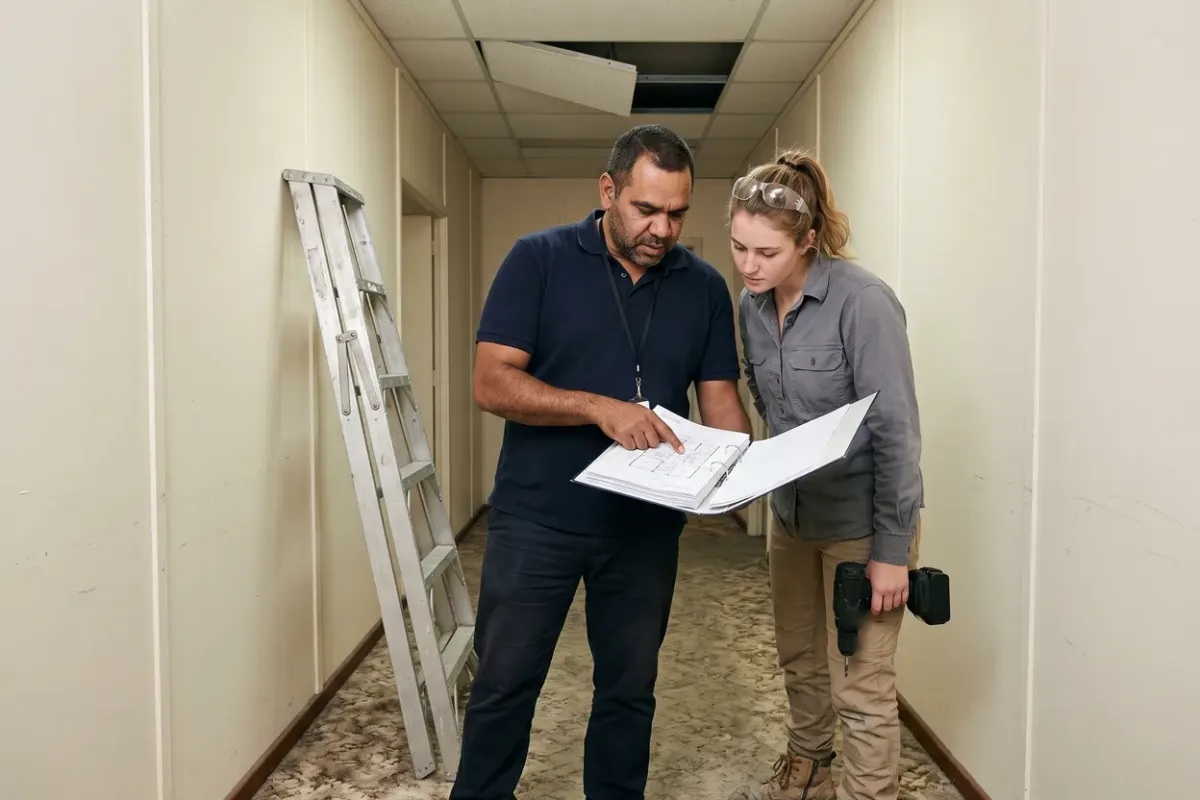
Every facilities manager with an older building has a version of the same story: a contractor drills, cuts, or lifts a ceiling tile, and only afterwards does someone ask whether anyone checked the asbestos register. The register usually existed. It was in a folder, on a shared drive, or with the previous property manager. It just did not reach the person holding the drill.
This guide covers what the register must contain, when a workplace does not need one, who must see it and when, how often to review it, and what the asbestos management plan adds. The examples come from an office building in property and facilities management and an older warehouse in transport and logistics. They are illustrations, not customers. A blank register with the columns below is in a CSV template you can open in a spreadsheet.
What Is an Asbestos Register?
It is the document that lists all the identified or assumed asbestos at a workplace. Safe Work Australia's code of practice says it is intended to ensure workers and others at the workplace do not accidentally disturb asbestos.1 Read that sentence again, because it sets the test for every register: not whether it exists, but whether the next person to work near the asbestos will know it is there.
Keeping it is the job of the person with management or control of the workplace. Under regulation 425 of the model WHS Regulations, that person must ensure a register is prepared and kept at the workplace, and maintained so the information in it is up to date.2 In a commercial building that is usually the owner, a commercial property manager given responsibility for the building, or a tenant allowed to make structural changes under its lease; Safe Work Australia's guide gives all three as examples.3
The asbestos register is one of two registers the model Regulations require a workplace to keep; the other is the hazardous chemicals register under regulation 346.2 Our guide to the duties of a PCBU covers where the register sits among the rest of a building owner's obligations.
What the Register Must Record.
The model rule is short. The register must record any asbestos or asbestos-containing material identified at the workplace, or likely to be present from time to time, including the date it was identified and its location, type, and condition. If no asbestos is identified and none is likely to be present, the register must say so.2
The code's template turns that into columns, and the August 2023 guide adds a few that a contractor will thank you for.13
| Column | What it tells the next person on site |
|---|---|
| Date identified or assumed | How old the information is, and so how far to trust it |
| Type of material, identified or assumed | Roof sheeting, wall cladding, pipe lagging, vinyl tiles |
| Friable or non-friable | Whether it crumbles by hand, which changes how it is handled |
| Condition | "Good, minor deterioration at the western end" is a finding; "OK" is not |
| Specific location | Level, room, wall, and height, written so a stranger can find it |
| Inaccessible area | Ceiling voids, risers, and wall cavities nobody could inspect |
| Photograph or drawing reference | So the contractor can see what they are looking for |
| Notes | How likely the material is to be disturbed, and what was recommended |
Two rules make the register honest. First, assumptions belong in it: the code says the register must include all presumptions made about materials, with a simple statement such as "Roof sheeting is presumed to contain asbestos".1 Second, the person with management or control must ensure, so far as is reasonably practicable, that asbestos is identified by a competent person, such as an occupational hygienist with asbestos experience or a licensed asbestos assessor, unless it is assumed to be present; and any sample must be analysed by a NATA-accredited laboratory or a laboratory operated or approved by the regulator.12 The model Regulations also require the presence and location of identified asbestos to be clearly indicated, by a label where reasonably practicable (regulation 424), and the code says labels should match the locations in the register, so the paper and the wall tell the same story.12
When Is an Asbestos Register Not Required?
Less often than most people think. The model rule applies to buildings whenever constructed. A workplace needs no register only if all three things are true: the building was constructed after 31 December 2003, no asbestos has been identified there, and none is likely to be present from time to time.2 A 2010 warehouse with old plant moved in from another site can still need one.
The date is not the same everywhere. Queensland's Regulation uses 31 December 1989 for the same exemption, and Western Australia's Regulations say constructed on or after 31 December 2003.45 Victoria has no construction-date test for its register at all; its register rules apply wherever asbestos is present at a workplace.6
Homes are the other exception. Under the model Regulations, the register and management plan rules do not apply to any part of residential premises used only for residential purposes.2 A strata building's common property and plant rooms can still be a workplace for the people maintaining them, so check what the manager actually controls before assuming the exemption.
Who Must See the Register & When.
There are two different duties here, and most registers fail the second one.
Ready access. Under regulation 427(1), the person with management or control must ensure the register is readily accessible to four groups: workers who have carried out, carry out, or intend to carry out work at the workplace; their health and safety representatives; businesses that have carried out, carry out, or intend to carry out work there; and businesses that require work to be carried out there.2 That last group can include a tenant business that commissions work in the building, and the client who commissions the job.
A copy to the contractor. Under regulation 427(2), if a business carries out, or intends to carry out, work at the workplace that involves a risk of exposure to airborne asbestos, the person with management or control must ensure that business is given a copy of the register.2 Access on request is not enough for that contractor. They are given it.
Before refurbishment or demolition. Under the model Regulations, for a structure or plant constructed or installed before 31 December 2003, the register must be reviewed before demolition or refurbishment and revised if it is inadequate for the planned work, and the business doing the work must be given a copy before it starts.2 Queensland applies these rules to buildings constructed before 31 December 1989, and to other structures and plant installed before 31 December 2003 where there are reasonable grounds to believe they contain asbestos.4 The duty runs both ways: under regulation 450 that business must obtain a copy before it commences.2 Before refurbishment, the person with management or control must also ensure that asbestos likely to be disturbed is identified and, so far as is reasonably practicable, removed before the work starts, and removal of more than 10 square metres of non-friable asbestos must be done by a licensed asbestos removalist.2
Minor work is outside the demolition and refurbishment rules. The model Regulations exclude minor or routine maintenance and other minor work, and the code gives cutting a small hole or hand-drilling up to a few holes in an asbestos cement sheet as an example.12 That does not take the job outside regulation 427: a contractor whose minor work still risks exposure is still given the register.
Handing the Register to a Contractor Before Work Starts.
Turn those duties into six steps that happen every time, not only when someone remembers.
- Ask what the job touches. When the work order goes out, ask the contractor which walls, ceilings, floors, risers, or plant the job will drill, cut, lift, or open. A ceiling access for a data cable is a different question from a tenancy strip-out.
- Check the register against that location. Look for listed and assumed material, and for inaccessible areas the job will open up. Before refurbishment, the code's questions are where the asbestos is in relation to the work and whether inaccessible areas likely to contain asbestos will be disturbed.1
- Review and revise if it falls short. If the register cannot answer those questions, it is inadequate for the job. Get a competent person to inspect before work, not after.
- Remove it first if the work will disturb it. Before refurbishment, asbestos the work is likely to disturb is removed, so far as is reasonably practicable, before work starts; above 10 square metres of non-friable asbestos, by a licensed removalist.2
- Give the copy, and record that you did. Send the current version with the work order and record which version went to whom and when. The code suggests a permit-to-work system where labels are not practicable, so trades are told before they start.1
- Ask for anything they find. The code says a business working at the site should tell the person with management or control if it finds asbestos, or could assume it, that is not in the register.1 Make that a condition of the job.
Our guide to paper and digital permits to work covers how a permit can carry the register check as a question that must be answered before the permit is issued.
How Often Should an Asbestos Register Be Reviewed?
On events, and at least every 5 years through the management plan. Regulation 426 requires the register to be reviewed and revised as necessary when the asbestos management plan is reviewed, when further asbestos is identified, and when asbestos is removed, disturbed, sealed, or enclosed.2 It sets no fixed period itself.
The 5-year figure that every consultancy page quotes comes from the plan. Regulation 430 requires the asbestos management plan to be reviewed at least once every 5 years, and a plan review triggers a register review.2 Safe Work Australia's code says the register should be reviewed at least once every 5 years, and its 2023 guide suggests a regular visual inspection, for example annually.13 Victoria writes the 5 years into its register rule directly.6
In practice, open the register after any asbestos work, before every fit-out or strip-out, when a contractor reports something unlisted, and when you take over a building. The outgoing manager must, so far as is reasonably practicable, give the register to whoever assumes management or control, so ask for it on day one.2
What Goes in an Asbestos Management Plan?
Wherever asbestos is identified or likely to be present, the model Regulations require a written asbestos management plan, kept up to date.2 It must include information about how the asbestos was identified, for example a reference to the register and the labelling; decisions about managing it and the reasons for them; procedures for incidents and emergencies involving asbestos; and the workers carrying out work involving asbestos, for example consultation, responsibilities, information, and training.2
The register says where the asbestos is. The plan says what you will do about it, such as leave it sealed and inspect it yearly, enclose it, or remove it before the next refit. Besides the 5-year cycle, the plan is reviewed when the register or a control measure is reviewed, when asbestos is removed, disturbed, sealed, or enclosed, when the plan is no longer adequate, and when a health and safety representative requests it.2
How Victoria's Rules Differ.
Victoria has its own Occupational Health and Safety Regulations, and the asbestos rules differ in five ways a manager with a national portfolio should know.6
- No date exemption. The Victorian rules apply wherever asbestos is present, with no construction-date test and no requirement to state that none was found.
- More in the register. It must include whether the material is friable, whether it is likely to be damaged, activities likely to disturb it, inaccessible areas likely to contain asbestos, and the date of each identification.
- 5 years in the register rule. The register must be reviewed, and revised if necessary, at least every 5 years.
- No management plan duty. The Victorian Regulations do not mention an asbestos management plan.
- A different access list. Copies go to employers and self-employed people based at the workplace and to the licensed removalist, and anyone engaged to do work that risks exposure to airborne asbestos fibres must be told about the register and given access to it.
The Victorian access rules carry up to 60 penalty units for a person and 300 for a body corporate, and a Victorian penalty unit is AU$209.10 from 1 July 2026.67
Penalties & Cases When the Register Is Missing.
The model penalties are set in tiers. As at 1 July 2026, Safe Work Australia lists tier E at up to AU$9,900 for an individual and AU$50,000 for a body corporate, and tier G at up to AU$5,900 and AU$30,000.8
| Duty in the model Regulations | Tier | Maximum, individual | Maximum, body corporate |
|---|---|---|---|
| Identify asbestos (regulation 422) | E | AU$9,900 | AU$50,000 |
| Indicate presence and location (regulation 424) | E | AU$9,900 | AU$50,000 |
| Prepare, keep, and update the register | G | AU$5,900 | AU$30,000 |
| Readily accessible, and a copy to a contractor at risk | G | AU$5,900 | AU$30,000 |
| Copy before refurbishment or demolition | E | AU$9,900 | AU$50,000 |
These are the model figures. Each state sets its own amounts in its own Regulations, and Western Australia, for example, writes its fines in dollars in its WHS (General) Regulations.5
The cases are more telling than the tables. WorkSafe Queensland reported that in September 2023 a principal contractor was fined AU$75,000 after subcontractors installing air conditioning cut holes in a ceiling containing asbestos, even though the principal contractor had a register that clearly identified it; the charges included not giving all subcontractors the register.9 In March 2026 WorkSafe Victoria warned that its inspectors had seen employees at several unrelated workplaces unknowingly disturbing and spreading friable asbestos because their employer had not provided and maintained a register.10
A Worked Example: An Office Refit & an Old Warehouse.
The office building. A 1978 office building has a register from a competent person's survey in 2022, with fibre cement wall sheets in the level 6 corridor listed as assumed asbestos. A tenant on level 6 books a refit, and its fit-out contractor quotes to remove two corridor walls. The property manager treats it as refurbishment: before the contractor's start date, the register is reviewed against the drawings, the ceiling void above the corridor is noted as an inaccessible area the work will open, and a competent person inspects it. Because the walls are assumed to contain asbestos and the refit will remove them, the property manager has them tested or, if they are asbestos, removed by a licensed asbestos removalist before the fit-out starts, which the model Regulations require so far as is reasonably practicable.2 The revised register goes to the fit-out contractor with the work order, and to the electrician the tenant engages separately for the same floor. The arcade example in Safe Work Australia's code makes the same point: the owner updates the register for the work, consults the tenants, and owner, contractors, and tenants coordinate.1
The warehouse. A distribution centre in a 1980s warehouse has asbestos cement sheet on its lower walls, listed in the register. A racking contractor is booked to anchor new uprights near the wall line, and a forklift has scuffed one sheet. The warehouse manager sends the register with the racking job and holds the work near that wall until it is checked. The code describes a dockside warehouse that protected its asbestos cement walls from a front-end loader with a false wall and bollards, and recorded those changes in the register.1 The protection is the control; the register entry is how the next contractor knows why the false wall is there.
Asbestos was completely banned in Australia from 31 December 2003, but the ban did not apply to asbestos-containing materials already in place, which is why this is still a live question in buildings and warehouses of that age.11
Keeping the Register Where Contractors Will See It.
The failure in every case above is distribution, not paperwork. A register in the building manager's office reaches the contractor only if someone remembers to send it.
In ComplyFlow's site documents, a register can be uploaded against a site with an expiry date, a version number, and a document owner, and is hidden from contractors until you choose to show it.12 Documents nearing expiry show as Expiring Soon within 90 days, with a dashboard alert and a monthly email, and a new version supersedes the old.13 On a site that uses Live Access for sign-in, a site document such as an asbestos register can be set to display at sign-in, which is off by default; staff and contractors then see it as the last step, and what was displayed is logged in the Sign In Book PDF export.1415 That log shows which version each person was shown at the gate. It does not replace sending the register to the contractor's business with the work order.
Start With the Next Job on the Calendar.
Pick the next job booked in your oldest building and run the six steps before the contractor arrives: what will the job touch, what does the register say about that spot, is it good enough, does anything need removing first, who gets the copy, and who tells you if they find something new. Then do the same for the warehouse or depot you think least about.
Expect the first run to show a register that is older than you thought and an inaccessible area nobody inspected. That is the point of doing it before the drill comes out. The register template has the columns from this guide. To see registers kept and shown at sign-in across a portfolio, book a demo.
Sources
- How to manage and control asbestos in the workplace: Code of Practice
- Model Work Health and Safety Regulations (as at 5 December 2025)
- Asbestos registers at the workplace
- Work Health and Safety Regulation 2011 (Qld)
- Work Health and Safety (General) Regulations 2022 (WA)
- Occupational Health and Safety Regulations 2017 (Vic), version 017
- Indexation of fees and penalties
- Maximum monetary penalties under WHS laws
- Asbestos audits, outcomes and prosecution update (eSAFE, December 2023)
- Use asbestos registers to help keep workplaces safe
- Communicating asbestos facts and figures to the public
- How to Upload Site Document
- Site Document Permissions and Feature Overview
- Live Access sign-in options: confirmation sets, site inductions and site documents
- Site Document Advanced Settings (including Live Access)
See It Against Your Own Contractors, Sites & Rules.
Book a 30-minute demo. We will show ComplyFlow working with your kind of sites, your kind of contractors, and your requirements. No slides, no hard sell.
Or Speak to Us
- ISO 27001
- Hosted on AWS
- Microsoft & Okta SSO
- API & MCP
- Data in Australia
Written by
Mitchell BourneManaging Director, ComplyFlow
Mitchell has run ComplyFlow since 2009 and has spent that time inside the contractor, site, and safety problems of Australian operators. He writes about where compliance actually fails, and what the people responsible for it can do about it.
Writes about: Contractor compliance, WHS duty and proof, Running a compliance program
Questions
Questions People Ask About This.
Who is responsible for the asbestos register in a leased building?
The person with management or control of the workplace. In a commercial building that is usually the owner or the property manager it has appointed, and a tenant can hold the duty for the parts it controls, for example where a lease lets it make structural changes. Write down who holds the register for each building and each tenancy, so a contractor knows who to ask before work.
Does a home need an asbestos register?
No. Under the model WHS Regulations the register and management plan rules do not apply to any part of residential premises used only for residential purposes. Where a business is doing demolition or refurbishment at a home built before 31 December 2003, the contractor must not start until a competent person has inspected for asbestos, and if asbestos is found or assumed it must tell the occupier and the owner.
Can the asbestos register be kept electronically?
Yes. Safe Work Australia's guide lists an online database, a local server network, or a paper copy as storage options. What matters is that the people entitled to see it can get to it readily, including a contractor standing at the site, and that a copy can be given to a contractor before work that risks exposure.
What should a contractor do if they find asbestos that is not on the register?
Stop work in that area and tell the person with management or control of the workplace. Safe Work Australia's code says a business carrying out work should advise them if asbestos is identified, or could be assumed to be present, and it is not in the register. The register owner then updates the register.
Is drilling a few holes refurbishment?
Not under the model laws' meaning. The demolition and refurbishment rules exclude minor or routine maintenance and other minor work, and Safe Work Australia's code gives hand-drilling up to a few holes in an asbestos cement sheet as an example of minor work. The access and copy duties for work that risks exposure still apply, so the contractor still sees the register.
Is there a template for an asbestos register?
Yes. Appendix D of Safe Work Australia's July 2020 code of practice has a template with columns for the date the asbestos was identified or assumed, the type of material, whether it is friable, its condition, its specific location, and whether the area is inaccessible. Add a photograph reference and notes on how likely it is to be disturbed, and keep the competent person's name with it.