Hot Work Permit: A Guide for Facilities Managers
A hot work permit authorises one job that can start a fire, such as welding, once combustibles are cleared and a fire watch named. Model WHS Regulations never name it; SafeWork NSW calls a permit system essential.
 John McCannHead of Product
- Published
- 13 min read
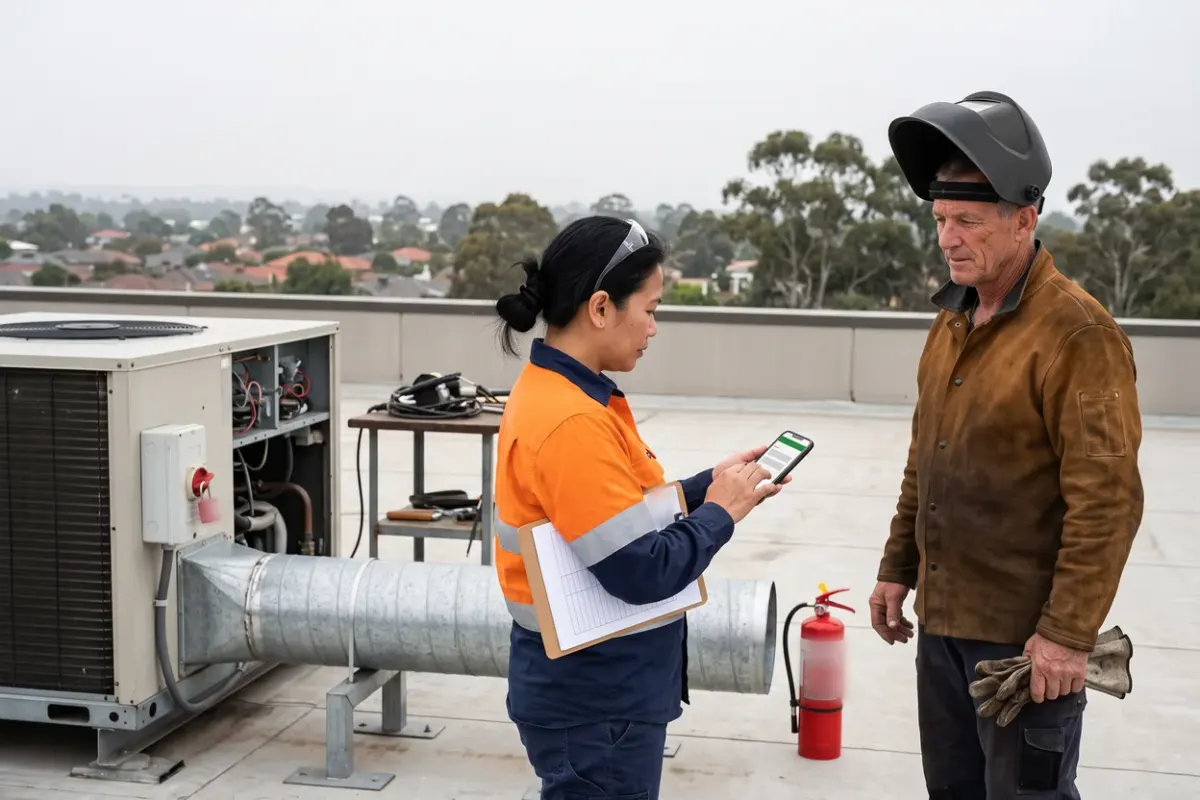
A spark from a grinder does not stay where the work is. It drops through a services penetration, settles in a ceiling void, or lands on a tenant's stock a floor below, and the fire it starts can show itself after the contractor has packed up and gone. A hot work permit is how a building decides, in writing, that a job can go ahead because those paths have been closed first.
This guide is for facilities managers who run office towers, shopping centres, and mixed portfolios in property and facilities management. It covers what a hot work permit is, what Australian law does and does not require, what the permit should record, who signs it, how long a fire watch should run, and how to handle the detector isolations that make hot work in an occupied building riskier than on a construction site. The examples are illustrations, not customers.
What Is a Hot Work Permit, and What Counts as Hot Work?
A hot work permit is a written authorisation for one job that can create an ignition source, in one place, for a set period. It is issued only after the fire risks around the work have been removed or controlled, it names the people and the fire watch, and it is closed with a check that nothing has been left smouldering.
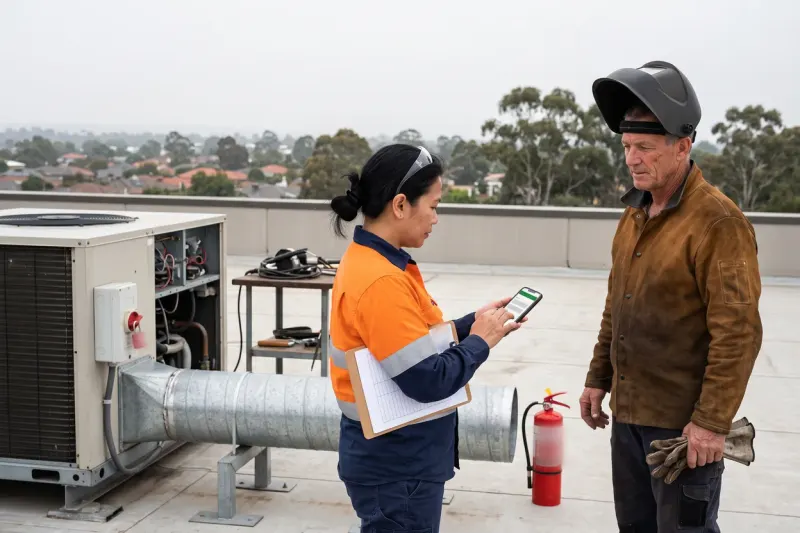
Hot work is wider than welding. The national training unit for issuing work permits says hot work includes any activity which has the potential to be or cause a source of ignition.1 SafeWork NSW's hot work alert gives grinding, welding, oxy cutting, and other processes that produce a flame or other ignition source as examples.2 In a managed building that takes in brazing a copper refrigeration line in a plant room, cutting a steel bracket for new signage, grinding a seized bolt on a roof anchor, and torching on a membrane over a leaking slab.
The permit is not the safety. It is the record that a competent person looked at the spot, removed what could burn, arranged the people and equipment to catch a fire early, and agreed when to check again. The value is in the looking, which is why a pad of pre-ticked forms protects nobody.
Is a Hot Work Permit a Legal Requirement in Australia?
Not by name in the general work health and safety rules. The model WHS Regulations, as at 5 December 2025, do not contain the words "hot work" at all, and Victoria's Occupational Health and Safety Regulations 2017 do not either.34 The one permit the model Regulations require outright is the confined space entry permit, under regulation 67.3 Other laws can name hot work and set their own conditions, such as mining safety rules for underground mines and state bushfire rules for welding and cutting in the open air. This guide covers hot work in and on occupied buildings, so for rooftop and other outdoor jobs, check your state's fire rules.
That does not make a hot work permit optional in practice. Safe Work Australia's welding code, writing about welding in a hazardous atmosphere or hazardous area, says that outside a confined space you should still document specific procedures that include the issue of a hot work permit, and it points to the Australian Standard AS 1674.1 for guidance.5 SafeWork NSW is blunter: before carrying out any hot work on site, it says, it is essential to implement a hot work permit system, with a detailed review that identifies the hazards and eliminates them or, where that is not reasonably practicable, controls the risks.2
The duties sit underneath. Under section 20 of the model WHS Act, a business that manages or controls a workplace, in whole or in part, must ensure, so far as is reasonably practicable, that the workplace, the means of entering and exiting it, and anything arising from it are without risks to the health and safety of any person.6 Approved codes of practice are not law, but courts may rely on them to decide what was reasonably practicable in the circumstances.7 So when a fire starts in a riser after a contractor's grinding, expect to be asked what you did about the risks the welding code and the regulator describe. The welding code is a model code: it carries that weight only where your state or territory has approved it, and Victoria has its own OHS laws. A signed and closed permit is the answer.
A hot work permit is also not the contractor's safe work method statement. Construction work carried out in an area that may have a contaminated or flammable atmosphere is one of the kinds of high risk construction work listed in regulation 291 of the model WHS Regulations, and under regulation 299 the business carrying it out must ensure a SWMS has been prepared before it starts.3 Our guide to what a SWMS must include covers that document; the permit checks the SWMS matches the job on the day.
Why Hot Work Is a Bigger Risk in an Occupied Building.
A construction site expects sparks. An occupied building does not, and almost everything about it makes a small fire harder to see and quicker to spread.
Ceiling voids and risers connect floors that look separate from the corridor. Services penetrations through slabs and walls are paths for sparks and for smoke. Tenants store cardboard, stock, and fit-out offcuts in places the facilities team never sees. Cleaners, security, and tenants' own staff move through after hours, when most hot work is booked to avoid trading. And when the detectors in the work zone are isolated so that fumes do not set them off, the building's early warning is switched off in exactly the place a fire is most likely to start.
SafeWork NSW's alert describes a fire in February 2018 on a building demolition site: plastic mesh screening caught alight while a metal beam was being cut with an oxy acetylene torch, the fire engulfed the site, and about 20 people were treated on site for smoke inhalation.2 That was a site built around the work. Put the same cut beside a shopfront hoarding in a trading shopping centre, and the people breathing the smoke are customers.
Plant rooms and basements add one more risk. Safe Work Australia's confined spaces code says there may be potential for fire or explosion where hot work is done in areas next to confined spaces that contain flammable atmospheres, and it lists prohibiting hot work in adjacent areas as a control to consider.8 In a property portfolio, the spaces to look for are the grease trap pit beside a food court, the sewage pump well, and the fuel room for a standby generator.
What a Hot Work Permit Should Record.
SafeWork NSW says a hot work permit system should incorporate a checklist that addresses all hazards and controls, reviewed and signed off by the people in control of the site and the people involved in the hot work.2 Built from the controls in its alert, with the extra lines an occupied building needs, a permit should record:
- the job, the exact location including the floor and the riser or room, and the start and finish times;
- the people doing the work, their employer, and the person in charge of it on the day;
- flammable and combustible material identified and removed, or covered with non-flammable covers or screens, including what sits below, above, and behind the work;
- services located and protected, and isolated where reasonably practicable;
- ventilation for fumes, and gas cylinders checked, undamaged, and fitted with flashback arresters;
- the firefighting equipment at the work, and its type;
- the fire watch, by name;
- the area isolated and secured against unauthorised access, with signage;
- any fire detection isolation: the zone, who applied it, and the time it must be restored;
- the post-work check for smouldering material, signed with a time, at every break, at the end of the shift, and on completion.
SafeWork NSW also says a copy of the permit should be kept in the site file and displayed at the site.2 Because the model Regulations do not name a hot work permit, they set no period for keeping one. Set a retention period yourself, the same as your other contractor records, so that a permit can be found when an insurer or an inspector asks about a fire months later.
Who Signs a Hot Work Permit?
We recommend at least three signatures: the person who issues it, the person in charge of the work who accepts its conditions, and the fire watch. The issuer is someone the business has authorised and who is competent to judge the fire risks of that spot. In a managed building that is usually the facilities manager, the building manager, or a trained supervisor, never the contractor asking for the permit.
The national unit MSMPER300 Issue work permits sets out what the issuer does: identify the need for a permit, make sure the job site is prepared, set a validity period, check the permit's conditions are met, have the recipient sign, monitor the work, and close the permit once the work satisfies its conditions.1 The unit states that 'no licensing, legislative or certification requirements apply to this unit at the time of publication', so treat it as a standard for training your issuers rather than a legal ticket.1
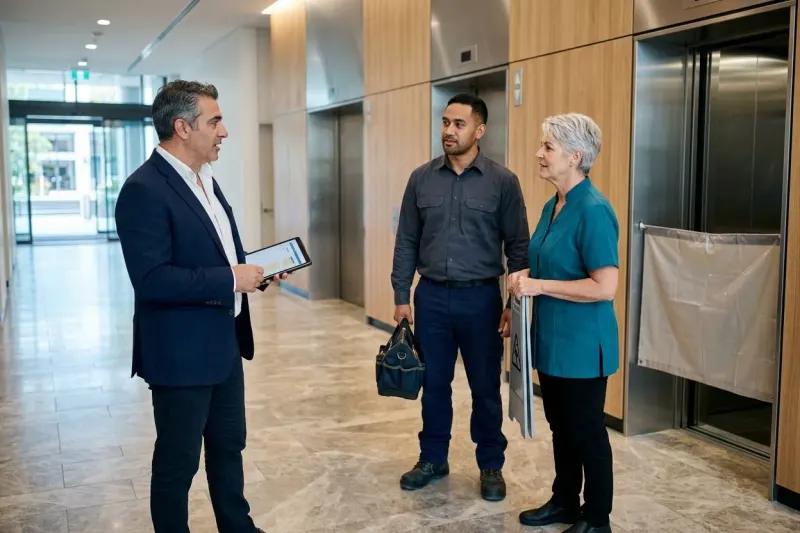
Buildings usually have more than one business with a say in the job. Under section 46 of the model WHS Act, where more than one person has a duty in relation to the same matter, each must, so far as is reasonably practicable, consult, co-operate, and co-ordinate activities with the others.6 Safe Work Australia's own example names the owner of a multi-tenanted shopping centre, its manager, the businesses in the shops, and the cleaning and security contractors as separate businesses at the one site.9
The permit is where that coordination gets written down. The tenant signs to say the space above their ceiling is clear. The security contractor knows the detectors in one zone are off until a set time. Our guide to the duty to consult, cooperate, and coordinate covers the rest of that duty.
How Long Should a Fire Watch Last?
Long enough to catch a fire that starts after the work stops, which is when a smouldering one shows itself. Among the typical key measures it lists for consideration, SafeWork NSW's alert includes a fire watch person and a post-work check for smouldering material before leaving the area, whether for a break, at the end of a shift, or when the work is finished.2 The Standard it points to, AS 1674.1, is a paid document and is not reproduced here.
What we recommend: write a time on the permit. The fire watch stays at the work while it is under way and for an agreed period after it stops, and a second person checks again later, before the permit is closed. Set that period by the building rather than by habit. Make it longer where sparks could have fallen into a void, a riser, or stored stock that nobody can see from the work, and longer again where detectors were isolated for the job.
The common failure is not a short fire watch. It is a fire watch nobody can prove happened. A name on the permit, and a signature and time at each check, is the evidence that the building was watched, and it is the first thing anyone will ask for after a fire.
Hot Work Permits and Fire System Isolations.
In a building with automatic detection, hot work often needs the smoke detectors in that zone isolated, because fumes and dust from welding or grinding can trigger them. That isolation is the most dangerous decision on the permit. It switches off the building's early warning in the one place a fire is most likely to start, and it is the step most often left open after the contractor goes home.
Treat the isolation as a section of the permit, not a phone call. Name the zone, the person who isolates it (usually the fire services contractor or whoever operates the fire panel), the time it goes off, the time it must come back, and the person who confirms it is restored. Isolate the smallest zone that will do the job, for the shortest time that will do it. Tell security, the building's emergency team, and any tenant on that floor.
Never close a hot work permit until the panel shows the zone back in service. Sprinklers are a separate question: a hot work job should never be the reason a sprinkler system is shut down. If a job truly needs one off, it needs its own impairment process, run by the fire services contractor, and not a line on a hot work permit.
A Hot Work Permit Worked Through in a Shopping Centre.
A mechanical contractor needs to replace a corroded steel support under the kitchen exhaust duct in the ceiling space above a food court. The job means cutting out the old bracket and welding in a new one. The centre trades from 9am, so the work is booked for 5am on a Monday.
On the Thursday before, the centre's facilities manager walks the ceiling space with the contractor's supervisor. They find grease residue on the underside of the duct, cardboard a tenant has stored above their own ceiling, and a cable tray running a metre below the bracket. The permit is drafted around what they saw, not around a template.
By Sunday night the kitchen exhaust cleaner has degreased the section of duct. The tenant has moved the cardboard and signed to say so. On the Monday the facilities manager checks the space again at 4:45am, sees a fire blanket over the cable tray and two extinguishers at the ladder, and confirms the fire services contractor will isolate the food court detector zone from 4:50am, with 7:15am written on the permit as the time it must be restored. Security, the centre's emergency team, and the food court tenants are told. The welder's offsider is named as fire watch.
The permit is issued at 4:55am. Welding finishes at 6:40am. Once the fumes have cleared, the fire services contractor restores the detectors at 7:10am and the facilities manager signs that the panel shows the zone in service, while the fire watch stays at the work until 7:40am and signs the permit with that time. The facilities manager checks the void again with a torch at 8:00am, finds nothing warm or smouldering, signs the check with the time, and closes the permit at 8:20am, 40 minutes before the doors open.
The permit did three things the contractor could not do alone. It got the grease off the duct before a torch came near it, it moved a tenant's stock, and it made sure the detectors were back on before the fire watch left.
Running Hot Work Permits Across a Portfolio.
One building can run hot work permits from a pad in the building manager's office. A portfolio cannot see them. A paper permit cannot tell a regional facilities manager which buildings have hot work today, which detector zones are isolated, or which permits were issued yesterday and never closed. Our guide to the full permit to work system covers the cycle every permit type shares, from request to hand-back.
In ComplyFlow's digital permits, a permit has a permit type, sites, an expiry, and a permit holder, and each section can have its own reviewer: a role, a team, or the permit holder.10 Contractors sign into an active permit from the Live Access app, and an area supervisor can check who has signed in and out.10 That lets a hot work permit carry its detector isolation as a section of its own, reviewed by the role or team that runs the fire panel, with the expiry written on the record rather than in a margin.
Write the Permit for Your Building, Not for a Welding Shop.
Take the fields above and add the three things your buildings have that a workshop does not: the voids and risers on each floor, the detector zones and who isolates them, and the tenants who need to know. Run the next contractor's hot work on it, then fix whatever the issuer had to write in the margin. A permit built for your buildings is one your issuers will actually read. To see permits, isolations, and contractor sign-ins on one record, book a demo.
Sources
- MSMPER300 Issue work permits (Release 2)
- Hot work safety alert
- Model Work Health and Safety Regulations (as at 5 December 2025)
- Occupational Health and Safety Regulations 2017 (Vic), version 018
- Welding processes: Code of Practice
- Model Work Health and Safety Act (model WHS Bill, as at 5 December 2025)
- Model WHS laws
- Confined spaces: Code of Practice
- What is a person conducting a business or undertaking
- Permits: Concepts, Workflow & Examples
See It Against Your Own Contractors, Sites & Rules.
Book a 30-minute demo. We will show ComplyFlow working with your kind of sites, your kind of contractors, and your requirements. No slides, no hard sell.
Or Speak to Us
- ISO 27001
- Hosted on AWS
- Microsoft & Okta SSO
- API & MCP
- Data in Australia
Written by
John McCannHead of Product, ComplyFlow
John has led ComplyFlow’s product since 2021, including its AI document review, its AI agents, and its MCP server. He writes about what AI can and cannot be trusted to do in safety and compliance work, from building it.
Writes about: AI in compliance, Product and integrations, Data and reporting
Questions
Questions People Ask About This.
Can one hot work permit stay valid for a whole week of work?
We recommend against it. A hot work permit covers the job, the place, and the period the issuer writes on it. The national training unit for issuing permits makes setting a validity period part of the issuer's job, and has the issuer revalidate it as required. If the job moves, the conditions change, or work stops and restarts on another day, issue a new permit rather than stretching the old one.
Do you need training to issue a hot work permit?
The model laws require no licence to issue a hot work permit and set no qualification for the issuer. Choose someone competent to judge the fire risks of that spot. MSMPER300 Issue work permits is the nationally recognised unit, and it states that 'no licensing, legislative or certification requirements apply to this unit at the time of publication'. SafeWork NSW says training should cover the hazards of hot work, using the permit system, using firefighting equipment, and emergency and evacuation procedures.
Does a hot work permit replace a contractor's SWMS?
No. A safe work method statement is the contractor's plan for high risk construction work, such as construction work in an area that may have a flammable atmosphere. The hot work permit is the building's authorisation for one job on one day, once the area has been made ready. A good permit checks that the SWMS matches the job; it never stands in for it.
Can hot work be done in or next to a confined space?
Only with great care, and inside one it needs a confined space entry permit as well. The model WHS Regulations bar introducing an ignition source into a confined space where it could cause a fire or explosion, and Safe Work Australia's confined spaces code lists prohibiting hot work in adjacent areas as an additional control to consider, and warns of fire or explosion where hot work is done next to confined spaces that contain flammable atmospheres.