AI in Workplace Safety: Uses, Limits & the Law
AI in workplace safety is reliable today for four jobs: reviewing a document such as a SWMS or a certificate against criteria you set, drafting a first version a person edits, answering questions from your own records, and running a reviewer your own team built. It should never decide who may be on site. Safe Work Australia now treats AI as a hazard a business must manage.
 John McCannHead of Product
- Published
- Updated
- 13 min read
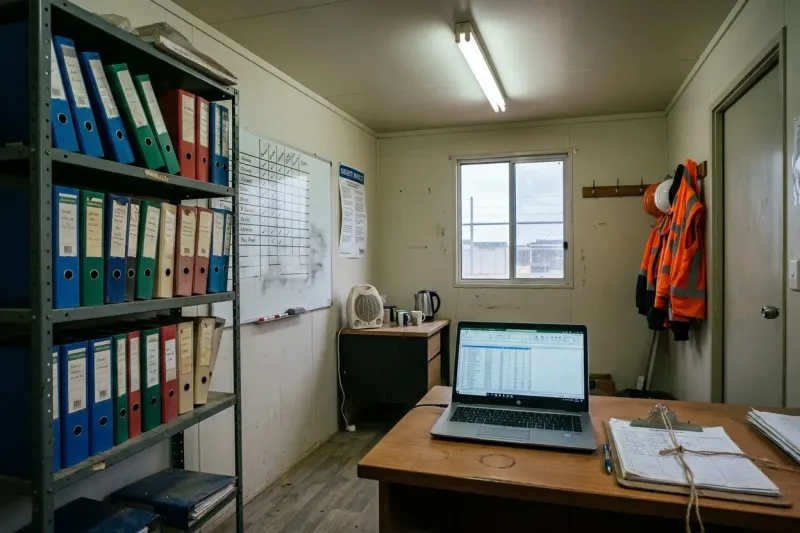
A facilities manager looking after a portfolio of commercial buildings reads more contractor paperwork than almost anyone in the business. Certificates of currency, licences, safe work method statements, inspection reports, and induction records arrive every week, for dozens of trades, across every site. That is exactly where AI has become useful, and exactly where it is easiest to trust it with the wrong thing.
I lead the team that builds these AI features, so I will say plainly where I think the line sits. AI reads, drafts, and answers against criteria you set. Your people still decide. The rest of this post is what that looks like on a property portfolio, what the law now expects of you, and one page to take to your next WHS committee.
How Can AI Be Used in Workplace Safety?
In four ways that hold up today: reviewing a document against criteria you set, drafting a first version for a person to edit, answering a question from your own records, and running a reviewer that your own team built. Safe Work Australia's own list of opportunities is close to this. It names automating routine tasks, identifying hazards such as fatigue from historical data, and identifying trends in data to improve WHS strategies.1
What those four have in common is that each one saves reading time without taking a decision away from the person accountable for it. That is the test worth applying to any AI tool a vendor shows you.
Reviewing a Document Against Criteria You Set.
A contractor's SWMS for roof work can run to 30 pages, and the person reviewing it is checking for perhaps a dozen things: the building and the roof named, edge protection described as a real control, a rescue plan if someone is left hanging in a harness, how the crane lift is kept away from tenants' cars. A model reads the whole document against those criteria and says what is present, what is partly present, and what is missing, with the passage it relied on.
The same applies to a certificate of currency or a high risk work licence. Reading the insured name, the policy period, and the limit off a scanned document is narrow, repetitive work, and it removes the most common error in any contractor register: a date typed in wrongly, or never typed in at all.
Drafting a First Version for a Person to Edit.
An inspection checklist that fits a particular building, or an induction drafted from your own procedures, is faster to edit than to start. The judgement lives in the editing, so the person editing is still the author.
There is one document AI should not be writing for someone else, and that is the contractor's SWMS. Safe Work Australia's construction code says the person responsible for carrying out the high risk construction work is best placed to prepare it, in consultation with the workers doing the job.2 In NSW that code now carries more than guidance: from 1 July 2026 a business must comply with an approved code of practice, or manage the risk to a standard equal to or higher than the code requires, so check the NSW version.22 A model has never stood on your roof. Review the SWMS with AI by all means; do not let anyone hand you one that a model wrote for a building it has never seen.
Answering a Question From Your Own Records.
Most compliance questions a facilities manager is asked are lookups dressed up as reports. Which contractors booked at the Parramatta buildings this month have insurance expiring before their job ends? Which sites had repeat near misses last quarter? An assistant connected to the system that holds the record can answer that in plain English, from the live data, without anyone building a report.
Running a Reviewer Your Own Team Built.
This is the one most AI pitches skip. A general-purpose chatbot knows nothing about your requirements: your insurance minimums, your roof access rules, what your property owner client insists on. The useful version is a reviewer your safety or facilities lead sets up themselves, against your own criteria, and tests on a real document before it goes live. The standard stays yours; the AI only applies it faster.
What Should AI Never Be Trusted With in Safety Work?
Four things, and the reason is the same each time: the model has no stake in being right.
Jurisdiction-specific judgement. Every jurisdiction has its own WHS regulator, and the model WHS laws have been implemented everywhere except Victoria, with variations, so the rules are not identical.3 Ask a general-purpose model when an incident becomes notifiable in your state and you get a confident answer assembled from whichever jurisdiction dominated its training data.
Anything that needed a person in the room. A model can confirm a traffic management plan for a loading dock names a spotter. It cannot tell you the spotter could not see the reversing line that morning because a skip bin had been moved overnight. Documents describe controls. People verify them.
Deciding whether a person may be on site. That decision is part of how the business meets its duty, so a named person should make it and be able to explain it afterwards. A system can put everything relevant in front of you, including what is expired and what is missing. The decision still belongs to somebody who can be asked afterwards why they made it.
Any output that goes out without a named human check. The failure here is ours, not the model's. Automation bias is the tendency to over-rely on automated advice, and a systematic review of the evidence found that decision support improves overall performance while the people using it often miss the errors it introduces.4 The finding that should worry an experienced manager comes from Parasuraman and Manzey in Human Factors, June 2010: automation bias "occurs in both naive and expert participants, cannot be prevented by training or instructions".5 Knowing about the trap is not protection from it. A named reviewer and a recorded check are.
Safe Work Australia says the same in its own words. It lists over-reliance on AI to detect hazards as a risk in its own right, with the example of relying on technology to spot fatigue while ignoring the worker's own signs.1
Safe Work Australia also looks at the harm AI can do to the people working with it, which is a separate question from whether its answers are right. It says AI and digital technologies can introduce physical and psychosocial hazards, and names surveillance used in an unfair or unjust way, automated decisions that are biased or faulty, and work paced by a computer.6 It even lists work where more tasks are focused on reviewing the output of AI as a risk.6 That is worth taking seriously in a post recommending exactly that: the answer is to review the flags that matter, not to turn a facilities coordinator into someone who checks machine output all day.
Is It Okay to Use ChatGPT for Safety Work?
Yes, for drafting, summarising, and explaining, with two conditions. The first is privacy. The Office of the Australian Information Commissioner recommends, as a matter of best practice, that organisations do not enter personal information, and particularly sensitive information, into publicly available generative AI tools.7 An incident report names an injured worker. A contractor's file holds licence numbers and dates of birth. None of that belongs in a public chatbot.
The second is that a public chatbot answers from what it was trained on, not from your records or your criteria. It can explain what a certificate of currency is. It cannot tell you whether the one in front of you meets your public liability minimum, because it has never seen your minimum. The safer pattern is an assistant connected to the system that already holds the record, reading within the user's own permissions, so nobody is pasting files into a chat window to get an answer.
What the Law Now Asks of a Business That Uses AI.
Safe Work Australia has put AI on the hazard list. Its guidance, out since at least July 2026,8 says a person conducting a business or undertaking must manage health and safety risks from AI and digital technologies, so far as is reasonably practicable, as with any other hazard.9 There is no separate AI process: you identify hazards, assess risks, control them, and review the controls, in consultation with workers and their representatives.6 The consultation duty bites first, because it applies before you introduce the technology, not after.9 The guidance also warns that routine changes to IT systems, including updates pushed by software providers, may introduce or change WHS risks,10 so an AI tool that changes under you is a change to manage, not only the day it arrives.
New South Wales has legislated. The Work Health and Safety Amendment (Digital Work Systems) Act 2026 received assent on 18 February 2026.11 Its first change is the one that matters to anyone using AI to review documents: a new paragraph in the primary duty, section 19(3)(c1). SafeWork NSW says it 'makes clear' that a business's duty to ensure, so far as is reasonably practicable, the health and safety of its workers includes ensuring they are not put at risk from its use of digital work systems, and describes it as a clarification of the existing duty. That applies to any use, not only to allocating work, and a digital work system is defined as an algorithm, artificial intelligence, automation, or an online platform.12
The Act also adds section 21A, requiring a business that allocates work through a digital system to ensure, so far as is reasonably practicable, that the allocation does not put workers at risk, and it sets out specific risks the business must consider.12 And it lets union officials holding a WHS entry permit require reasonable assistance to access and inspect a digital work system relevant to a suspected contravention, on at least 48 hours' notice.11
The main duties have not commenced. Only the provisions requiring SafeWork NSW to write guidelines on that access took effect on assent; the rest start on proclamation, and no date has been set.11 Most of them cannot start earlier than one month after those guidelines are published, and SafeWork NSW was still developing them, with public consultation to come, in September 2026.13 Passed and in force are two different facts, and you need both. For a facilities team with NSW buildings the practical step is the same either way: be able to show how each AI tool you use is controlled, because an entry permit holder could ask to inspect it.
Australia has no national AI-specific law. The National AI Plan of 2 December 2025 says the government will "continue to build on Australia's robust existing legal and regulatory frameworks".14 The live national guidance is the National AI Centre's Guidance for AI Adoption, whose six essential practices include deciding who is accountable, testing and monitoring, and maintaining human control.15 Read them beside a safety management system and they are the same document with the nouns changed.
Worked Example: Roof Plant Replacement on a Property Portfolio.
This is an illustration, not a customer story, but every step in it is one a facilities team will recognise.
What Arrived on Thursday.
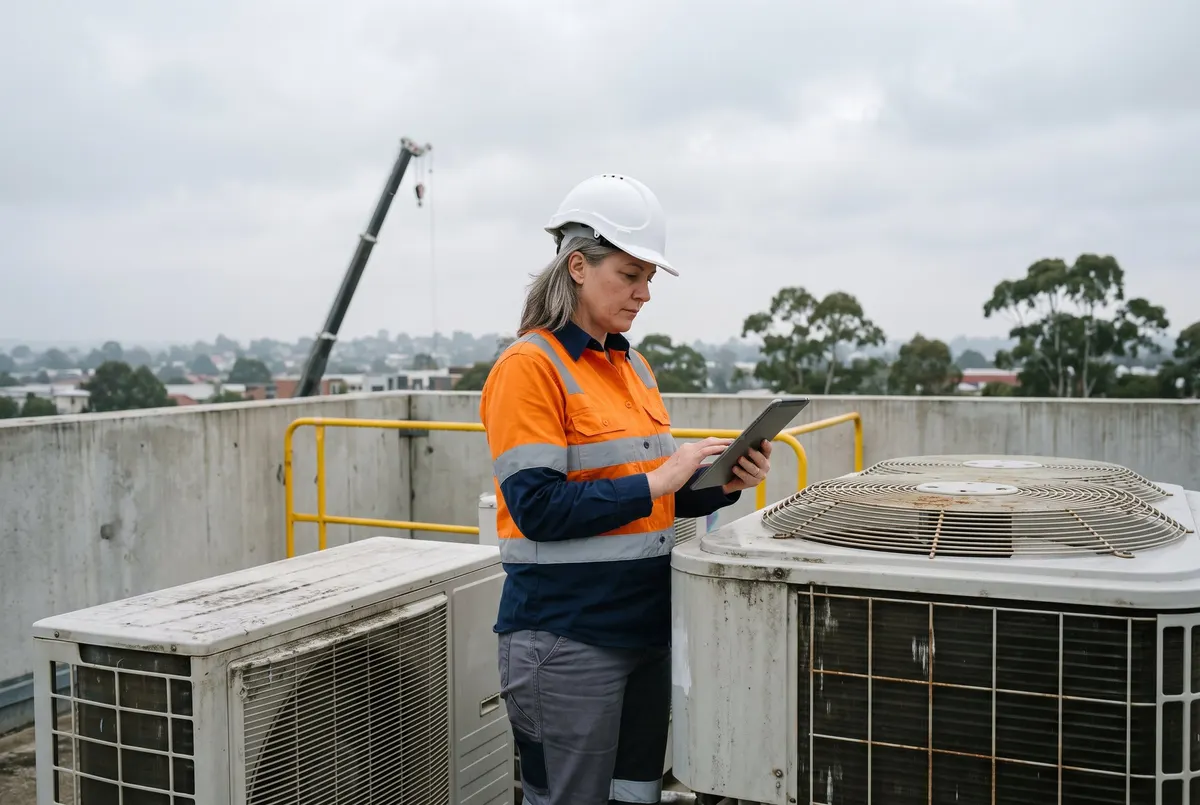
An FM provider manages 14 commercial buildings in Western Sydney for one property owner. A mechanical contractor is booked to replace two rooftop air-conditioning units at the Parramatta building on Monday, with a crane lift over the car park. Part of the roof has no permanent guardrail, so the work carries a risk of a person falling more than 2 metres, which makes it high risk construction work under the Work Health and Safety Regulation 2025 (NSW), so the contractor needs a SWMS before it starts.16 On Thursday afternoon the contractor uploads a certificate of currency for public liability, the SWMS, and the rigger's high risk work licence.
What the AI Read.
In ComplyFlow the two documents meet two kinds of AI review. The certificate is uploaded against a document category the FM provider set up, with AI review switched on and its own criteria written in. The check runs on upload: it reads the expiry date, the name on the document, and the document number, and shows the contractor what passed and what did not before the document goes for approval.17
The SWMS is a file upload on the provider's work permit form, and a review agent sits on that question.18 The safety lead built the agent by picking the document type, keeping and editing the criteria the wizard suggested, adding the car park rule, and running it against a real SWMS before saving it.19 The contractor can run the review before submitting, and sees each criterion marked pass, partial, or fail, with feedback.20
The rigger's licence passes. The certificate passes on the insured name and the limit, and fails on dates: the policy period ends on Saturday, two days before the job. The SWMS passes on the building, the task, and the edge protection. It is partial on the crane lift, which describes an exclusion zone but says nothing about the car park at 7am, when tenants start arriving. It fails on a rescue plan for anyone left suspended in a harness. The contractor submits anyway, because the job is on Monday.
What the Facilities Manager Decided.
The facilities manager opens the approval queue and sees, for the certificate, which criteria passed, the expiry read off the document beside the one the contractor typed in, and a recommendation.17 For the SWMS, the answer and the agent's assessment sit side by side. The facilities manager reads the two flags rather than all 30 pages, rejects the SWMS with those two reasons attached so the contractor knows exactly what to fix, asks for the renewed certificate, and confirms the job goes ahead on Monday if both arrive by Friday. The AI recommended; a person decided.
What Was Kept.
Each check stays listed on the document with its date and outcome, including the earlier ones when a file is replaced.17 If the property owner's auditor asks in six months why this contractor was allowed on the roof, the answer is on the record rather than in somebody's memory.
On Monday morning, before the crane arrives, the facilities manager asks ChatGPT, Claude, or Microsoft Copilot which contractors booked at the Parramatta buildings this month have a certificate of currency expiring before their job ends. It answers from the live record through ComplyFlow's MCP server, within that user's own permissions and site assignments, on a read-only token, so it can look things up and change nothing.2122 The same pattern works in a distribution centre, where the document is a forklift contractor's traffic management plan and the question is which carriers' drivers are booked with a licence about to lapse; transport and logistics operators run the same reviews at the dock.
That is AI in ComplyFlow in one week: document review, a reviewer the client built, and an assistant that reads the record. What it never did was approve anything.
How to Introduce AI Safely: One Page for Your WHS Committee.
Take one page to your next WHS committee meeting and fill in one row for every place AI already touches your safety work, including the tools nobody approved. For each, record who is accountable if the output is wrong, what the named human check is and where it is kept, and whether the output could change a decision about a person's right to work.
| AI use | Accountable | Named check, and where it is kept | Affects a person? |
|---|---|---|---|
| SWMS review | Facilities manager | Approver decides; on the document | Yes: a person decides |
| Emails drafted in a public chatbot | Each author | Read before sending; no personal information | No |
Everything in the last column marked yes comes back to a person, permanently. Then add AI to your risk register as a hazard with controls, because that is how Safe Work Australia's guidance now treats it, and get the consultation with workers on the record before the next tool arrives rather than after.
If you are the facilities manager who owns contractor compliance across the portfolio, the review that saves you most is the one on your busiest document. For most property and facilities management teams that is the SWMS, and why SWMS review becomes a bottleneck covers how to set the criteria before the document arrives. For the habits that make any of this work, the five AI skills a WHS manager should be building is the companion piece.
The teams I see get the most from AI are not the most technical ones. They are the ones who decided early, and in writing, which questions a machine would never answer for them, starting with whether the person at the gate is cleared to walk through it.
Sources
- Artificial intelligence (AI) and digital technologies: Example opportunities and risks
- Construction work: Code of Practice
- Law and regulation: model WHS laws
- Automation bias: a systematic review of frequency, effect mediators, and mitigators
- Complacency and Bias in Human Use of Automation: An Attentional Integration
- Artificial intelligence (AI) and digital technologies: Managing risks
- Guidance on privacy and the use of commercially available AI products
- AI and WHS: what builders need to know
- Artificial intelligence (AI) and digital technologies: WHS duties
- Artificial intelligence (AI) and digital technologies
- NSW Parliament passes WHS digital work system duty
- NSW's New AI Workplace Laws: What Every Australian Employer Using Digital Tools Should Know
- Development of the Digital Work Systems Guidelines
- National AI Plan: Keep Australians safe
- Guidance for AI adoption
- Work Health and Safety Regulation 2025 (NSW), clause 291
- Release Notes 16-09-2026 P1: AI Document Categories and Document Review
- Quick Start Guide: Selecting and Configuring an AI Agent for Form Questions
- Release Notes 29-06-2026 AI Tools V2
- Quick Start Guide: How Users Experience AI Review
- ComplyFlow MCP Server Overview
- Creating an API Token and Managing Scopes
- Industrial Relations and Other Legislation Amendment (Workplace Protections) Act 2025
See It Against Your Own Contractors, Sites & Rules.
Book a 30-minute demo. We will show ComplyFlow working with your kind of sites, your kind of contractors, and your requirements. No slides, no hard sell.
Or Speak to Us
- ISO 27001
- Hosted on AWS
- Microsoft & Okta SSO
- API & MCP
- Data in Australia
Written by
John McCannHead of Product, ComplyFlow
John has led ComplyFlow’s product since 2021, including its AI document review, its AI agents, and its MCP server. He writes about what AI can and cannot be trusted to do in safety and compliance work, from building it.
Writes about: AI in compliance, Product and integrations, Data and reporting
Questions
Questions People Ask About This.
Can AI approve a contractor's SWMS or insurance certificate?
It should not. AI can read a SWMS or a certificate of currency against criteria you set and report what is present, partly present, or missing, with its reasons. Approving the document, and with it the contractor's right to start work, is a decision a named person makes and can explain afterwards.
Who should write a contractor's SWMS, and where does AI fit?
The business responsible for carrying out the work, in consultation with the workers doing it, not AI. Safe Work Australia's construction code says the person responsible for carrying out the high risk construction work is best placed to prepare the SWMS, in consultation with the workers doing it. A model has never seen your site. Use AI to review the SWMS against your criteria, not to write it.
Does using AI change a business's WHS duties?
Nationally, it adds a hazard to manage rather than a new set of duties. Safe Work Australia's guidance on AI, out since at least July 2026, says a business must manage the risks from AI and digital technologies so far as is reasonably practicable, like any other hazard, and consult workers before the technology is introduced. In NSW, an amendment that SafeWork NSW says makes clear the primary duty covers a business's use of digital work systems, AI included, has passed but not yet commenced.
Does a person still have to check what the AI produces?
Yes, and the check needs a name against it. Research on automation bias has found that people using a decision aid often miss the errors it introduces, and that training and instructions do not prevent this in experts or novices. A check that lives in the procedure and on the record is a control; good intentions are not.
What should a facilities manager ask a vendor about its AI?
Whose criteria it reviews against, and whether you can change them. Whether the grade and the reasons are kept with the document. Who approves, and whether the AI can ever approve on its own. What an assistant connected to your records can see, and whether it can change anything. And where the data is stored.