Job Safety Analysis (JSA): Steps & a Worked Example for Depots
A job safety analysis (JSA) breaks one task into steps, names the hazards at each step, and sets controls and who applies them. The model WHS laws do not require one; high risk construction work needs a SWMS.
 Bart CrowtherDirector of Sales
- Published
- 11 min read
Plenty of depots have a folder of job safety analyses. Far fewer have JSAs that the people on the dock could describe without opening the folder. The difference is not the template. It is whether the JSA was written with the people who do the job, about the job as it is really done, and whether anyone reads it again when the job changes.
This guide is for safety managers in transport and logistics: distribution centres, cross-docks, and transport depots with yards, workshops, and a steady flow of other businesses' drivers. It covers what a JSA is, where it stands in Australian law, when a contractor owes you a SWMS instead, which jobs need one, how to write one in six steps, and why most of them fail on the day. The examples are illustrations, not customers.
What Is a Job Safety Analysis?
A job safety analysis is a short document that takes one task, breaks it into the steps in which it is actually done, names the hazards at each step, and sets the controls for each hazard and the person who applies them. It is written before the work starts, and it is used to brief the people who will do it. It is also called a job hazard analysis, or a job safety and environment analysis where environmental risks are included.
Safe Work Australia puts the JSA among the documents that focus on specific tasks or processes, alongside the safe operating procedure, and contrasts both with the safe work method statement.1 That focus is the JSA's strength. A risk register looks across a whole site; a JSA looks at the few minutes it takes to unload one trailer, when a forklift and a driver share the same pad.
The test of a good one is simple. Could a new forklift operator, on their third day, read it in two minutes and know where to stand, what to check, and when to stop?
Is a JSA a Legal Requirement in Australia?
No, not under the model WHS laws or Victoria's OHS laws. A JSA has no legal standing of its own. Neither the model WHS Act nor the model WHS Regulations mention a job safety analysis, and nor do Victoria's OHS Regulations 2017.234 WorkSafe Victoria says outright that risk assessments and JSAs are not required under legislation, though they can be useful tools for identifying hazards and assessing risks.5
What the law requires is the outcome a JSA is meant to produce. Under section 19 of the model WHS Act, a business must ensure, so far as is reasonably practicable, the health and safety of workers it engages or causes to be engaged, and of workers whose activities in carrying out work it influences or directs, while they are at work in the business or undertaking. Section 19(2) adds that it must ensure, so far as is reasonably practicable, that the health and safety of other persons is not put at risk from its work.2 A carrier's driver on your dock is a worker or another person, and your shift lead tells them where to park and when to open the curtains.
The model Regulations also set the order in which controls are chosen. Under regulation 36, where it is not reasonably practicable to eliminate a risk, it must be minimised, so far as is reasonably practicable, by substitution, isolation, or engineering controls; then by administrative controls; and only then by personal protective equipment.3 Our guide to the hierarchy of controls covers that order in full. A JSA is one of the clearest ways to show that thinking was done for a particular task, step by step.
When the Job Needs a SWMS Instead.
A JSA is not the same as a safe work method statement. WorkSafe Victoria puts it plainly: a SWMS is required under legislation to perform high risk construction work; risk assessments and JSAs are not.5 Under regulation 299 of the model WHS Regulations, a business that carries out high risk construction work must ensure, before that work starts, that a SWMS is prepared or has already been prepared by another person, and the SWMS must identify the work, specify its hazards and risks, describe the control measures, and describe how they will be implemented, monitored, and reviewed.3
That matters in a warehouse more often than people expect. The list of high risk construction work in regulation 291 includes construction work with a risk of a fall of more than 2 metres, and construction work in an area of a workplace where powered mobile plant is moving.3 So a roofing contractor replacing sheeting over the dock, or a concreter replacing a section of slab in a live forklift aisle, must have a SWMS for that work before it starts. Ask to see it; a JSA only meets that requirement if it contains everything regulation 299 asks of a SWMS.
If a contractor hands you a JSA for high risk construction work, ask for the SWMS, and read our guide to what a SWMS must include before you accept it.
Which Jobs in a Warehouse or Depot Need a JSA?
Not every job. A JSA earns its place on a task that has hurt someone before, nearly did, is done rarely enough that people forget how, involves another business's people, or has just changed. Your incident and near-miss records, and your hazard register, will name most of them. In a distribution centre or transport depot the usual list includes:
- unloading side-loaded or floor-loaded freight while the carrier's driver is on the dock;
- coupling and uncoupling trailers in the yard;
- changing or charging an electric forklift battery;
- clearing a jam on a conveyor or sortation line, with the drive isolated;
- working at the open edge of a mezzanine or pick tower;
- changing a heavy vehicle tyre in the workshop.
Unloading also falls under heavy vehicle law in every state and territory except Western Australia and the Northern Territory, where the Heavy Vehicle National Law has not commenced:9 it names the consignee, the loading manager, the loader, and the unloader of goods as parties in the chain of responsibility, each with a duty to ensure, so far as is reasonably practicable, the safety of its transport activities relating to the vehicle.8 Our guide to chain of responsibility covers those duties, which a site JSA should not try to restate.
How to Write a Job Safety Analysis in Six Steps.
A JSA template needs four columns: the step, the hazards in it, the controls, and who applies or checks each control. Some businesses add a risk rating before and after the controls, scored on a risk matrix. The six steps that fill it are:
- Define the job and its edges. "Unload a curtainsider at the side-loading pad" is a job. "Warehouse operations" is too broad to analyse, and "lift one pallet" is too narrow to be worth the paper.
- Watch it done and break it into steps. Six to ten steps, in the order the crew really does them, not the order the procedure says.
- Name the hazards at each step. Ask the people doing it what has gone wrong, nearly gone wrong, and annoys them. They know where the workarounds are.
- Set controls in the order the law sets. Remove the hazard where that is reasonably practicable; if not, swap it for something less dangerous, separate people from it physically, or engineer it out; then procedures and signs; then protective equipment.
- Name who does each control, and when. "Shift lead checks the driver safe zone barrier is in place before the first trailer" is a control. "Be careful" is not.
- Brief it, record the briefing, and review it. The JSA is read to the crew at the job, the names of those briefed are kept, and it is reopened whenever the job changes.
The hardest step is the fourth. Writing "wear hi-vis" is easier than moving the place where drivers wait, but the hi-vis does nothing about where the forklift is.
A JSA Worked Through at the Side-Loading Pad.
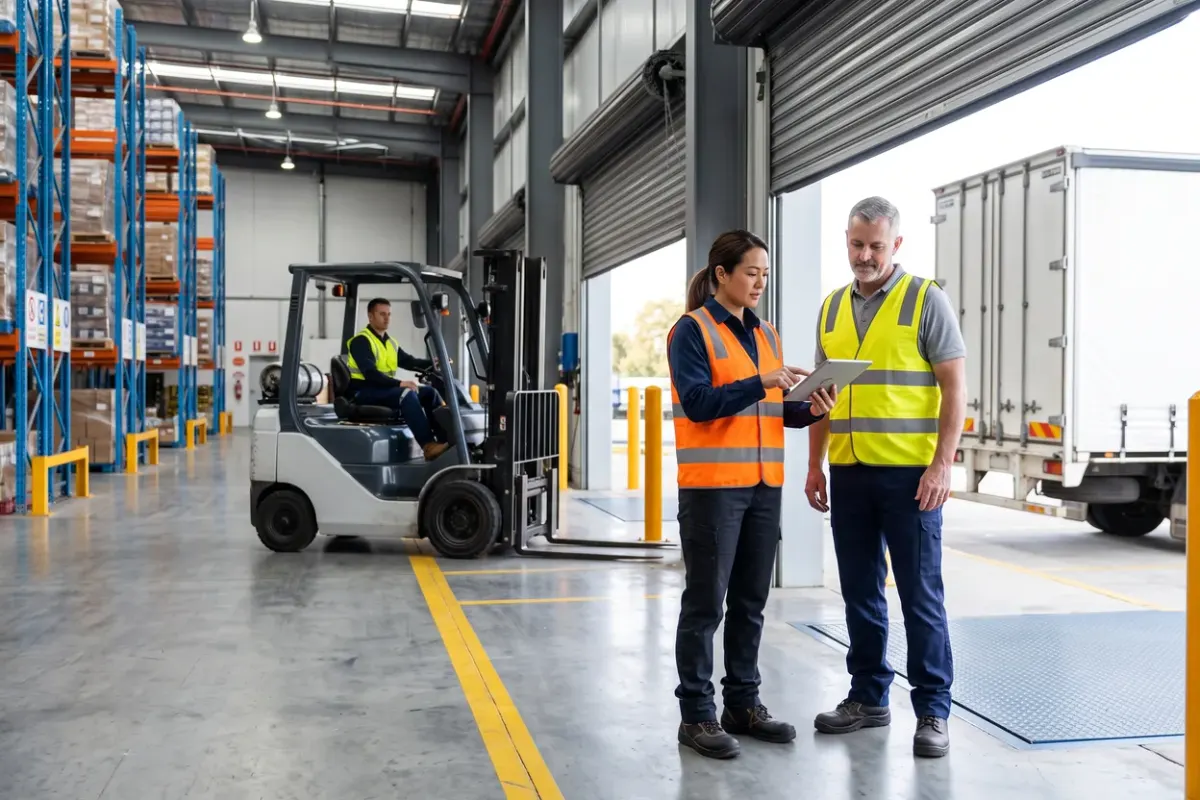
A distribution centre receives curtainsiders on a hardstand beside its dock. Each one is unloaded by forklift from the side, and the carrier's driver opens the curtains and releases the straps. The JSA came out of a near miss: a driver stepped back from a curtain into the path of a reversing forklift.
| Step | Hazard | Control | Who |
|---|---|---|---|
| Truck parks on the pad | Driver walking across forklift paths from the cab to the safe zone | Painted walkway from the pad to a fenced driver safe zone | Shift lead checks the walkway markings weekly and the safe-zone barrier before the first trailer |
| Driver releases straps and opens curtains | Load shifted in transit falls as the curtain is opened | Forklift stopped and lowered; driver opens from the trailer's end, never standing in front of a bay | Forklift operator holds until the driver is behind the safe-zone barrier and signals |
| Shifted load found | Unloading a load that is leaning or broken | Stop. Shift lead decides how to unload it; it is photographed and reported | Shift lead |
| Forklift unloads | Driver re-entering the work area | Driver stays in the safe zone behind the barrier until the operator signals clear | Forklift operator and driver |
| Curtains closed, truck leaves | Forklift and truck moving at once | Operator parks clear of the pad before the driver leaves the safe zone | Forklift operator |
The first control is the one that mattered. Before the near miss, the driver's place was "stand clear". After it, the driver's place was a fenced zone with a gate, reached by a painted walkway, which removed most of the chance of a person and a forklift sharing the same metre.
What the centre kept was as important as what it wrote. It kept the JSA, the names of the crew briefed on it, the gatehouse record that each carrier's driver had been told where the safe zone is, and the photographs of every shifted load, which went to the inbound team to raise with the carriers concerned.
Why JSAs Fail on the Day.
A JSA rarely fails because a hazard was missed. It fails because it was never really part of the job. The common reasons are:
- Written in the office. The steps are the procedure's, not the crew's, so the real workaround is not in it.
- Copied from another site. The dock at one depot is not the dock at another; door numbers, ramps, and traffic flows differ.
- Controls that leave the decision to the worker. Safe Work Australia's model Code of Practice: Construction Work says a statement such as "use appropriate personal protective equipment" does not detail the control measures; the same is true in a JSA.6
- Signed, not briefed. A signature sheet shows who signed, not who understood.
- Never reopened. The forklift fleet changed, the racking moved, and the JSA still describes the old layout.
Every one of these is fixed by the same thing: writing and reviewing the JSA at the job, with the people who do it.
Who Should Write a JSA, and Who Should Check It?
The people who do the job, with their supervisor holding the pen. They know the steps and the shortcuts; the supervisor knows what the site will and will not allow. The safety manager's job is to check a sample, test the controls against the hierarchy, and make sure the JSAs for the riskiest tasks are the best written, not to write every one.
That is also what the law expects of consultation. Under section 47 of the model WHS Act, a business must, so far as is reasonably practicable, consult the workers who carry out work for it and who are, or are likely to be, directly affected by a work health and safety matter.2 A JSA written without the crew is a missed chance to do that, and usually a worse JSA.
Contractors bring their own JSAs for their own work, and that is right: they know their task. What they do not know is your site. Check that their JSA names your dock, your traffic, and your people, and add the site's controls where theirs stop.
Keeping JSAs Current Across Depots.
A JSA is current when it describes the job as it is done this week. The triggers to reopen one are the same everywhere: an incident or near miss on the task, new equipment, a changed layout, a new contractor or carrier, or a fixed review date for jobs that have not changed. Across a network of depots, the harder problem is knowing which site's JSA is the latest, and which contractors' documents were checked against it.
That is where a system helps. In ComplyFlow, a client can switch on AI-powered review for selected questions in a form, so that a contractor who uploads a document, such as their JSA for a job on your site, gets feedback against the criteria the client has set and can update it and review again up to 3 times.7 The review does not block submission and does not replace the reviewer, who still makes the final decision.7 The documents sit with the contractor's other site documents, and our page on AI in ComplyFlow covers what else it reads.
Start With the Jobs Your Near Misses Point To.
Pull the last 12 months of incidents and near misses for one depot, and find the three tasks that appear most often. Write the JSA for each at the job, with the crew who do it, and put the carrier's driver into it wherever they stand on your dock. Brief it, record who heard it, and reopen it the first time something changes. Three JSAs the dock can recite beat a folder nobody opens. To see contractor documents, reviews, and site records on one record, book a demo.
Sources
- Safe work method statement for high risk construction work: information sheet
- Model Work Health and Safety Act (model WHS Bill, as at 5 December 2025)
- Model Work Health and Safety Regulations (as at 5 December 2025)
- Occupational Health and Safety Regulations 2017 (Vic), authorised version 018
- Safe Work Method Statements (SWMS)
- Construction work: Code of Practice
- AI-Powered Review in Forms
- Heavy Vehicle National Law (Queensland), current as at 1 August 2026
- Heavy Vehicle National Law and Regulations (has not commenced in Western Australia or the Northern Territory)
See It Against Your Own Contractors, Sites & Rules.
Book a 30-minute demo. We will show ComplyFlow working with your kind of sites, your kind of contractors, and your requirements. No slides, no hard sell.
Or Speak to Us
- ISO 27001
- Hosted on AWS
- Microsoft & Okta SSO
- API & MCP
- Data in Australia
Written by
Bart CrowtherDirector of Sales, ComplyFlow
Bart leads sales at ComplyFlow and spends his week with the safety, procurement, and facilities teams deciding how to manage contractors. He writes about what buyers ask, and what separates a system that gets used from one that gets ignored.
Writes about: Choosing a compliance system, Rollout and adoption, What buyers ask
Questions
Questions People Ask About This.
Is a job safety analysis the same as a job hazard analysis?
Yes, in practice. Job hazard analysis (JHA) is the more common name in the United States, and job safety and environment analysis (JSEA) is used where environmental risks are included. In each case the method is the same: break the task into steps, name the hazards at each step, and set the controls.
What is the difference between a JSA and a risk assessment?
A risk assessment looks at a hazard, an area, or an activity and judges how likely and how serious the harm is. A JSA looks at one task step by step and sets the controls for each step. A good risk assessment tells you which tasks need a JSA; the JSA tells the crew how to do that task safely.
Should a carrier's driver sign the site's JSA?
They should be briefed on the parts that involve them, such as where they stand while a trailer is unloaded, and that briefing should be recorded. Many sites do this at the gatehouse or in a short dock induction rather than by having every driver sign the full JSA.
How often should a JSA be reviewed?
Whenever the job changes: new equipment, a new layout, a new contractor, an incident, or a near miss. Many businesses also set a fixed review date, often yearly, so that JSAs for jobs that have not changed are still read again by the people doing them.