Chain of Responsibility: The Duty, the 2026 Changes, and the Evidence
Chain of Responsibility is the part of the Heavy Vehicle National Law that makes businesses other than the driver responsible for heavy vehicle safety. Anyone who consigns, receives, packs, loads, schedules, or operates has a primary duty to ensure the safety of those activities so far as is reasonably practicable, and executives carry a personal duty of due diligence. The law changed on 1 August 2026.
 Mitchell BourneManaging Director
 - Published
- Updated
- 16 min read
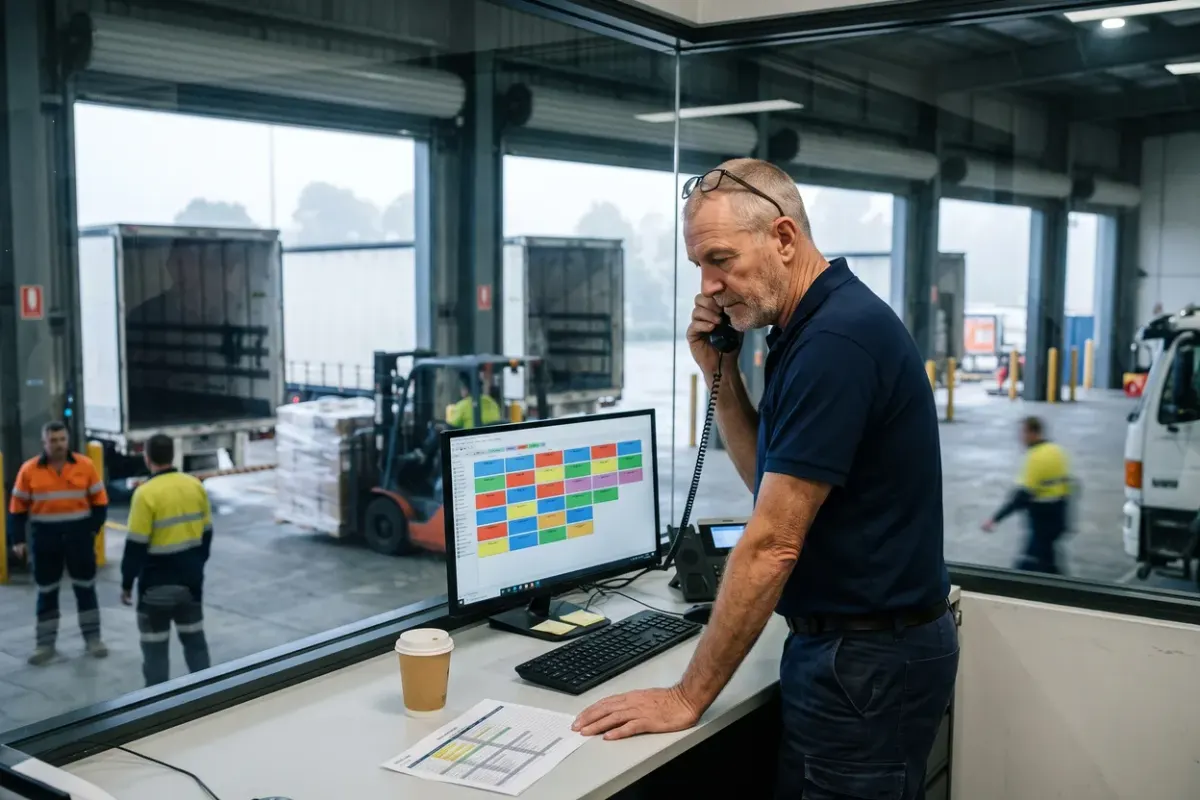
If your business sends freight out or takes it in by heavy vehicle, you are in the Chain of Responsibility whether anyone has told you or not. It is not a transport company's problem that customers can stay clear of. It sits with the business that sets the delivery window, loads the trailer, books the carrier, and signs the contract, and the law that governs it changed on 1 August 2026.
This guide is written for the operations manager at a transport and logistics business: a distribution centre, a third-party warehouse, or a freight business that subcontracts its linehaul. It covers what the duty is, who holds it, what changed this year, what the penalties are now, where it applies, and what evidence shows you met it.
What Is Chain of Responsibility?
Chain of Responsibility is the part of the Heavy Vehicle National Law (HVNL) that makes parties other than drivers responsible for the safety of heavy vehicles on the road.1 The law puts it as a principle: the safety of transport activities relating to a heavy vehicle is the shared responsibility of each party in the chain.2
A heavy vehicle, for these purposes, is one with a gross vehicle mass or aggregate trailer mass over 4.5 tonnes, or a combination that includes one.2
The idea behind it is simple. A crash caused by a fatigued driver often starts somewhere else: a delivery window nobody could meet legally, a load that was not ready when the truck arrived, a contract that paid by the drop and penalised lateness. Before October 2018 these laws were based on extended liability. Since then they have worked on a positive duty that each business carries for itself.4
Who Is a Party in the Chain of Responsibility?
A business is a party when it performs one of 10 functions: it employs a driver, engages a self-employed driver, operates the vehicle, schedules goods or drivers, consigns goods, receives goods, packs them, manages the premises where they are loaded, loads them, or unloads them.5
Three details in that list catch operations teams out.
The first is that responsibility follows the function, not the job title or the wording of a contract. The NHVR says you are a party "because of a function you perform, not because of a title or job description, or the words of a contract."5 Its rule of thumb is blunter: if your business sends or receives goods by heavy vehicle, it is a party.5
The second is the loading manager. That is whoever manages premises where, on the NHVR's description, five or more heavy vehicles are loaded or unloaded each day.5 A busy distribution centre clears that easily. The law also counts as a loading manager a person assigned to supervise, manage, or control the loaders and unloaders at those premises,2 which can be the operations manager reading this.
The third is the driver. Driving is not one of the functions, so an employed driver is not a party because they drive, though drivers carry obligations of their own. An owner-driver is a party, as the operator of their own vehicle.5
What Is the Primary Duty?
However many functions a business performs, the NHVR says it has one Primary Duty.5 Section 26C of the HVNL says each party "must ensure, so far as is reasonably practicable, the safety of the party's transport activities relating to the vehicle."2 That means eliminating public risks, and where that is not reasonably practicable, minimising them. It also means, so far as is reasonably practicable, ensuring its conduct does not directly or indirectly cause or encourage a driver, or another party, to break the law.2
"Reasonably practicable" means what could reasonably be done at the time, weighing up all relevant matters, the last of which is whether the cost is grossly disproportionate to the likelihood of the risk or damage.2 Where more than one party has the duty, each discharges it to the extent it can influence and control the matter, or would have been able to but for an agreement that limits that capacity.2
Two features matter most for anyone who writes or signs transport contracts. Entering into a contract counts as conduct under the duty, so the terms you set are part of what you are judged on.2 And the duty cannot be passed on: "A duty under this Law may not be transferred to another person."2
The NHVR restated this on 22 September 2026, in new advice on shared responsibility. Parties "remain a CoR party even when their transport activities are contracted, or subcontracted, to another party," and more than one party can hold the Primary Duty for the same activity at once.7 Shared responsibility, it adds, "does not mean equal responsibility": responsibility follows influence and control, and parties are accountable for "the constraints they impose" on others.7
Nothing has to go wrong for the duty to be breached. The NHVR's own guidance says a business could be charged "even if no incident has actually occurred."4
What Changed on 1 August 2026.
The amended HVNL commenced on 1 August 2026, after the Heavy Vehicle National Law Amendment Act 2025 passed the Queensland Parliament on 18 November 2025.8 The Primary Duty itself is word for word the same. These are the changes that bear on a business's duty:
- Prohibited requests and contracts (s 26E) were widened and the penalty doubled. It is an offence to ask, direct, or require a driver or another party, or to contract with them, to do something the person "knows, or ought reasonably to know" would make the driver speed, drive while impaired by fatigue or unfit to drive, or drive a fatigue-regulated heavy vehicle in breach of work and rest hours. The fatigue limb now covers any heavy vehicle, driving while unfit is new, and the base penalty rose from AU$10,000 to AU$20,000.2 Indexed, it is AU$28,230 from 1 August 2026,9 up from AU$14,120 on the July 2026 schedule.10
- The executive duty has its own subsection (s 26D(1A)) for the Primary Duty, with its penalty tied to the three breach categories.2
- A safety management system is now defined in the law (s 457A), and an audit of one by an approved auditor is admissible in a Primary Duty prosecution (s 632B).2
- Codes of practice are now issued by the NHVR (s 705) rather than registered industry codes, and a court may rely on them to decide what was reasonably practicable (s 632A).2
- Accreditation changed. The Heavy Vehicle Accreditation scheme replaced the old national scheme, with General Safety Accreditation and Alternative Compliance Accreditation levels.11 An accreditation in force before 1 August 2026 keeps running under the old law until it expires or is cancelled.2
The operational rules changed as well. The NHVR lists updates to fatigue requirements, simplified work diary record-keeping, and changes to mass, dimension, and loading provisions.3 This guide is about the duty; for the detailed rules that apply to your fleet, go to the NHVR's reform pages.
For a consignor, the first of those is the one to act on. The penalty is aimed at exactly the pressure a customer or a shipper applies: the window that cannot be met without breaking the rules, the late fee that makes a driver choose between the fine and the rest break.
Executive Due Diligence Is a Personal Duty.
If the business is a party, its executives carry a separate duty to exercise due diligence to make sure it complies.2 For a company, that means an executive officer; for a partnership, a partner. An executive can be convicted even if the business itself has not been prosecuted.2
This may include you. The HVNL defines an executive officer of a corporation as a director or "any person, by whatever name called and whether or not the person is a director of the corporation, who is concerned or takes part in the management of the corporation."2 An operations manager who runs the dock, sets the booking rules, and engages the carriers takes part in management in a way that can matter. The NHVR's own page puts it more broadly still: the term "includes an executive officer, a manager or another person who takes part in the management of a business."12
The law spells out what due diligence involves: taking reasonable steps to keep up to date with safe transport practice, understanding the business's own transport activities and their risks, making sure it has and uses the right resources and processes, and verifying that those resources and processes are actually being provided, used, and implemented.2 That last step is the one a board paper cannot satisfy on its own. An executive who fails in the duty can face the same penalty as an individual who breached the Primary Duty.4
The Penalties From 1 August 2026.
The HVNL sets each maximum penalty in dollars and indexes it every 1 July.2 The NHVR publishes the indexed figures. These are the maximums for 1 August 2026 to 30 June 2027.9
| Offence | Individual | Company |
|---|---|---|
| Category 1, reckless conduct exposing someone to risk of death or serious injury or illness (s 26F) | AU$436,850 or 5 years' imprisonment, or both | AU$4,230,550 |
| Category 2, a breach that exposes someone to that risk (s 26G) | AU$212,090 | AU$2,120,880 |
| Category 3, a breach of the Primary Duty (s 26H) | AU$70,580 | AU$705,820 |
| Prohibited requests and contracts (s 26E) | AU$28,230 | Up to AU$141,150, five times the individual maximum (s 596) |
The figures in the law itself are the base amounts: AU$300,000 and five years, AU$3,000,000 for a company, and so on down.2 Those are the numbers most guides still quote, without a date. Where an offence sets no separate figure for a company, as section 26E does not, a court may fine a body corporate up to five times the individual maximum.2 Court is not the only outcome: the NHVR says sanctions range "from education and improvement notices to prosecution."7 None of the three Primary Duty categories can be dealt with by an infringement notice; they go to court.9 Since 1 August 2026, if a Category 1 charge is not proven, the court can find the person guilty of a Category 2 or 3 offence instead.2
Does Chain of Responsibility Apply in My State?
The HVNL commenced on 10 February 2014 in the Australian Capital Territory, New South Wales, Queensland, South Australia, Tasmania, and Victoria.3 Each has its own law adopting it, with some local variations. It has not commenced in Western Australia or the Northern Territory, but it applies to vehicles from those jurisdictions once they cross into one where it does, and some rules, such as work diary requirements, can apply before the border.3
| Where | Which law | What it means for a national operation |
|---|---|---|
| ACT, New South Wales, Queensland, South Australia, Tasmania, Victoria | The HVNL, adopted by each; the text is the schedule to a Queensland Act | One duty, one set of penalties, one regulator, the NHVR |
| Western Australia | Its own Chain of Responsibility laws, in the Road Traffic (Administration) Act 2008 and the Road Traffic (Vehicles) Act 2012 | Separate law and regulator, Main Roads WA; the HVNL applies once a WA vehicle crosses into a state or territory where it has commenced |
| Northern Territory | The HVNL has not commenced | Check the Territory's own road transport rules; the HVNL applies once an NT vehicle crosses into a state where it has |
Western Australia brought in Chain of Responsibility in 2015, and Main Roads WA publishes yearly prosecution outcomes on its Chain of Responsibility page.13 A business that runs freight into Perth should read the WA rules on their own terms rather than assume the HVNL applies.
What a Consignor Checks Before a Carrier Is Booked.
Take a third-party logistics business running a distribution centre in western Sydney. Forty trucks a day load there, which makes it a loading manager as well as a consignor. Its largest retail customer runs a regional distribution centre in Canberra with two-hour receiving slots and a fee for every missed one. The operations manager subcontracts the run to a carrier the business has used for a year, loading at 2am for a 6am slot.
Here is where the duty bites. If the trailer is loaded two hours late and the slot does not move, the driver has already spent those hours waiting at the dock, and the run to Canberra is about three hours. Making the slot means driving at the end of a long shift, or pushing the speed on the Hume. The distribution centre did not drive the truck, but it set the constraint, and under the NHVR's advice the responsibility follows the constraint.7
What a careful operations manager has checked, and kept, before that night:
- The carrier, before the first booking. The NHVR's guidance is to find out how another business operates before you contract with it, and to put provisions in the contract that give you access to its safety performance information.6 In practice: its accreditation where it holds one, its insurance, and how it manages fatigue, on file with their expiry dates.
- The booking system. Among the NHVR's own examples of fatigue controls: booking systems that "allow for unexpected delays without penalty", and packing and loading planned so goods are ready for collection on time.14 The NHVR has also published regulatory advice on managing the risks of time slot bookings (10 May 2022).15
- The customer contract. Whether a late fee survives a delay caused at the dock, and whether the window can move. A term that punishes a safe late arrival is the kind of pressure section 26E is written for.
- What happened on the night. The late load recorded, the customer's receiving office told, a new slot agreed, and the driver not asked to make up the time.
None of that is exotic. It is the ordinary record of a well-run dock. The difference is whether it exists when someone asks for it.
What Records Prove You Managed the Risks?
The NHVR sets out six steps: know your transport activities, identify the risks, assess them, decide how to control them, put the controls in place, and monitor and update them. It names the main risks as fatigue, speeding, excessive mass or dimension, poorly restrained loads, and unsafe vehicles.14 The controls it lists include training or recruitment, procedures, forms and documentation, equipment, technology, monitoring, auditing, and "agreements or amended agreements".14
Loading gets its own advice: the NHVR's guidance on loading and load restraint (13 February 2024) covers packing, loading, unloading, and restraint practices under the Primary Duty.15 By function, the evidence a regulator would expect looks like this:
| Your function | What you control | What shows you controlled it |
|---|---|---|
| Consignor or consignee | Delivery windows, booking terms, what you ask of carriers | Contract terms, booking records, how delays were handled |
| Loading manager, loader, or packer | Mass, dimension, restraint, and loading time | Load records, restraint checks, dock queue times |
| Scheduler | Driver hours and timetables | Schedules against work and rest hours, records reviewed regularly |
| Operator or employer | Vehicles, drivers, and carriers engaged | Maintenance and pre-start records, licences, the carrier file |
| Executive | Resources and processes | Evidence the processes are used and checked, not only written |
A safety management system is not a legal requirement for most heavy vehicle businesses, but the NHVR calls it one of the best ways to manage the risks and demonstrate compliance with the Primary Duty.11 Operators accredited under the new scheme must have one. The NHVR's 2026 Master Code, reorganised around 45 transport activities, carries no offence for skipping a control, but a court can use it as evidence of what was reasonably practicable.16
How Often Should You Audit for Chain of Responsibility?
Auditing is one of the control measures the NHVR lists, alongside procedures, monitoring, and agreements.14 Since 1 August 2026 it also carries legal weight: an audit of an operator's safety management system by an approved auditor, carried out under the audit standard, is admissible in a Primary Duty prosecution (s 632B).2 The new accreditation scheme comes with its own National Audit Standard.8
The NHVR material we read sets no audit frequency for a business outside accreditation. Set it by risk: more often where you load heavy vehicles every day or rely on subcontracted carriers, and after any change to your customers' delivery terms. Audit carriers against what their contract promised, and audit your own dock against the controls above. An audit that finds nothing and changes nothing is a record too, but a weak one.
For a vehicle-level view of the same problem, our guide to what a digital vehicle inspection has to record covers pre-starts and defects.
Who Needs Chain of Responsibility Training?
Everyone whose work is one of the 10 functions, in proportion to what they control. The NHVR lists training among the control measures a business can use, and publishes regulatory advice on managing the risks of undertrained workers.15 In a distribution centre that means the schedulers who set windows, the dock staff who load and restrain, and whoever books carriers and signs their contracts.
Executives are in the list too. Part of their due diligence duty is to take reasonable steps to acquire and keep up to date knowledge of safe transport activities.2 A briefing once, at induction, does not keep anything up to date.
What matters in the record is who was trained, in what, and when, kept where you can find it. A loader who has never been shown how to restrain a load is a risk you knew about.
Keeping the Carrier File Current.
Most of the evidence above is about other businesses: the carriers, owner-drivers, and subcontractors you engage. That makes it contractor management, and it fails the same way contractor management fails elsewhere, in spreadsheets and inboxes that nobody can search when it matters.
This is where ComplyFlow is built to help. A carrier can be prequalified like any other contractor, through a questionnaire where insurances are mandatory and documents are uploaded against it.17 Vehicle documents are held against the vehicle, with their expiry dates, and approved by the people assigned to that category.18 A single report shows every document across the account, including anything due to expire within a set number of days.19 For a transport and logistics team, that is the carrier file, current and in one place.
A Chain of Responsibility Checklist for Operations Managers.
Run this against your own operation. Every no is a gap in the evidence, whatever the practice on the dock actually is.
- We have listed which of the 10 functions our business performs, at each site.
- Every carrier we book was checked before its first job, and its insurance, and accreditation where it holds one, are on file with expiry dates.
- Our carrier contracts give us access to their safety performance information.
- Our booking system and our customer contracts allow for delay without penalising a safe late arrival.
- Loading is planned so goods are ready when the truck arrives, and restraint is checked before it leaves.
- Schedules are checked against work and rest hours, and those records are reviewed.
- Loaders, schedulers, and dock staff have been trained in their part of the duty, and we can show it.
- Everyone who takes part in managing the business, not only the board, can show they check that all of this is happening, not only that it is written down.
- Where we run freight into Western Australia, we have read the WA rules.
The duty is to ensure safety so far as is reasonably practicable. Nobody expects a consignor to drive the truck. The law expects it to stop setting conditions that only an unsafe trip can meet. The record of what it checked and changed is how it shows that, when someone asks. For more on how this plays out by role, see our page for operations leaders.
Sources
- Chain of Responsibility (CoR)
- Heavy Vehicle National Law (Queensland), current reprint
- Heavy Vehicle National Law and Regulations
- Chain of Responsibility FAQs
- Parties in the CoR
- Primary duty scope
- Regulatory Advice: Shared Responsibility
- HVNL reform implementation
- HVNL penalties and infringements, 1 August 2026 to 30 June 2027
- HVNL penalties and infringements, July 2026
- CoR resources
- Executive due diligence duty
- Chain of Responsibility
- Complying with your Primary Duty obligations
- Regulatory Advice
- 2026 Master Code
- Form Prequalification Process
- Plant & Vehicle Documents
- Reporting on all documents in the system
See It Against Your Own Contractors, Sites & Rules.
Book a 30-minute demo. We will show ComplyFlow working with your kind of sites, your kind of contractors, and your requirements. No slides, no hard sell.
Or Speak to Us
- ISO 27001
- Hosted on AWS
- Microsoft & Okta SSO
- API & MCP
- Data in Australia
Written by
Mitchell BourneManaging Director, ComplyFlow
Mitchell has run ComplyFlow since 2009 and has spent that time inside the contractor, site, and safety problems of Australian operators. He writes about where compliance actually fails, and what the people responsible for it can do about it.
Writes about: Contractor compliance, WHS duty and proof, Running a compliance program
Questions
Questions People Ask About This.
Does Chain of Responsibility apply to businesses that do not own trucks?
Yes. The Heavy Vehicle National Law names 10 functions that make a business a party, and most of them, including consignor, consignee, packer, loader, unloader, loading manager, and scheduler, belong to businesses that may never own or drive a heavy vehicle. A business that sends or receives goods by heavy vehicle is a party for those activities.
Is a truck driver a party in the Chain of Responsibility?
Not because they drive. The NHVR says driving is not one of the Chain of Responsibility functions, so an employed driver is not a party for that reason, though drivers have their own obligations under the law. An owner-driver is a party, because running their own vehicle makes them its operator.
Do I need a safety management system to comply with Chain of Responsibility?
Not for most businesses. The NHVR says an effective safety management system is not a legal requirement for most heavy vehicle businesses, but is one of the best ways to manage the risks and show you met the Primary Duty. Operators accredited under the Heavy Vehicle Accreditation scheme must have one that meets the Safety Management System Standard.
What is the penalty for a Chain of Responsibility breach?
It depends on the category. For 1 August 2026 to 30 June 2027 the NHVR's indexed maximums run from AU$70,580 for an individual and AU$705,820 for a company for a Category 3 breach, up to AU$436,850 or five years' imprisonment, or both, for an individual and AU$4,230,550 for a company for a reckless Category 1 breach. The amounts are indexed every 1 July.
Is it an offence to set a delivery deadline a driver cannot meet safely?
It can be. Under section 26E of the Heavy Vehicle National Law it is an offence to ask, direct, or require a driver or another party, or to enter into a contract with them, to do something you know or ought reasonably to know would make the driver speed, drive while impaired by fatigue or unfit to drive, or drive a fatigue-regulated heavy vehicle in breach of work and rest hours. From 1 August 2026 its indexed maximum is AU$28,230 for an individual, and a court can fine a company up to five times that.
Can a contract transfer my Chain of Responsibility duty to a carrier?
No. The Heavy Vehicle National Law says a duty under it may not be transferred to another person, and more than one party can hold the Primary Duty for the same activity at once. A contract can set safety expectations, give you access to a carrier's safety information, and set up monitoring and reporting, but the duty stays with you.