Confined Space: The Legal Definition and the Building Owner's Checks
Under the model WHS Regulations, a confined space is an enclosed or partially enclosed space not designed or intended primarily to be occupied by a person, at (or designed or intended to be at) normal atmospheric pressure while anyone is in it, that is or is likely to be a risk from an unsafe oxygen level, contaminants that may cause fire or explosion, harmful concentrations of airborne contaminants, or engulfment; mine shafts and mine workings are excluded.
 John McCannHead of Product
- Published
- 17 min read
Most commercial buildings have confined spaces that nobody on the facilities team ever enters: the grease arrestor under the food court, the stormwater and sewer pits, the fire and rainwater tanks, the sump in the basement car park. This guide is for the facilities manager or building owner who has to decide whether a space is a confined space, and what must be in place before a contractor climbs down into it.
The examples come from property and facilities management, with a second from a distribution centre. They are illustrations, not customers.
What Is a Confined Space?
A confined space is a space that meets four tests at once. The model WHS Regulations define it, in regulation 5, as an enclosed or partially enclosed space that is not designed or intended primarily to be occupied by a person, is, or is designed or intended to be, at normal atmospheric pressure while anyone is in it, and is or is likely to be a risk to health and safety from an atmosphere without a safe oxygen level, from contaminants (including airborne gases, vapours, and dusts) that may cause injury from fire or explosion, from harmful concentrations of any airborne contaminants, or from engulfment. Mine shafts and the workings of a mine are excluded.1
Safe Work Australia's model confined spaces code adds two points that settle most arguments on site. A confined space is decided by the hazards in a set of circumstances, not just because the work is in a small space. And entry happens when a person's head or upper body is in the space, so leaning into a pit to reach a valve counts.2
Every state and territory except Victoria has implemented the model laws as its own, with some variations, so check your own jurisdiction's Act and Regulations.3 Victoria's definition is different, and it is covered further down.
Which Spaces Are Not Confined Spaces?
The code lists places that are generally not confined spaces: rooms built for people with adequate ventilation, lighting, and a safe way in and out, such as offices and workshops; spray booths designed for a person to occupy; and spaces designed to be occupied now and then that have a readily and conveniently accessible doorway at ground level, such as a cool store, where escape and rescue can happen quickly once the alarm is raised.2
In the code's worked table, clearing a sludge blockage in a drain pit is a confined space. Inspecting a new, clean tank before it is commissioned is not, and neither is installing insulation in a roof cavity.2
The same structure can be a confined space on one visit and not the next, and work that would generate harmful fumes can turn an ordinary space into one. Temporary measures, such as temporary ventilation or a satisfactory gas test before entry, do not stop a confined space being one. The code says a space is declassified only after sufficient changes in its structure and use to eliminate all the hazards that make it a confined space.2
Confined Spaces in a Building, a Centre & a Depot.
The code says confined spaces are commonly found in tanks, pits, pipes, ducts, underground sewers, wells, shafts, and tunnels, when they meet the definition.2 In a property portfolio that points straight at the plant the facilities team controls but rarely sees inside: grease arrestors, sewage and stormwater pits, fire water and rainwater tanks, cooling tower basins, service tunnels, and underground pump wells.
The code names the hazards that make these spaces dangerous. Hydrogen sulphide builds up in sewers and pits, and decomposing organic material releases it, especially when disturbed; sludge and deposits release contaminants when they are stirred up. Carbon monoxide from LPG forklifts working near a space can collect inside it.2
Under the model code, engulfment also covers any liquid, including oil or water, in which a person can drown.2
Your Own Duty as the Owner or Facilities Manager.
The business with management or control of a workplace must ensure, so far as is reasonably practicable, that the workplace, the ways in and out of it, and anything arising from it are without risks to the health and safety of any person, under section 20 of the model WHS Act.4 The grease arrestors, tanks, and pump pits are the building's plant too, and the business with management or control of fixtures, fittings, or plant at a workplace must ensure, so far as is reasonably practicable, that they are without risks to the health and safety of any person, under section 21.4 The confined space rules in the model Regulations attach to each business through the spaces under its management or control, and that business must ensure, so far as is reasonably practicable, that no worker enters a space before those rules have been met for it.1
You also carry a duty yourself. While at work, a worker must take reasonable care for their own health and safety, take reasonable care that their acts or omissions do not adversely affect the health and safety of others, and comply, so far as they are reasonably able, with the business's reasonable instructions, under section 28 of the model WHS Act, and an officer of the business must exercise due diligence to ensure the business complies with its duties under the Act, under section 27; whether a facilities manager is an officer depends on the role.4
In practice, three things belong to the building, whoever does the work: knowing where its confined spaces are, stopping people getting into them by accident, and making sure nobody goes in on a job until the rest of this guide is in place. The code says signage alone should not be relied on to prevent unauthorised entry, and that security devices, such as locks and fixed barriers, should be installed.2
Who Is Responsible When a Contractor Goes In?
Both businesses are. Safe Work Australia's code says that the person who owns the plant or structure containing the confined space has management or control of it, and that a contractor engaged to work in the same space also has management or control of it while the work is being carried out.2
The model WHS Act does not let either one hand its duty to the other. A duty cannot be transferred, and where more than one person has a duty for the same matter, each keeps responsibility for its own, and must discharge it to the extent it has the capacity to influence and control the matter, or would have had that capacity but for an agreement or arrangement purporting to limit or remove it.4 Section 46 then requires each of them to consult, co-operate, and co-ordinate activities with the others, so far as is reasonably practicable.4 Our guide to consulting, cooperating, and coordinating with contractors covers how that works day to day.
Regulation 67 puts the permit on the business that directs the worker in: it must not direct a worker to enter a confined space to carry out work unless it has issued a confined space entry permit for the work.1 When the plumbing contractor directs its own plumber into your pit, that is the contractor; if your own team directs a worker in, it is you. Agree before the job who completes the permit, and make sure the building's part, such as the services only you can shut off, is written on it.
What Must a Confined Space Entry Permit Include?
The model WHS Regulations set the contents. The permit must be completed by a competent person and be in writing. It must name the confined space, the people permitted to enter, the period during which the work will be done, and the measures to control the risks, and it must have space to acknowledge that the work is finished and everyone has left. The controls must be based on the risk assessment and include those for safe entry and details of the communication and standby system. When the work is done, everyone must leave and the competent person must complete that acknowledgement.1
That permit duty is not qualified by what is reasonably practicable. Directing a worker in without one is an offence with a maximum penalty at tier E in the model Regulations. In the model Act's Schedule 4 the tier E maximum for a body corporate is five times that for an individual, and each jurisdiction that has adopted the model laws sets its own amounts.14
The code adds the practical rules. A permit is issued each time work is to be done in a confined space, and each one covers one space only. The competent person who directs and supervises the work should complete it. A permit is needed even to enter for the first hazard check, it should be displayed where people can sign it, and it is the written record that everyone has come out.2 Its sample permit, in Appendix C, runs through isolation, atmosphere test results, the conditions for entry, hot work, the authority to enter, the people authorised, and the withdrawal of that authority.2 For how a confined space permit fits beside hot work and isolation permits, see our guide to permit to work systems.
What Makes a Confined Space Dangerous.
The code warns that many confined space hazards cannot be seen, toxic gases among them, or cannot be seen from outside the space.2 According to the model WHS Regulations (as at 5 December 2025), a safe oxygen level is between 19.5% and 23.5% by volume at normal atmospheric pressure; normal air holds 21%, according to Safe Work Australia's November 2026 code.12 According to the same model WHS Regulations (as at 5 December 2025), a business must ensure, so far as is reasonably practicable, that flammable gas, vapour, or mist stays below 5% of its lower explosive limit while work is going on. If that is not reasonably practicable, according to the same model Regulations (as at 5 December 2025), between 5% and 10% of that limit workers must be removed at once unless a suitably calibrated, continuous-monitoring flammable gas detector is used in the space, and at 10% or more they must be removed at once.1
The code is blunt that a person's senses should never be used to decide whether the air is safe. Hydrogen sulphide is heavier than air and, in an unventilated space, settles at the bottom, and methane is lighter and collects at the top, so a single reading at the hatch can miss both.2
The code also lists engulfment, moving parts, electricity, heat, noise, and poor lighting inside the space, and falls into openings and passing traffic outside it.2
Avoid Entry, Then Assess, Isolate & Test the Air.
The first question the code asks is whether the work can be done without going in at all. Its examples include cleaning a tank with spray heads or high-pressure hoses through the hatch, inspecting with a remote camera, and retrieving a dropped object with a hook or a magnet on a string.2
A business must manage the risks of each confined space under its management or control, including the risk of someone entering it by accident and of work on or near it. It must ensure a risk assessment is done by a competent person and recorded in writing, and one of the matters the assessment must consider is whether the work can be done without entering the space.1 The business must also, so far as is reasonably practicable, eliminate the risk of anything being introduced into the space by plant or services connected to it, or of that plant being activated or energised, and otherwise minimise it so far as is reasonably practicable.1
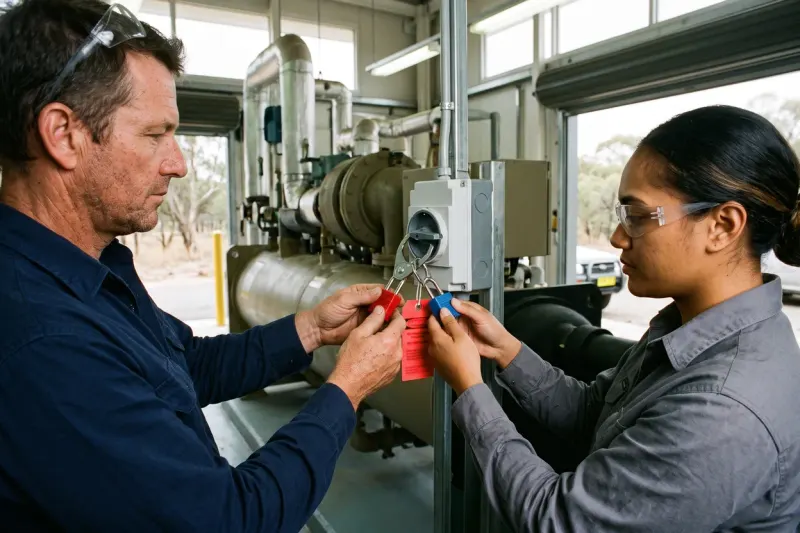
The code says to isolate all potentially hazardous plant and services before anyone enters, and to keep the isolations in place until all work is complete and everyone is out. Where a lock is used, the key should stay with the person who placed it, and the tag should say a person is inside.2 Our lockout tagout guide covers the locks and tags. Testing should be done by a competent person with a correctly calibrated detector, from outside first, side to side and top to bottom, and repeated or run continuously if the work could change the air.2
Signs, the Standby Person & a Rescue Plan That Works.
Signs must go up next to each entry, identifying the space and telling workers not to enter without a permit, from preparation through to packing up.1 A business must ensure that a worker does not enter a confined space to carry out work unless it provides a system of work with continuous communication with the worker from outside the space and a standby person near the space monitoring conditions inside and, if practicable, watching the work, under regulation 69.1
The code describes that standby person carefully. They should understand the hazards and recognise the symptoms, stay outside and do no other work, have the rescue equipment at hand, have authority to order everyone out, and never enter the space to attempt a rescue.2 A second plumber who is also running the pump is doing other work that may interfere with monitoring, which the code says a standby person should not do.
The business must set up first aid and rescue procedures, practise them as necessary so they are efficient and effective, and start them from outside the space as soon as practicable in an emergency.1 If the plan relies on the fire brigade, the code asks how they will be called, what they will be told about the space when they arrive, and whether arrangements have been made so they can respond in a reasonable time with specialist retrieval equipment. It also asks whether they can reach the site at night, on weekends, and over holidays.2 A phone number on the permit answers none of those.
What Records Must You Keep, and for How Long?
Under regulation 77 of the model Regulations, the business that prepares the risk assessment must keep a copy until at least 28 days after the work is completed, and the business that issues the permit must keep it at least until the work is completed. If a notifiable incident occurs in connection with the work, each must be kept for at least 2 years after the incident, and a copy must be available to any relevant worker who asks.1
Training is recorded separately. Relevant workers, including those who support the work without entering it and the people supervising them, must be given information, training, and instruction on the hazards, the controls, protective equipment, the permit's contents, and emergency procedures, and a record of all that training must be kept for 2 years.1
The record duties sit with the business that prepares the risk assessment or issues the permit, and the training record with each business whose relevant workers are involved. Under regulation 76 those include workers who carry out any function in relation to the work or the emergency procedures without entering the space, and the people who supervise them, so your own staff can be among them.1 As the owner, keep your own copy of each permit with its exit acknowledgement signed, and of the risk assessment for each space. When something goes wrong a year later, the copy in your files is the one you can find.
A Worked Example: The Grease Arrestor Under a Shopping Centre.
A liquid waste contractor pumps out the grease arrestor under a shopping centre's food court every few weeks from the surface. This time the outlet is blocked, and the plumbing contractor says someone has to go in to clear it.
The plumber first tries a jetting hose through the hatch, and it does not shift the blockage. So the space is judged against the four tests: enclosed, not designed or intended primarily to be occupied by a person, at normal atmospheric pressure, and a risk from hydrogen sulphide released as the sludge is disturbed. It is a confined space, and the code's own table treats clearing a sludge blockage in a drain pit the same way.2
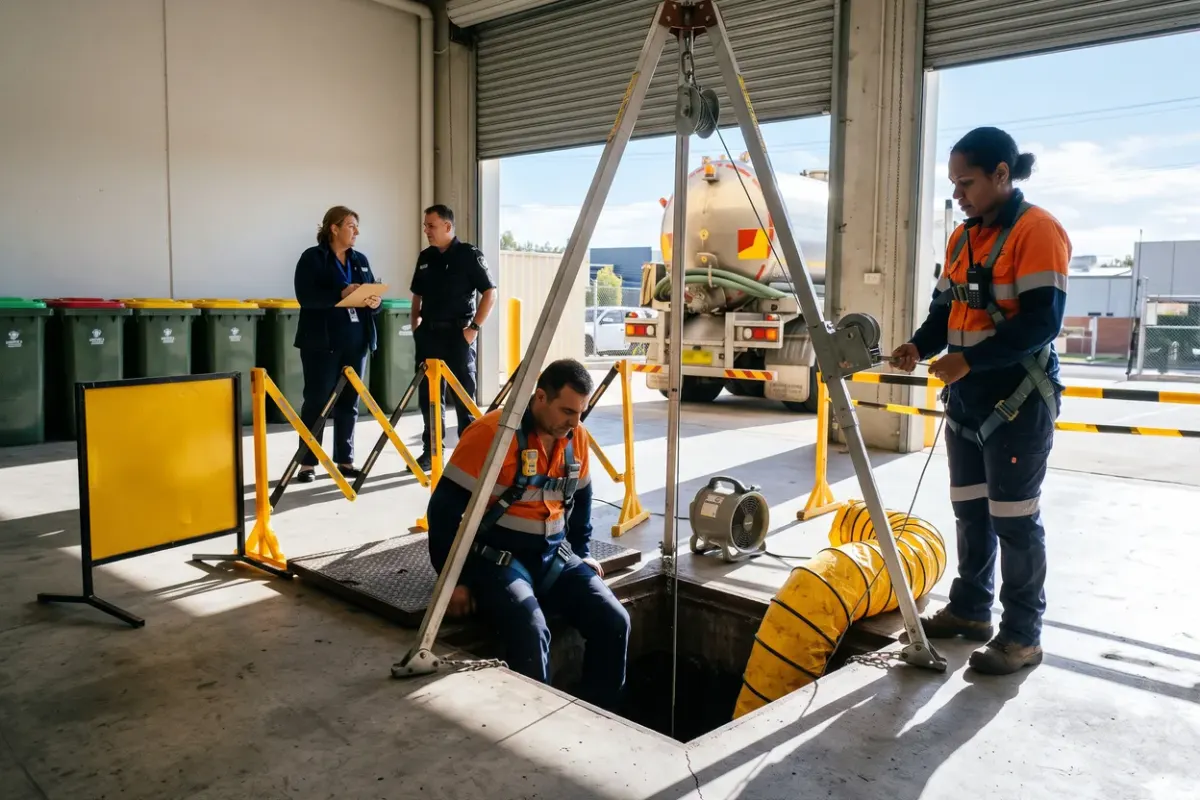
The plumbing contractor directs its worker in, so its supervisor completes the permit, and its second worker is the standby, with a tripod and winch over the hatch. The centre does the parts only it can do. It tells the food court tenants the night before that nothing may drain to the arrestor from 5am to 8am, and its security officer checks the kitchens at 5am. It closes the dock bay over the hatch, stops delivery trucks idling nearby, and puts up barriers around the opening. Before entry, the liquid waste contractor pumps the arrestor down, a fan ventilates it, and the supervisor tests the air from the hatch with a calibrated detector, lowering the probe to sample top to bottom as the code advises, with the readings recorded on the permit.2 Before anyone goes in, the centre manager confirms how the fire brigade would reach the dock before the centre opens.
What the centre keeps: its copy of the permit with the exit acknowledgement signed at 7.40am, the contractor's risk assessment for the arrestor, the training records for the plumber, the standby, and the supervisor, and its own record of the training given to the security officer and centre manager, who have parts in the job and the rescue plan.
A Second Example: A Stormwater Pump Pit at a Distribution Centre.
At a distribution centre, the pump in a below-ground stormwater pit fails, and an electrician needs to replace a float switch inside it while a pump technician stays outside as the standby person.
The site isolates the pump at its switchboard and locks it, with the key kept by the electrician and a tag saying a person is inside. It closes the hardstand lane next to the pit, so no forklift or truck runs near the opening.
The same site's cool store, designed to be entered now and then through a readily and conveniently accessible ground-level door, is generally not a confined space; the code uses a cool store worked by an LPG forklift as its example.2 The carbon monoxide from an LPG forklift in it can still be hazardous, and it falls under the business's primary duty to ensure, so far as is reasonably practicable, the health and safety of workers (model WHS Act, section 19), even though no confined space permit is needed.
How Victoria Differs.
Victoria has its own law: the Occupational Health and Safety Regulations 2017, Part 3.4, numbered regulations 50 to 73. Its definition adds a test the model one does not have: the space must have a limited or restricted means of entry or exit that makes it physically difficult to get in or out. And its engulfment limb covers stored substances that could engulf a person, except liquids.5
The Victorian permit, under regulation 63, must also list the name of any person the employer assigns to a function under regulation 65: keeping continuous communication with the employee from outside the space, and making sure emergency procedures can be started from outside. The employer must keep each permit until the work is completed, or for at least 2 years after a notifiable incident, and must keep a written record that all employees have exited the space. Each of those two record duties carries a maximum of 60 penalty units for a natural person and 300 for a body corporate, in the Regulations incorporating amendments as at 20 October 2026.5
WorkSafe Victoria's compliance code says an employer's duties to employees extend to independent contractors it engages and their employees, on matters the employer controls or would control but for an agreement to the contrary. The employer must also ensure, so far as is reasonably practicable, that people other than its employees are not exposed to risks from its business, under section 23.6
What to Check Before a Contractor Goes In.
- Can the job be done from outside?
- Is it a confined space? Judge it against the four tests, for this job, today.
- Who issues the permit? Agree it in writing, and put your isolations on it.
- The risk assessment. Written, by a competent person, for this space and this work.
- The air. A calibrated detector, testing from outside first and at every level, with readings on the permit.
- The standby person and the rescue plan. Named, outside, equipped, and with emergency services arrangements made, not assumed.
- Training records. For each entrant, the standby worker, and the supervisor.
- Signs, barriers, and closing up. Barriers at every opening during the job, and the hatch locked after it.
- Your copies. The permit with its exit acknowledgement signed, and the risk assessment.
How ComplyFlow Supports Confined Space Work.
ComplyFlow does not test the air or hold the retrieval line; the competent person and the standby do that. What it holds is the record around the entry. A permit in ComplyFlow has a permit type, sites, an expiry, and a permit holder, with sections that each have a reviewer and questions, and it becomes active once reviewed and approved, when contractors can sign in to it from the Live Access dashboard.7 A supervisor can approve or reject a permit on a phone after viewing its files and attachments, with a comment that notifies the person who submitted it.8
An area supervisor can open an active permit, see how many people are signed in to it, get an alert when someone signs out, and confirm each sign-out.9 At the site entrance, a sign-in point can require a site induction and confirmation checkboxes on the way in and out, and show site documents such as site plans.10 Your own confined space questions, such as the gas readings and the standby person's name, go into the permit's sections; the digital permits page shows how.
Start With a List of the Spaces You Already Have.
Walk the building with the plans and write down every pit, tank, and well, how it is reached, and what it could hold.
To see confined space permits that contractors sign in to and supervisors close out, book a demo and bring the space your team worries about most.
Sources
- Model Work Health and Safety Regulations (as at 5 December 2025)
- Model Code of Practice: Confined spaces
- Model WHS laws
- Model Work Health and Safety Act (model WHS Bill, as at 5 December 2025)
- Occupational Health and Safety Regulations 2017 (Vic), version 018
- Compliance code: Confined spaces (Edition 2)
- Permits Concepts, Workflow & Examples
- Approving Permits via Live Access
- Area Supervisor Checking Sign In and Out in Permit
- Live Access Sign-In Options: Confirmation Sets, Site Inductions and Site Documents
See It Against Your Own Contractors, Sites & Rules.
Book a 30-minute demo. We will show ComplyFlow working with your kind of sites, your kind of contractors, and your requirements. No slides, no hard sell.
Or Speak to Us
- ISO 27001
- Hosted on AWS
- Microsoft & Okta SSO
- API & MCP
- Data in Australia
Written by
John McCannHead of Product, ComplyFlow
John has led ComplyFlow’s product since 2021, including its AI document review, its AI agents, and its MCP server. He writes about what AI can and cannot be trusted to do in safety and compliance work, from building it.
Writes about: AI in compliance, Product and integrations, Data and reporting
Questions
Questions People Ask About This.
What should I check on a contractor's confined space ticket?
Check that the training covers what the model WHS Regulations require for anyone who could enter or work in a confined space or support that work: the hazards, the controls, personal protective equipment, the contents of the entry permit, and emergency procedures. Ask whether the standby worker and the supervisor are trained too, and when each was last refreshed. Under the model WHS Regulations, each business that must ensure its relevant workers are trained must also ensure a record of that training is kept for 2 years. That includes the contractor for its own workers, so ask the contractor for the record rather than a photo of a card.
What oxygen level is safe in a confined space?
Under the model WHS Regulations, a safe oxygen level is a minimum of 19.5% oxygen by volume and, according to those Regulations as at 5 December 2025, a maximum of 23.5%, both at normal atmospheric pressure. The business must ensure the space has a safe oxygen level while work is going on; only where that is not reasonably practicable and oxygen is below that minimum may it instead provide air-supplied respiratory equipment to every worker carrying out work in the space. Too much oxygen matters as well, because it raises the risk of fire.
Are there different types of confined spaces?
Not under the model WHS laws or Victoria's OHS Regulations. Each gives one definition, and Safe Work Australia's code turns the model one into a yes-or-no test: a space either is a confined space or it is not. What differs from one space to the next is the hazard, such as low oxygen, a flammable atmosphere, a toxic gas, or engulfment, and so the controls each one needs.
Is a roof cavity or a lift pit a confined space?
Safe Work Australia's code gives installing insulation in a roof cavity as an example of work that is not in a confined space. A lift pit is not among the code's examples, so judge it against the four tests in the model definition: enclosed or partially enclosed, not designed or intended primarily to be occupied by a person, at (or designed or intended to be at) normal atmospheric pressure, and a risk from the atmosphere or engulfment. A pit that can collect water, sewage gas, or fumes is the one to treat with care.
Does the fire brigade need an entry permit to rescue someone?
No. Under the model WHS Regulations, the permit and signage rules do not apply to an emergency service worker rescuing someone from a confined space, or giving first aid inside it, at the direction of their emergency service organisation. Your own staff and contractors get no such exemption, and the code says to assume a rescue entry is unsafe without air-supplied respiratory equipment if the person inside was overcome by the atmosphere.
Can one entry permit cover a job that runs over several days?
Yes. Safe Work Australia's code says a single permit can be used for multiple entries into one space, but it must be re-validated if the person with direct management or control of the work changes, a break in work continuity occurs, changes to the work introduce hazards the permit does not address, or new control measures are needed. Treat an overnight stop as a break in continuity: re-validate the permit and re-test the air before the first entry each morning.
Keep Reading