Workplace Exposure Limits From 1 December 2026: A Depot Guide
From 1 December 2026, workplace exposure limits replace exposure standards: diesel particulate matter gets an 8-hour limit of 0.01 mg/m3, carbon monoxide falls to 20 ppm, and phosphine to 0.05 ppm, with exceptions in Victoria and Western Australia.
 Mitchell BourneManaging Director
- Published
- 7 min read
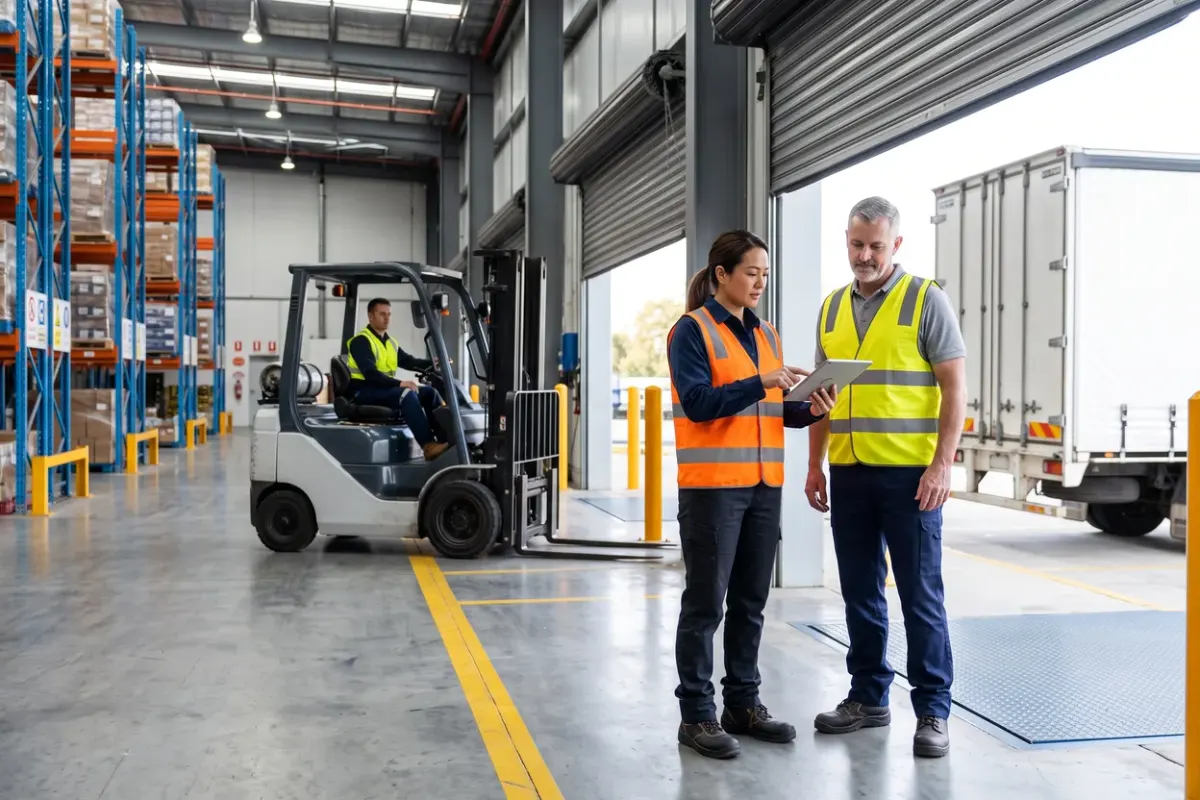
At a distribution centre, some of what hangs in the air at the dock is not yours. It comes from a carrier's prime mover idling at the door, a hire contractor's diesel sweeper, or a fumigator's work on stored grain. On 1 December 2026 the numbers that air is measured against change across most of Australia, and diesel particulate matter, measured as respirable elemental carbon, which had no entry on the old national list, gets a limit of its own.12 This is what an operations manager in transport and logistics needs to know, and what to ask contractors before then.
What Changes on 1 December 2026?
Workplace exposure standards become workplace exposure limits. Safe Work Australia says a business must ensure workers and others are not exposed above the existing standards until 30 November 2026, or above the new limits from 1 December 2026.1 The new name is deliberate: the limits are levels "that must not be exceeded rather than best practice standards".1 Safe Work Australia tells businesses to check with their WHS regulator about how the new list is being implemented in their state or territory; the Victorian and Western Australian differences are below.7
Most values do not move. Safe Work Australia's new list says most limits remain unchanged, some are modified, new contaminants are added, and a new notation flags ototoxic substances, where exposure combined with noise can raise the risk of hearing loss.2 The underlying duty is also unchanged: a business must eliminate the risk of exposure to airborne contaminants so far as is reasonably practicable, and if that is not reasonably practicable, minimise the risk so far as is reasonably practicable, whether or not a substance has a limit.1
The model WHS Regulations carry two duties. Under regulation 49 a business must ensure no person at the workplace is exposed to a contaminant above its limit, and under regulation 50 it must carry out air monitoring if it is not certain on reasonable grounds whether the level is exceeded, or where monitoring is needed to work out whether there is a risk to health.2
Which Limits Matter at a Depot or Distribution Centre.
We compared Safe Work Australia's old list with the new one, line by line, for the contaminants a depot or warehouse is most likely to have in the air.23
| Contaminant | Old standard (8-hour) | Safe Work Australia's new limit (8-hour), from 1 December 2026 | Our examples at a depot |
|---|---|---|---|
| Diesel particulate matter, as respirable elemental carbon | No entry | 0.01 mg/m3 | Diesel trucks, forklifts, sweepers, and generators |
| Carbon monoxide | 30 ppm | 20 ppm | Engine exhaust in enclosed docks and stores |
| Phosphine | 0.3 ppm | 0.05 ppm | Fumigation of stored grain |
In Victoria the limits from 1 December 2026 are 0.1 mg/m3 for diesel particulate matter and 0.3 ppm for phosphine, and Western Australia has announced it will hold back the lower phosphine limit to 1 December 2029.45 Phosphine also gets a peak limit of 0.15 ppm on the new list, in place of the old 1 ppm short-term limit, and exposure above a peak limit is not allowed at any time.23
Diesel particulate matter is the one to plan around. It has no entry on the old list, so many depots have never had a number to measure it against.32 Carbon monoxide also carries the new ototoxic notation, which matters on a noisy dock.2 The 8-hour figure is an average over the working day, and short-term and peak limits apply at all times.2 Where shifts run longer than 8 hours, workers do more than 40 hours a week, or there are fewer than 16 hours between shifts, Safe Work Australia says the business may need to adjust the 8-hour limit downwards.2
Benzene is the exception to the 1 December date. On 29 October 2026 Safe Work Australia announced that ministers had agreed a lower benzene limit of 0.2 ppm from 1 June 2027, with the current 1 ppm applying until then.7
Does the New Phosphine Limit Apply Everywhere?
Not yet. Safe Work Australia says some states have told it they will delay the lower phosphine limit beyond December 2026.6 Western Australia announced on 14 October 2026 that its phosphine limit of 0.05 ppm will take effect from 1 December 2029, and said the decision follows similar moves in two other states, one of them Victoria.5 For any other state or territory, check with your regulator before relying on either date.
Victoria makes the change in its own Occupational Health and Safety Regulations 2017, amended by the Occupational Health and Safety Amendment (Workplace Exposure Limits) Regulations 2026, on its own timetable.4 Most of the new limits apply there from 1 December 2026. WorkSafe Victoria says 15 substances, including diesel particulate matter, phosphine, grain dust, and Portland cement, have transition arrangements until 30 November 2029, and Victoria's amended regulations set interim limits for most of them.4 For diesel particulate matter outside underground mining, WorkSafe Victoria lists 0.1 mg/m3 from 1 December 2026 and 0.01 mg/m3 from 1 December 2029.4 On WorkSafe Victoria's timetable, a national carrier with depots in Victoria and another state will work to two diesel numbers until December 2029.
Who Carries the Duty When the Exhaust Is a Contractor's?
Both of you, and neither can hand it to the other. Under the model WHS Act more than one person can hold the same duty at the same time, and a duty cannot be transferred to another person.8 Each discharges it to the extent of their capacity to influence and control the matter, or would have had that capacity but for an agreement or arrangement purporting to limit or remove it.8 And where more than one person has a duty in relation to the same matter, each must, so far as is reasonably practicable, consult, cooperate, and coordinate activities with the others.8
At a distribution centre, the operator controls the building, the ventilation, the dock doors, and the hours. The cleaning contractor controls its sweeper, the fumigator its gas, and the carrier its truck. The limit applies to the air your workers and theirs share, so the conversation about it should happen before the work, as our guide to the duty to consult, cooperate, and coordinate sets out.
Worked Example: An Enclosed Dock on a Night Shift.
A distribution centre runs a 10-hour night shift with the dock doors closed in winter. A cleaning contractor brings a diesel ride-on sweeper in at 2 am, and two carriers back trailers in with engines running while they wait for a door.
The operations manager starts with the list. From 1 December 2026, diesel particulate matter has an 8-hour limit of 0.01 mg/m3 (0.1 mg/m3 in Victoria), and carbon monoxide falls to 20 ppm.24 Because the shift runs longer than 8 hours, the business also asks whether the 8-hour limit needs adjusting downwards.2 Nobody can say on reasonable grounds that the dock is under the limit, so the site books air monitoring with an occupational hygienist before 1 December.12
Then it goes to the contractors. The cleaning company is asked whether a battery sweeper can do the night run; that is a substitution, higher on the hierarchy of controls than any mask. Carriers are told engines go off at the door, and the dock procedure says so. The business keeps the monitoring report, the contractor's reply, the revised dock procedure, and a record of the toolbox talk where workers were told what changed.
What to Do Before 1 December 2026.
WorkSafe WA's own list for the change is a sound one for any depot: review your chemical inventory, review and improve controls, monitor the air and workers' health where exposure may occur, update risk assessments, safety data sheets, and procedures, and consult workers.9 For a site that relies on contractors, add four steps of your own:
- Ask each contractor what they bring. Fumigants and solvents, each with its current safety data sheet, and any diesel plant, before the work is booked.
- Check the new value, not the old one. Look up each substance on Safe Work Australia's new list, and in Victoria on WorkSafe Victoria's table.24
- Agree who monitors and who sees the results. A fumigator's clearance reading and your workers' breathing zone are different measurements; Safe Work Australia makes the same point about phosphine labels.6
- Treat respirators as the last control. Safe Work Australia says respiratory protection can be taken into account when working out compliance with a limit only once every reasonably practicable higher order control is in place and it is worn correctly.1
Keeping the Contractor Side in One Place.
The hard part is keeping step 1 current across dozens of contractors and sites. In ComplyFlow's contractor management software, a hazardous chemical can be recorded against a contractor and project, with where it is stored, its intended use, the quantity on site, and its safety data sheet, which carries an issue date and an expiry date.10 Document requirements can be assigned to an individual site, so a depot can ask for what its own dock needs.11 More on how this works for transport and logistics and for operations managers.
The limits change on a Tuesday in December. The depots that will be ready are the ones that have already asked their contractors what goes into the air at 2 am.
Sources
- Workplace exposure standards/limits: information for PCBUs
- Workplace exposure limits for airborne contaminants
- Workplace exposure standards for airborne contaminants
- Workplace exposure standards/limits
- Deadline for workplace exposure limit for phosphine extended
- APVMA consideration of phosphine product labels following introduction of a reduced workplace exposure limit
- Reduced workplace exposure limit for benzene to take effect on 1 June 2027
- Model Work Health and Safety Bill
- WES-WEL transition
- Adding and managing hazardous chemicals
- Compliance requirements: training requirements and site contact
See It Against Your Own Contractors, Sites & Rules.
Book a 30-minute demo. We will show ComplyFlow working with your kind of sites, your kind of contractors, and your requirements. No slides, no hard sell.
Or Speak to Us
- ISO 27001
- Hosted on AWS
- Microsoft & Okta SSO
- API & MCP
- Data in Australia
Written by
Mitchell BourneManaging Director, ComplyFlow
Mitchell has run ComplyFlow since 2009 and has spent that time inside the contractor, site, and safety problems of Australian operators. He writes about where compliance actually fails, and what the people responsible for it can do about it.
Writes about: Contractor compliance, WHS duty and proof, Running a compliance program
Questions
Questions People Ask About This.
When do the new workplace exposure limits start?
On 1 December 2026. Safe Work Australia says businesses must ensure workers and others are not exposed above the existing workplace exposure standards until 30 November 2026, or above the new workplace exposure limits from 1 December 2026. Benzene has a later date: Safe Work Australia says ministers have agreed a lower limit of 0.2 ppm from 1 June 2027. Victoria has its own regulations and transition arrangements for 15 substances, including an interim diesel particulate matter limit of 0.1 mg/m3, and Western Australia has announced a delay to the lower phosphine limit.
Is diesel exhaust covered by the new workplace exposure limits?
Yes. Diesel particulate matter, measured as respirable elemental carbon, has an 8-hour time-weighted average limit of 0.01 mg/m3 on Safe Work Australia's list of workplace exposure limits. It has no entry on the old list of exposure standards. In Victoria the limit is 0.1 mg/m3 from 1 December 2026, and WorkSafe Victoria says it will fall to 0.01 mg/m3 outside underground mining from 1 December 2029.
Do we have to measure the air at our warehouse?
Under the model WHS Regulations, a business must carry out air monitoring if it is not certain on reasonable grounds whether the airborne concentration of a substance exceeds the exposure limit, or where monitoring is needed to work out whether there is a risk to health. Safe Work Australia suggests an occupational hygienist may be needed to understand and show compliance.
Can a mask or respirator be used to meet the new limits?
Only as a last step. Safe Work Australia says the protection from respiratory protective equipment can be taken into account when working out compliance with an exposure limit only where every reasonably practicable higher order control has been put in place and the equipment is worn correctly. It calls personal protective equipment one of the least effective controls.