Forklift Pre-Start Checklist: What to Check & Who Acts on a Fault
A forklift pre-start checklist is the operator's check of a forklift before use: a walk-around with the engine off for leaks, tyres, forks, mast, chains, and the load plate, then brakes, steering, hydraulics, horn, and lights with it running. WorkSafe Victoria advises doing it at the start of each shift and when the operator changes; Queensland's regulator says report any defect at once and take the key and tag the truck out until it is repaired.
 Mitchell BourneManaging Director
- Published
- 12 min read
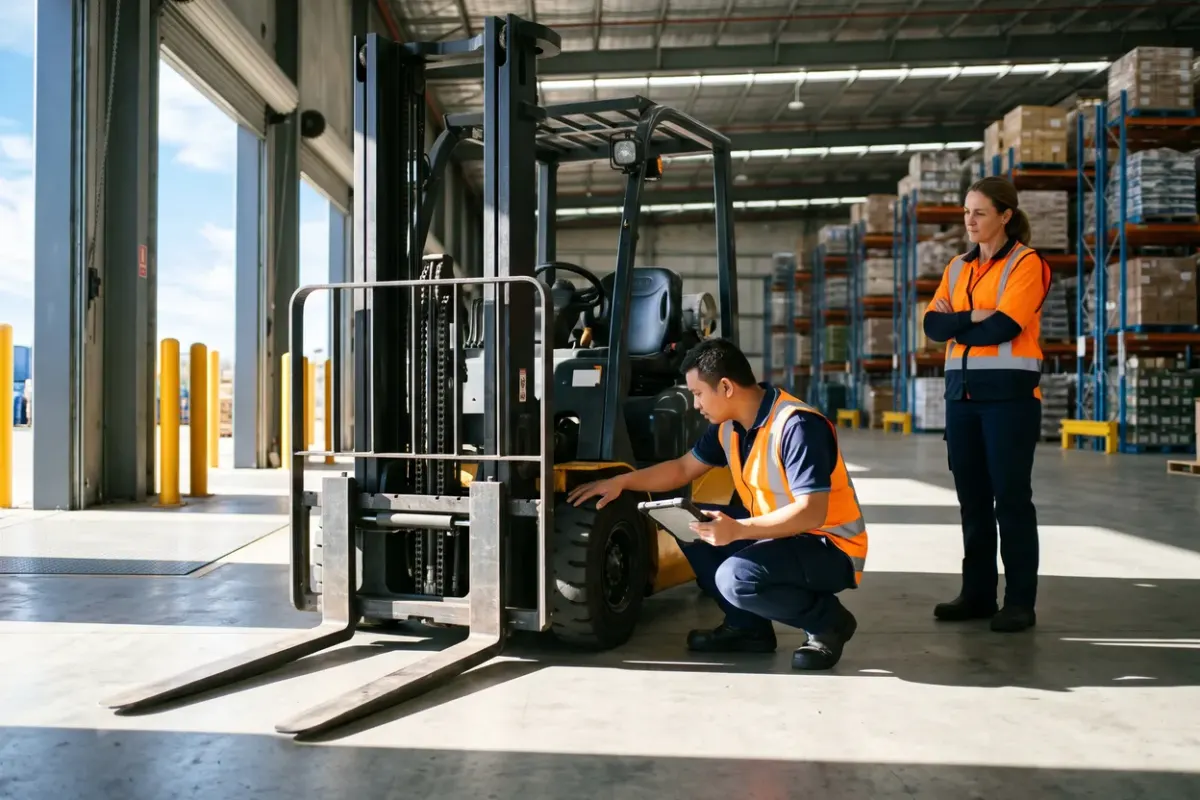
In a busy warehouse the forklift pre-start is the most repeated safety check on site. It happens every shift, on every truck, and it is the first thing to be rushed when the first trailer is already on the dock. Done properly it takes a few minutes and catches the leaking hose or the worn fork before it fails under a load. Done as a box-ticking exercise, it produces a stack of clean checklists for trucks that were not checked at all.
This guide gives you the checklist itself, then the part most checklists leave out: what the business does with a failed check, who signs a truck back into service, and the records that show the system works.
What Is a Forklift Pre-Start Check?
A forklift pre-start check is the inspection the operator does before using the truck, to find faults before they cause an incident. Regulators call it a pre-operation or pre-operational check. WorkSafe Victoria says it should follow the manufacturer's recommendations, and Workplace Health and Safety Queensland tells operators to complete it by following the manufacturer's instructions in the forklift manual.1 3
That reference to the manual matters more than any generic list, including the one below. An electric reach truck, an LPG counterbalance, and a diesel yard truck share most checks but not all of them, and the manufacturer knows its own machine. Use the checklist here as the frame, then add the items your manuals name for each model on your floor.
Is a Forklift Pre-Start Checklist a Legal Requirement?
The law puts the duty on the business, not on a piece of paper. Under regulation 213 of the WHS Regulations, a person with management or control of plant at a workplace must ensure its maintenance, inspection, and if necessary testing, is carried out by a competent person, following the manufacturer's recommendations, or a competent person's where there are none; if neither is reasonably practicable, inspection must be done annually.12 In Victoria, which runs its own OHS laws,8 WorkSafe Victoria says employers and self-employed people must ensure plant is inspected so far as is necessary to ensure any risk associated with its use is monitored.5
The daily pre-start is how most operations meet that duty for forklifts, and regulators treat it as the expected practice. WorkSafe Victoria says forklifts and their attachments must be regularly inspected and maintained to control the risks of their use, and that a checklist can help.1 Queensland's regulator tells transport and warehousing businesses to complete pre-operational checks, inspect plant before use, and keep records of completed checks.6
What we recommend: treat the pre-start as part of your legal system for plant, not as a form. A regulator who finds a damaged truck in use will ask how the fault was missed, and the pre-start record is your answer.
When Should the Check Be Done?
WorkSafe Victoria says a pre-operation inspection should be done at the start of each shift before first daily use, and when there is a change of operator.1 SafeWork NSW says forklift safety checks are to be done at the start of each day.2 The stricter of the two is the one to run. A truck driven by three operators over two shifts gets three checks, because each operator is accepting the truck in the condition they found it.
The Checklist, Part One: Engine Off.
With the truck parked, forks lowered, and the key out, walk around it and check:
- Leaks. Oil, hydraulic fluid, coolant, or fuel under the truck or on the mast.
- Tyres and wheels. Damage, wear, embedded objects, cracked rims, loose wheel nuts, and inflation pressure on pneumatic tyres against the manufacturer's figure.
- Forks. Cracks, bends, and heel wear, with both forks level and evenly spaced. SafeWork NSW's forklift safety fact sheet, as published on its website in November 2026, says fork heel wear must not exceed 10%, and worn forks past that point must be replaced.2
- Mast, chains, and carriage. Damage, loose or missing parts, chain wear, and even tension on both chains; chain anchor pins, the load backrest, and fork locking pins all in place.
- Overhead guard and seat. The guard in place and undamaged; the seat secure, and the seat belt latching and retracting.
- Load rating plate. SafeWork NSW says it should be readable, list the forklift's capacity, and list any attachment used with its working load limit.2
- Labels and decals. Safety and operating labels in place and legible.
The power source has its own checks, and the manual for each model is the authority on them:
- LPG. The cylinder seated and held by its locating pin and strap, the valve and hose undamaged, and no smell of gas at the connection.
- Diesel. Engine oil, coolant, and fuel levels, no leaks at the engine or exhaust, and the spark arrestor where one is fitted.
- Electric, lead-acid. Battery terminals clean and tight, cables and plug undamaged, the battery secure, charge level, and electrolyte topped up as the manual directs.
- Electric, lithium. Connections and plug undamaged, the battery secure, charge level, and no battery fault shown on the display.
- Order pickers. Everything above, plus the operator platform, its gates or chains, and any harness anchor point and lanyard the manual calls for, because the operator rises with the load.
The Checklist, Part Two: Engine On.
Seated, belted, and with the area clear, check:
- Start-up and operator presence. Warning lights clear once the truck starts, and the seat switch or operator presence pedal stops drive and hydraulics when the operator leaves the seat or lifts off the pedal.
- Brakes. Service brake and parking brake both hold.
- Steering. Smooth, with no excess play.
- Hydraulic controls. Lift, lower, tilt, and side shift all work smoothly, with no drift.
- Warning devices. Horn, flashing light, reversing beeper, and blue light indicators, the warning items SafeWork NSW lists.2
- Gauges and lights. Warning lights clear, fuel, temperature, and battery discharge gauges in the normal range, hours counter working, headlights on where the truck is used in low light.
If any item fails, the check has done its job. What happens next is where most systems break.
What Happens When a Check Fails?
Workplace Health and Safety Queensland tells operators to report any damage or problems to their supervisor immediately, and to remove the key and tag out unsafe forklifts to prevent unauthorised use. It says a damaged forklift should not be used until a qualified person has made it safe and removed the tags, and that a business should have a procedure for unsafe forklifts that covers isolating and tagging the truck and reporting the problem to the right person.3 WorkSafe Victoria says defects need to be reported and a system should be in place to lock the forklift or attachment out of service when a defect makes it unsafe.1
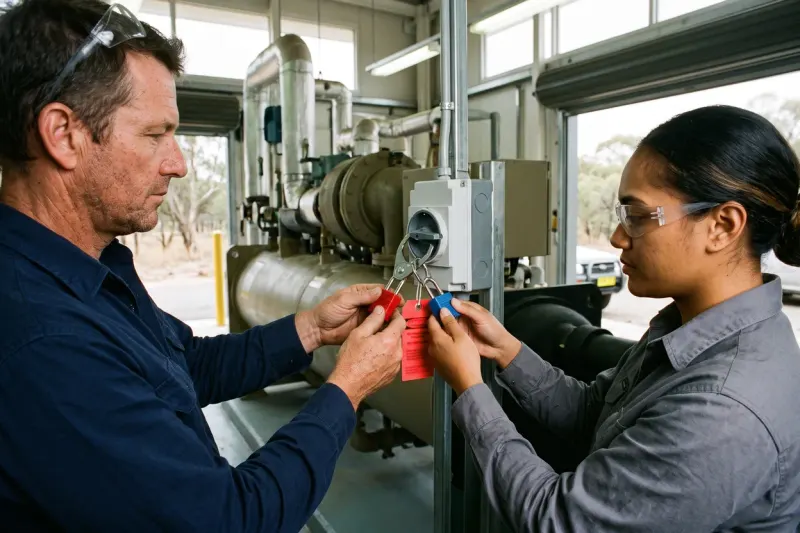
A tag is a message, not a barrier. The Commonwealth plant code says a tag should not be used on its own as an isolation device, because only a lock is effective at isolating the energy source, and that damaged plant should be withdrawn from service until the risks have been controlled.4 For a forklift, taking the key to the supervisor and tagging the truck is the minimum; a truck that will sit for days waiting on a part is better parked out of the traffic aisle with the key locked away. Our guide to lockout tagout covers isolation for maintenance work in more detail.
The Operator Checks; the Business Acts.
The pre-start splits a job in two. The operator finds the fault. The business decides what happens to it, and that half belongs to the operations manager or the supervisor on shift, not to the person in the seat.
That decision has three parts. Who repairs it: WorkSafe Victoria advises engaging a suitably competent forklift technician to maintain forklifts, and Workplace Health and Safety Queensland says only licensed gas fitters should repair or replace parts on an LP gas-powered forklift.1 3 Who says it is fixed: the qualified person who made it safe removes the tags, not the next operator who needs a truck.3 And who records it, so the next shift knows the truck was down and why.
A Worked Example: A Hydraulic Leak at Shift Change.
A distribution centre runs three shifts across 14 counterbalance forklifts and four order pickers. At 5:40 am the night shift operator on truck 9 does her end-of-use walk-around and finds hydraulic fluid weeping from a hose at the base of the mast. She ticks the item as failed, writes what she saw, takes the key to the shift supervisor, and hangs an out-of-service tag on the steering wheel.
At 6:00 am the day shift operator assigned to truck 9 opens his pre-start. Because the night shift's failed check went to the supervisor and not into a book in the cab, the truck is already shown as out of service, and he is moved to truck 12. The supervisor raises a repair job with the forklift service contractor, with the operator's note and a photograph of the hose attached.
The technician replaces the hose at 11:00 am, tests the hydraulics, signs the job off, and removes the tag. Only then does the supervisor return the key. The record for truck 9 now shows the fault, who found it, when the truck came out of service, who repaired it, and when it went back on the floor. That is the record a regulator asks for, and it is the same record that tells you truck 9 has had three hose failures this year and needs a closer look.
Check the Licence With the Truck.
The pre-start checks the truck. The person driving it needs checking too. A powered forklift truck with a mast and an elevating load carriage, with fork arms or other arms that can be raised 900 mm or more, needs an operator holding the LF class of high risk work licence; pedestrian-operated trucks and pallet trucks are not forklift trucks for this purpose. An order-picking forklift truck where the operator's controls are incorporated and elevate with the load carriage needs the LO class.7 12 In Victoria, WorkSafe Victoria says an employer must not allow an employee to use a forklift unless they hold an appropriate high risk work licence.5 In NSW a high risk work licence expires after 5 years, and high risk work cannot be done on an expired one.7
The law adds a record. Under regulation 85 of the WHS Regulations (section 85 of the NSW Work Health and Safety Regulation 2025), as each state and territory outside Victoria has adopted it, a business must not direct or allow a worker to carry out high risk work unless it sees written evidence that the worker holds the relevant licence, and must keep a record of that evidence for at least one year after the work.12 Queensland inspectors enforced exactly this in their 2025 transport and warehousing campaign.6 The simplest way to meet that wherever it applies is to link each operator's licence to the pre-start, so a check cannot be started by someone whose licence is missing or expired. Our high risk work licence check guide explains how to verify a licence in each state.
Hired Trucks and Labour Hire Operators.
Peak season brings hired forklifts and labour hire operators, and both blur who owns the pre-start record. In practice, the business running the warehouse floor should own the daily check and the decision to take a truck out of service, whoever owns the truck, and the hire company usually does the servicing and repairs. Agreeing who services it does not hand over the legal duty: under regulation 213 of the WHS Regulations (Victoria has its own rules) the maintenance and inspection duty sits with each business that has management or control of the truck at the workplace, which can be more than one.12 Agree in writing who is called when a hired truck fails a check, and keep the hire company's service records with your own pre-starts for that truck.
Labour hire operators do the same pre-start as your own staff, on the same form. In Victoria, WorkSafe Victoria notes that employers must, so far as is reasonably practicable, consult with labour hire workers, and that employers and labour hire providers who share duties to those workers also have consultation obligations to each other.5 Put simply, the labour hire firm should know how your pre-start and defect process works before its operators arrive, not on their first shift.
What Records Should You Keep?
WorkSafe Victoria says forklift inspection and maintenance records should show what needs inspecting at each maintenance interval, what has been inspected, any maintenance done, and any defects and repairs, including pending maintenance awaiting sign-off.1 Workplace Health and Safety Queensland advises keeping detailed records of every inspection, service, maintenance, repair, and modification, with dates, the names of the authorised people involved, and the readings on the truck's hours counter.3 SafeWork NSW says maintenance must follow the manufacturer's requirements or a competent person, and that log book or maintenance records must be kept.2
Why it matters now: when Workplace Health and Safety Queensland inspected transport and warehousing businesses between April and June 2025, it found pre-operational checks not completed or documented, damaged plant not isolated and tagged before use, operators without the required licence, and licence information not recorded at the workplace.6 Inspectors made 267 assessments and issued 290 enforcement notices in that campaign.6 The regulator also reported that mobile plant and transport incidents accounted for 91.4% of fatalities in Queensland's transport and warehousing industry from 2019 to 2023, a period in which 58 workers died in transport industry incidents.6 That figure covers all mobile plant and vehicles, not forklifts alone, but it shows where the risk in a warehouse sits.
Where ComplyFlow Fits on the Warehouse Floor.
A paper pre-start book lives in the cab, which is exactly where nobody else can see it. In ComplyFlow, an operator scans the QR code on the truck to start its inspection, sees the plant item's details, and works through the template configured for it.9 Documents for each truck, such as service records, are held against its plant category with an expiry date where they have one.10 A failed item becomes an action that is closed out with a comment, a completion date, and an uploaded photograph or document as evidence.11
For a transport and logistics operation, that puts every truck's checks, defects, and repairs in one record the supervisor can see from the office. The plant and equipment module and the mobile apps carry it; for heavy vehicles on the road, the same approach is set out in our guide to digital vehicle inspection apps.
Pull Last Week's Pre-Starts.
Take last week's pre-starts for your busiest forklift and count three things: checks done against shifts worked, defects raised, and defects closed with a named repairer and a return-to-service time. If checks are missing, the problem is the routine. If defects are near zero across a working fleet, the checklist is being ticked, not done. If defects are raised but never closed, your system is collecting evidence of known faults.
Fix whichever number is worst first. If you would like to see a warehouse's pre-starts, defects, and repairs kept in one record, book a demo.
Sources
- Forklift maintenance and inspection
- Forklift safety fact sheet
- Three serious forklift incidents - one fatal
- Work Health and Safety (Managing Risks of Plant in the Workplace) Code of Practice 2015
- Forklift legal duties
- Transport and warehousing campaign report (April to June 2025)
- High risk work licences
- Introduction to forklift health and safety
- Scanning a QR Code to Start a Plant Inspection
- Plant & Vehicle Documents
- Closing Out Actions
- Work Health and Safety Regulations 2011 (Cth), compilation 28
See It Against Your Own Contractors, Sites & Rules.
Book a 30-minute demo. We will show ComplyFlow working with your kind of sites, your kind of contractors, and your requirements. No slides, no hard sell.
Or Speak to Us
- ISO 27001
- Hosted on AWS
- Microsoft & Okta SSO
- API & MCP
- Data in Australia
Written by
Mitchell BourneManaging Director, ComplyFlow
Mitchell has run ComplyFlow since 2009 and has spent that time inside the contractor, site, and safety problems of Australian operators. He writes about where compliance actually fails, and what the people responsible for it can do about it.
Writes about: Contractor compliance, WHS duty and proof, Running a compliance program
Questions
Questions People Ask About This.
What are the steps when parking a forklift?
SafeWork NSW lists five: park on level ground, lower the load arms, turn off the forklift, apply the hand brake, and remove the key. Removing the key matters most at the end of a shift, because it stops an unlicensed person driving a truck that nobody is watching.
Who should do the forklift pre-start check?
The licensed operator who is about to use the truck, following the manufacturer's manual. A supervisor or the operations manager then owns what happens next: reading the defects, keeping a faulty truck out of service, arranging a competent repair, and deciding when it goes back on the floor.
Does an order picker need a forklift licence?
An order-picking forklift truck where the operator's controls are built in and rise with the load carriage has its own high risk work licence class, LO, separate from the LF class for a standard forklift with a mast and an elevating load carriage; the LF class is not for order pickers. Check that the operator holds the class that matches the truck, not just any forklift licence.
How long should forklift pre-start records be kept?
The guidance cited here does not set a retention period for daily pre-starts. We recommend keeping them for as long as the truck is in service with you, beside its maintenance history, because they are the record of what was found and when. Separately, regulation 85 of the WHS Regulations, used everywhere except Victoria (in NSW it is section 85 of the Work Health and Safety Regulation 2025), requires a record of the written evidence of a worker's high risk work licence to be kept for at least one year after the work.
Keep Reading