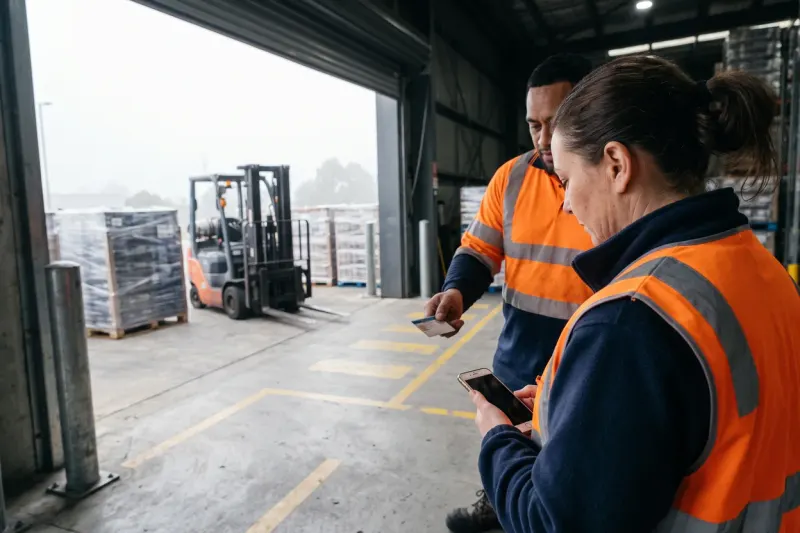
High Risk Work Licence Check: Verify a Licence in Any State
A high risk work licence check confirms that a worker's licence is real, current, and covers the class of work, by searching the register of the state or territory that issued it. Each keeps its own: NSW, Victoria, Queensland, WA, SA, the ACT, and the NT each run an online check. Tasmania publishes no online check, so contact WorkSafe Tasmania.
 Mitchell BourneManaging Director
- Published
- 10 min read

A forklift licence can look fine and still be expired, the wrong class, or a scan of someone else's card with a new name. For a safety manager in a warehouse, a high risk work licence check is the short habit that catches those before the worker drives anything. This guide covers what the law asks you to see and keep, where to check in each state, which class the job needs, white cards, and the signs of a fake.
The examples come from a distribution centre in transport and logistics, where forklifts and order-pickers are the daily case, and a building in property and facilities management, where the elevating work platform and the crane arrive with a contractor. They are illustrations, not customers.
What Is a High Risk Work Licence Check?
It is confirming three things before someone does licensed work at your site: that the licence is genuine, that it is current, and that it covers the class of work they are about to do. The card tells you what the worker says. The issuing state's register tells you what is true.
A licence is needed for 29 classes of high risk work under Schedule 3 of the model WHS Regulations, from scaffolding, dogging, and rigging to cranes, hoists, forklifts, order-picking forklifts, and pressure equipment such as boilers.1 Safe Work Australia says a licence is valid for 5 years and generally valid across Australia, and that it does not issue licences itself; your state or territory regulator does.2
What the Law Requires: Written Evidence & a Record.
The duty sits with the business, not only the worker. Under regulation 85 of the model WHS Regulations, a business must not direct or allow a worker to carry out high risk work for which a licence is required unless it sees written evidence, provided by the worker, that the worker has the relevant licence. It must keep a record of that written evidence for at least 1 year after the high risk work is carried out.1
Those are separate offences in the model: regulation 85(1) carries a tier G penalty and 85(4) a tier I penalty. As at 1 July 2026, Safe Work Australia lists tier G at up to AU$5,900 for an individual and AU$30,000 for a body corporate, and tier I at up to AU$2,000 and AU$10,000.3 Each state sets its own figures; Western Australia's Regulations set AU$4,200 for an individual and AU$21,000 for a body corporate for not seeing the evidence.4
Victoria is different. Its Regulations say an employer must not allow an employee to perform high risk work unless the employee holds an appropriate licence, with a penalty of up to 100 penalty units for a natural person and 500 for a body corporate; a Victorian penalty unit is AU$209.10 from 1 July 2026.56 Part 3.6 of the Regulations has no written evidence or record-keeping rule; the duty is that the employee actually holds the licence, so a dated register check is the practical way to show it.5
How to Check a High Risk Work Licence in Each State.
Search the register of the state or territory that issued the licence. Each regulator's page was checked in October 2026, and the details each one asks for are the most common reason a check fails.
| Issued in | Where to check | What you need | What it tells you |
|---|---|---|---|
| New South Wales | Service NSW, which opens Verify NSW7 | The licence holder's name or licence number | Class, status, expiry, any suspension or cancellation, and offences the holder was convicted of or paid a penalty notice for8 |
| Victoria | myWorkSafe, Validate a WorkSafe Licence9 | Licence number and surname; it validates digital licences only, so a worker with only a plastic card may not show10 | Whether the licence validates |
| Queensland | WorkSafe Queensland's high risk work online register11 | First name, surname, date of birth, one licence class, and two more details12 | The licence status |
| Western Australia | WorkSafe WA's Online Licence Search13 | The licence number | Whether the record is current |
| South Australia | SafeWork SA's licence check14 | Licence number, date of birth, and surname15 | Name, expiry date, and classes |
| Tasmania | No online check published; call WorkSafe Tasmania, 1300 366 32216 | The details on the card | Ask what they can confirm |
| ACT | WorkSafe ACT public register17 | A keyword such as the name18 | Licence number, type, expiry, and infringements, as at the register's last update |
| Northern Territory | Territory Services licence check19 | Licence number, issue date, and date of birth | Name, expiry, and classes |
Three practical points. Collect the worker's date of birth with their licence, because three of the eight checks will not run without it. Save or print the result with the date, because that is the record. And if a check finds nothing, do not assume fraud: SafeWork SA says a failed match can also mean the licence has expired or been cancelled, or an application has not been processed, and some licences near renewal are still on its previous form, so try that form before you call the regulator.14 In Victoria, a worker with no digital licence will not validate; ask them to link one in myWorkSafe.10 And a worker who finished training in the last 60 days may not be on any register yet: under the model rules they can work on their certification if they apply for the licence in time, and you must see that certification and the application.1
Interstate Licences: Check With the Issuing State.
Under the model Regulations, a licence granted under another jurisdiction's WHS law is recognised as long as it is used within its own conditions, unless it is suspended, cancelled, or expired where it was issued; Victoria's Regulations recognise interstate licences on similar terms.15 So a Queensland-issued forklift licence used in a distribution centre in another state is valid, and you check it on the Queensland register, not the NSW one.
There is no national register to fall back on. NT WorkSafe's advice to employers is that for an interstate licence you will need to contact the regulator of the issuing jurisdiction, some of which have online registers.20
Which Licence Class Does the Job Need?
A licence is for a class of work, and the class has to match the machine and the task. In a warehouse and a building, these come up most often.1
| Work | Licence class | Watch for |
|---|---|---|
| Counterbalance or reach forklift | LF, forklift truck | Does not cover an order-picker |
| Order-picking forklift | LO, order-picking forklift truck | Does not cover a standard forklift |
| Boom-type elevating work platform | WP | Needed when the boom is 11 metres or more |
| Slinging and directing a crane lift | DG, dogging | Rigging classes cover more |
| Mobile crane lifting plant to a roof | The crane class for its capacity | Slewing classes go up by tonnes |
| Erecting, altering, or dismantling scaffold from which a person or object could fall more than 4 metres | SB, SI, or SA scaffolding | Classes go up by complexity |
The two-letter codes come from the regulators' registers, such as Queensland's online register, rather than the model Regulations, which describe each class in words.112 When a card lists several codes, read the one for the job.
Do High Risk Work Licences Expire?
Yes. Under the model Regulations a licence takes effect on the day it is granted and expires 5 years later. Renewal must be applied for before expiry, and if it is, the licence continues in force until the holder is given notice of the decision. An expired licence can generally be renewed within 12 months, longer only in exceptional circumstances, but the worker cannot carry out the work until it is.1
That makes the expiry date the field to diarise. Record it at the first check and check again before it passes, not at the next annual review.
How Do You Check a White Card?
A white card shows general construction induction training, which a worker needs before doing construction work, including construction work inside a warehouse or a building you manage. Under the model rules, a business must not direct or allow a worker to carry out construction work unless they have completed the training and, if it was more than 2 years ago, have done construction work in the preceding 2 years.1
Not every state lets you check one online. Service NSW checks NSW white cards by name, number, ABN, or ACN; WorkSafe WA's Online Licence Search covers construction induction cards; and myWorkSafe validates Victorian construction induction cards.21229 In Queensland and South Australia the registered training organisation issues the card, so ask the RTO named on it.2324
Spotting a Fake or Altered Licence.
Fraud is not hypothetical. WorkSafe Queensland reported in February 2026 that licence cards had been altered with the printed classes removed and other classes superimposed, and scanned versions sent with job applications; eight matters went to the Queensland Police Service and four resulted in 11 charges.25 NT WorkSafe described a worker supplied by a recruitment agency who had tried to pass off another worker's doctored certificate as his licence, with a fraudulent interstate white card.20
WorkSafe WA's bulletin lists the signs: a different font, especially in the name; crisp and blurry text side by side, such as a clear photo with blurry details; a different font front and back; and noticeably different wear on parts of the card.26 It recommends checking originals rather than photocopies or scans and using the online tools, and notes that a certified copy only shows the certifier saw a document, not that it is genuine.26 SafeWork NSW's poster is blunter: businesses should not accept photocopies of a licence.27
A Worked Example: A Distribution Centre & a Building Lift.
The distribution centre. A labour hire agency sends six forklift drivers for a peak-season night shift. The shift supervisor asks each driver for their original card before induction. Five are NSW LF licences and check out on Verify NSW. The sixth is a South Australian card that lists LF and LO. The check needs the driver's date of birth and surname, which were not on the agency's paperwork, so the driver is rostered on the dock until the check runs at the start of the next shift. The record kept for each driver is the card photograph, the register result, and the date.
The office building. A facilities manager books a contractor to replace a façade light with a boom lift, and a crane to lift a new condenser to the roof. The boom lift's reach is over 11 metres, so the operator needs the WP class; the crane needs a crane operator and a dogger. The contractor's paperwork arrives with three card scans. The facilities manager asks for the originals on the day, checks each on the issuing state's register, and does not let the lift start until the dogger's licence is confirmed.
In both cases the worker was employed by someone else. Outside Victoria the model rule binds any business that directs or allows the work, alongside the agency or contractor, and in the NT case above the company that took on the agency worker was given an improvement notice to fix how it checked.120
Checking Labour Hire & Contractor Workers at Scale.
A spreadsheet of licence numbers works for a handful of people. It breaks when the workers come through agencies and contractors, when they move between your sites, and when nobody owns the expiry dates. Our guide to building a training and competency matrix for contractors covers how to decide which licence each role and site needs. Trade licences, such as an electrician's or a plumber's, sit on separate state registers; our guide to the contractor licence check lists them.
In ComplyFlow, a site can carry its own document requirements, such as high risk work licences, which appear on the dashboard of anyone assigned to that site and set their status to Documents Pending until supplied.28 Since September 2026, a people document can be required of anyone working in a plant category, so an operator competency such as a forklift licence is set up the same way.29 A reviewer checks the expiry date the contractor entered before approving, and the workers list downloads as a spreadsheet with an Alerts column for each worker.3031 The register search is still yours to run; the system keeps the record and the date it is due again.
Start With Today's Forklift Roster.
Take the list of everyone rostered to drive a forklift, operate a lift, or sling a load this week. For each, find the original card, the issuing state, the class, the expiry date, and the result of the register check. Where any one of those is missing, that is the first check to run.
Expect two or three gaps the first time: a missing date of birth, a class that does not match the machine, an expiry nobody diarised. To see licence checks tracked across sites and labour hire workers, book a demo.
Sources
- Model Work Health and Safety Regulations (as at 5 December 2025)
- High risk work licences
- Maximum monetary penalties under WHS laws
- Work Health and Safety (General) Regulations 2022 (WA)
- Occupational Health and Safety Regulations 2017 (Vic), version 017
- Notice fixing the value of a penalty unit (Victoria)
- Check a high risk work licence (NSW)
- High risk work licences register (NSW)
- Validate a WorkSafe Licence or Construction Induction Card
- Validate a licence (Victoria)
- Work health and safety licences: high risk work online register (Queensland)
- High Risk Work Online Register (Queensland)
- WorkSafe licence and registration search (Western Australia)
- High risk work licence check (South Australia)
- High Risk Work Licence Validation (South Australia)
- High risk licensing (Tasmania)
- High risk work licences (ACT)
- Public register (ACT)
- Check a high risk work licence (Northern Territory)
- Construction industry urged to check validity of work licences (Northern Territory)
- Check a general construction induction card (white card) (NSW)
- Construction induction training card database (Western Australia)
- General construction induction (Queensland)
- White card (South Australia)
- High risk work licences fraud alert (eSAFE, February 2026, Queensland)
- Health and Safety Bulletin No. 23: attempted use of falsified licences (Western Australia)
- High risk work without a licence (poster SW08056, NSW)
- Compliance Requirements, Training Requirements and Site Contact
- Release Notes 16-09-2026 P1
- Approving or Transferring Documents
- Checking Compliance Status for All Workers (in Bulk)
See It Against Your Own Contractors, Sites & Rules.
Book a 30-minute demo. We will show ComplyFlow working with your kind of sites, your kind of contractors, and your requirements. No slides, no hard sell.
Or Speak to Us
- ISO 27001
- Hosted on AWS
- Microsoft & Okta SSO
- API & MCP
- Data in Australia
Written by
Mitchell BourneManaging Director, ComplyFlow
Mitchell has run ComplyFlow since 2009 and has spent that time inside the contractor, site, and safety problems of Australian operators. He writes about where compliance actually fails, and what the people responsible for it can do about it.
Writes about: Contractor compliance, WHS duty and proof, Running a compliance program
Questions
Questions People Ask About This.
Is there a national high risk work licence register?
No. Safe Work Australia says it does not issue licences and points to the local WHS regulator, and NT WorkSafe tells employers to contact the regulator of the issuing jurisdiction for an interstate licence. Search the register of the state or territory named on the card.
Can I accept a photo or scan of a high risk work licence?
Treat it as a starting point only. WorkSafe Queensland says a scan or photocopy is a useful guide but should be verified against the physical card and the issuing regulator's register, and SafeWork NSW's poster says businesses should not accept photocopies. Ask to see the original before the worker starts.
Do I need to check the licence of a labour hire worker?
Yes. The model rule applies to any worker your business directs or allows to carry out high risk work, and a labour hire worker is a worker of your business under the model WHS Act. Agree with the agency who checks and who keeps the record, but see the evidence yourself before the worker starts. In Victoria the duty sits with the employer (OHS Regulations 2017, regulation 129), so agree in writing who checks before the worker starts.
Can a worker operate a forklift while their licence renewal is pending?
Under the model Regulations, a renewal application must be made before the licence expires, and if it is, the licence continues in force until the holder is given notice of the regulator's decision. An expired licence can generally be renewed within 12 months, but the worker cannot do the work until it is renewed. Check the expiry date and ask for evidence of the renewal application.
What should our licence check record show?
The worker's name, a photograph of both sides of the original card, the issuing state, the class and expiry date, the register result, the date you checked, and who checked it. The model WHS Regulations require a record of the written evidence to be kept for at least 1 year after the high risk work, so keep it for the engagement plus that year.
Keep Reading