Corrective Action Register: Turning Inspection Findings Into Fixes
A corrective action register turns each failed inspection item into a fix with one owner, a due date, and proof it worked: make it safe the same day, fix it for good, escalate it when late, and close it once checked.
 Mitchell BourneManaging Director
- Published
- 14 min read
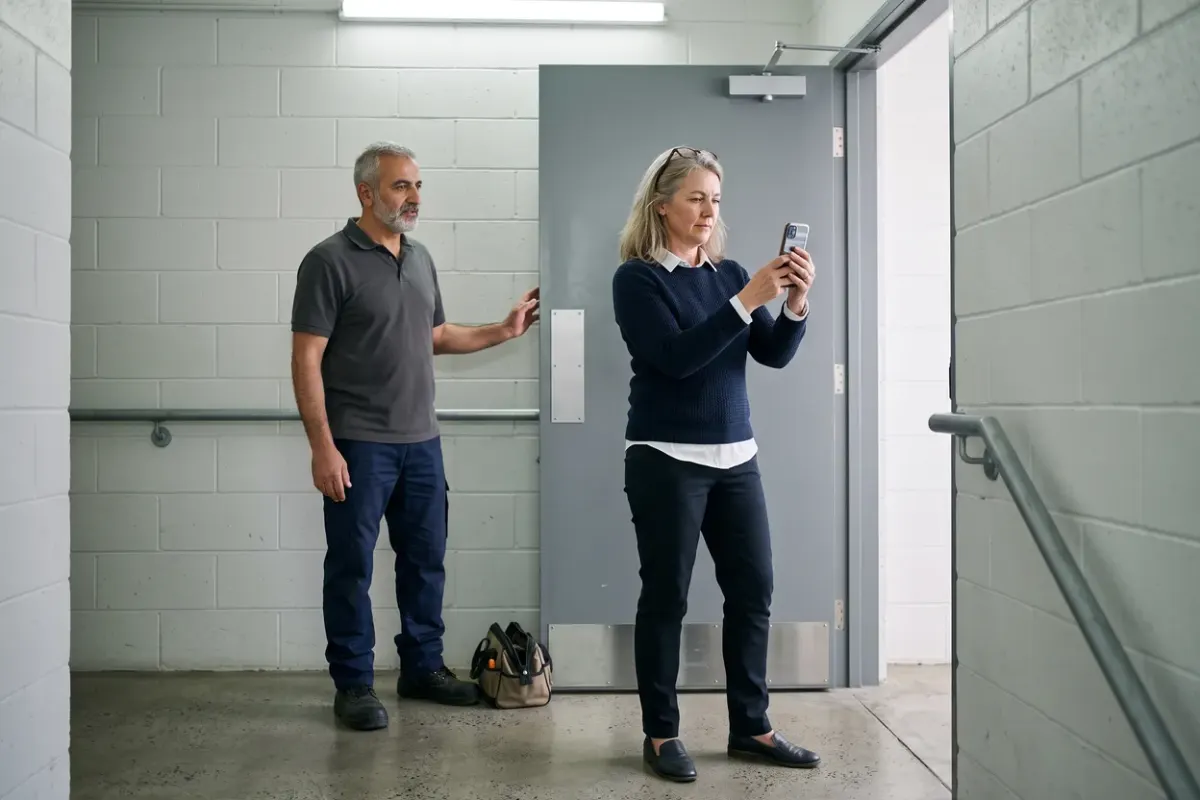
This guide is for the facilities manager whose inspections find problems that take too long to fix, or come back. The examples are a multi-tenant office building in property and facilities management and a distribution centre in transport and logistics: illustrations, not customers. The register and a close-out checklist fit on 2 pages: download the PDF, or the CSV for a spreadsheet.
What Is a Corrective Action Register?
A corrective action register is one list of every fix your inspections have asked for, each with an owner, a due date, a status, and the evidence it was done. Incidents, audits, and worker reports feed the same list, so nothing depends on which form found the problem. The register is the part of an inspection program that proves the inspections changed anything.
Keep one register for the business, not one per building or per checklist. A facilities team running 12 buildings needs every open action in one view, sorted by priority, or the portfolio's worst hazard sits on page 3 of one building's spreadsheet.
Write the Finding So the Fixer Needs Nothing Else.
The person doing the fix was not on the walk. Write each finding so a contractor reading it on a phone next week knows where to go, what is wrong, and what fixed looks like. Four parts do it:
- Where, precisely. 'Fire stair B, landing between levels 4 and 5', not 'stairwell'. In a warehouse, the aisle and the bay.
- What is wrong, as an observation. 'Nosing lifted about 15 mm at the eastern end', not 'trip hazard'. The hazard is the conclusion; the observation is what the fixer will check.
- Who could be hurt. One clause: 'used by every tenant in an evacuation'. It is what the priority will rest on.
- A photograph framed for the fixer. Wide enough to find the spot, close enough to see the fault.
Keep the recommendation apart from the finding. 'Replace nosing' written into the finding stops anyone asking whether replacing it is the best fix, and that question deserves its own field.
What Is the Difference Between a Correction and a Corrective Action?
A correction deals with the hazard in front of you today. A corrective action removes the reason it is there. Taping off a lifting stair nosing is a correction; replacing the whole run of nosings, because the adhesive under all of them is failing, is the corrective action. A preventive action goes one step further, to the places that have not failed yet, such as checking the same nosings in the other fire stairs.
Safe Work Australia's code of practice on managing risks says administrative controls and personal protective equipment are the least effective controls, and should only be used as a back-up to higher controls, as a short-term interim measure until a more effective control can be used, or as a last resort.1 That is where the line between the two sits. Hazard tape, a sign, and an email to tenants are a fair way to make a fire stair safe on a Tuesday afternoon, and no way to leave it at the end of the quarter.
In Victoria, which has its own Occupational Health and Safety Act 2004, WorkSafe Victoria gives employers similar advice: consider whether temporary controls are needed while the preferred control is prepared.2 So give each register row two dated entries, the make-safe and the fix, so you can show both were done.
Choose the Fix From the Top of the Hierarchy of Control.
If removing the hazard altogether is reasonably practicable, that is the fix. For the risks the model WHS Regulations require you to manage, regulation 36 sets the order of the hierarchy of controls when elimination is not reasonably practicable: substitution, isolation, and engineering controls first, then administrative controls, then personal protective equipment, each only so far as is reasonably practicable.3 Some of those risks carry their own, more specific order, which must be followed as well: for a fall from one level to another that is reasonably likely to cause injury, regulation 78 requires the work to be done on the ground or on a solid construction so far as is reasonably practicable; where the risk cannot be eliminated, regulation 79 requires a fall prevention device if that is reasonably practicable, otherwise a work positioning system, and only if neither is, a fall arrest system.3 For every other risk, the code says the same hierarchy can be applied.1
The model laws have been adopted in every state and territory except Victoria, some with local variations, so check your own state's Regulations before quoting a number to a contractor.4
Take the distribution centre, where the weekly walk keeps failing one item: the painted pedestrian walkway at the dock 7 crossing is worn through where forklifts turn. Repainting it is a marking, and a marking works like an administrative control, because it relies on people seeing it and staying inside it. A fixed barrier that keeps people out of the turning circle isolates the hazard. Moving the walkway away from the turn could remove it. The register row should record which level was chosen and, if it was the paint, why the higher options were not reasonably practicable.
Cost counts, but not for everything. The code says cost can be weighed in deciding what is reasonably practicable but cannot be a reason for doing nothing, nor for relying only on people's behaviour when substitution, engineering, or isolation would work.1 Where a hazard could kill or seriously injure someone, it says to favour controls that reduce how bad the harm would be over those that only make it less likely.1
Set Due Dates by Risk.
Every action gets one owner, a named person with the authority and the budget to get it done. The code asks for managers and supervisors to be given the authority and resources to implement and maintain controls, with accountability clearly allocated.1 The inspector who found the fault is rarely that person, and a shared inbox never is.
Write the due-date rule down before the next inspection, so dates come from the priority rather than from whoever is holding the phone. The code says to fix easy problems straight away and to prioritise the rest by risk, highest first.1 The make-safe and fix-by numbers below are examples to replace with your own, and they match the example in Rolling Out an Inspection App, which covers moving the checklist itself from paper to a phone. The escalation column is added here.
| Priority | Make safe | Permanent fix due | Escalate to the owner's manager |
|---|---|---|---|
| High | The same day; before the inspector leaves the area if someone could be seriously hurt | Within 7 days | The day after the due date, by phone; to the site's senior manager after 3 days |
| Medium | Only if someone is exposed before the fix | Within 30 days | 7 days after the due date |
| Low | Not needed | At the next planned works | At the monthly review |
Two rules keep the table honest. A due date moves only with a reason and the manager's approval, and the original date stays on the row, because a register where every date has slipped tells you nothing. And a quote is not a fix: an action waiting on a contractor's quote is still open and still ageing.
In the office building, the lifting nosing is high priority: a fall on an exit stair that every tenant uses in an evacuation. Tape and a sign go up that afternoon and are logged as the make-safe. The building services coordinator owns the permanent fix, due within 7 days, and raises the work order from the register row rather than from memory.
What Happens When a Corrective Action Goes Overdue?
It should reach someone with more authority than its owner, on a set day, without anyone deciding to send it. Write the ladder into the register so it runs on dates:
- The due date passes. The owner is asked for a new date and a reason, and both go on the row.
- The escalation point in the table arrives. The owner's manager sees the action, its age, and its priority, by name.
- Twice that time passes. It goes on the agenda of the site or portfolio meeting with a decision required: fund it, re-plan it, or put in a stronger interim control.
- The action is high priority. The call goes the day after the due date, by phone, not by email.
While a fix is late, the interim control is doing all the work, so check it and record the check on the row. A barrier that was in place in week 1 can easily have been moved by week 6. Most overdue actions are waiting on money, a part, a shutdown window, or a tenant, and the ladder's real job is to put that decision in front of the person who can make it.
Keep the Owner Inside Your Business.
In a multi-tenant building, many fixes are done by people you do not employ: the mechanical contractor, the fire services contractor, or the tenant whose staff prop open a fire door. The work can be theirs. The row should still have an owner inside your business, because that person raises the work order, follows it up, checks the result, and files the evidence.
Under the model WHS Act, more than one person can hold the same duty at once, and each must meet it even if someone else holds it too, to the extent the person has the capacity to influence and control the matter, or would have had that capacity but for an agreement or arrangement that tries to limit or remove it.5 Section 46 then requires each person with a duty in relation to the same matter to consult, co-operate, and co-ordinate activities with the others, so far as is reasonably practicable.5 Safe Work Australia's consultation code gives, as an example, a landlord or managing agent consulting commercial tenants, or a contractor doing maintenance or repairs.6
Three kinds of row turn up again and again:
- The contractor's fix. A guard missing from a condenser fan in the roof plant room sits inside the mechanical contractor's maintenance scope. The row records the work order, the contractor's service report, and a photograph of the guard refitted, and your coordinator verifies it on the next roof visit.
- The tenant's fix. A fire door inside a tenancy wedged open for deliveries is the tenant's habit to change. The property manager writes to the tenant and records the reply, and the next inspection checks the door. If it is wedged again, the fix moves up the hierarchy: find out why it is propped and change that.
- The shared fix. A damaged dock leveller used by two tenants needs the owner, the managing agent, and both tenants to agree who pays and when the dock closes. Record the agreement on the row; it is your consultation evidence.
In a leased warehouse, a finding at a loading dock often has more than one duty holder in law, the warehouse operator and the carrier among them, and still needs one owner on the row.6
Verify the Fix, Then Verify It Again.
Three different checks close a row:
- Done. The work happened: the date, who did it, and a photograph of the result.
- Effective. The hazard is controlled: the nosing sits flush and fixed, the barrier stops a pallet jack, the fire door closes and latches from fully open.
- Still effective. It is working weeks later, at the next inspection.
The law cares about the second and the third, and the third is the one registers miss. Where the model Regulations require a risk to be managed, regulation 37 requires a control to be maintained so that it remains effective, including fit for purpose, suitable for the nature and duration of the work, and installed, set up, and used correctly.3 The code adds that you should decide what monitoring and maintenance a control needs when you put it in, and schedule those checks.1
In practice, someone other than the person who did the work verifies every high-priority action, on site. For everything else, the next scheduled inspection asks the same question, and the row is not finished until that answer is a pass. A fixed item that fails at the next walk is not a new finding. It is the same row, reopened.
Why Does the Same Finding Keep Coming Back?
Because the fix dealt with the symptom. Where the model Regulations require the risk to be managed, a repeat is also a legal trigger: regulation 38 requires a control to be reviewed, and revised as necessary, when it does not control the risk it was put in for, so far as is reasonably practicable. Its first example is monitoring results that show the control is not working, and its second is a notifiable incident caused by the risk.3 An inspection that fails the same item again is a monitoring result of that kind.
To find the cause, keep asking why until the answer is something you can change. In the distribution centre: the walkway paint wore through; because forklifts turn across it; because nobody mapped the turning path when dock 7 was added. So the fix is to move or fence the walkway, and the preventive action is a walk of the floor plan before the next layout change. Two or three whys usually reach the cause; the habit matters more than the form.
Count repeats by item and site every month. The same item failing at 3 buildings is a portfolio problem with one fix, such as a change to a maintenance specification, and that is cheaper than 3 separate repairs.
Is a Corrective Action Register a Legal Requirement in Australia?
Not by that name in the model WHS laws. The phrase appears nowhere in the model WHS Act or the model WHS Regulations, and the 4 places the Regulations mention corrective action are all about major hazard facilities.35 Safe Work Australia's risk code says you may prepare a risk register naming the action needed, who is responsible, and by when, and 'may' is the code's word for an optional course of action.1 What the model WHS Act requires is the managing: under section 17, a duty to ensure health and safety means eliminating risks so far as is reasonably practicable and, where that is not reasonably practicable, minimising them so far as is reasonably practicable.5
The register is how you show it was done. Safe Work Australia's code says keeping records of the risk management process demonstrates what you have done to comply with the WHS Act and Regulations, and that codes of practice are admissible in court proceedings under the WHS Act and Regulations, where courts may rely on them to decide what was reasonably practicable in the circumstances the code covers.1 Our post on what goes in a risk register covers the register of hazards; the corrective action register is the list of what you are doing about the ones that failed.
The Records That Show the Fix Was Done.
Records are easiest to test one finding at a time. Take an item from last quarter's inspection and follow it to the end: who owned it, what was done and when, how you know it worked, and whether it came back. The code lists what is worth keeping, including the hazards, risks, and chosen controls, how and when the controls were implemented, monitored, and reviewed, and who you consulted.1 On a register row that means keeping:
- the finding as written, with its photograph, location, date, and inspector
- the priority, the interim control, and when it went in
- the permanent control, its level in the hierarchy, and why a higher one was not reasonably practicable
- every change of owner or due date, with the reason
- the evidence of completion, who verified it, and how
- the answer at the next inspection, and who was consulted, contractors and tenants included.
Keep the photographs with the row rather than in someone's camera roll, and never delete closed rows. A register that throws away closed actions throws away the evidence that the program works. How often each inspection runs, and the proof that the schedule was kept, is the subject of How to Build an Inspection Schedule That Holds.
What to Automate So Nobody Has to Chase.
Chasing is moving information between people on dates. Automate the creation of each action, the notice to its owner, the reminders, the escalation, and the weekly overdue list. Keep the judgements with people: the priority, the choice of control, accepting a partial fix, and verifying anything high-priority.
Raising and closing an action in ComplyFlow's Inspection app is shown step by step in the rollout guide linked above. Three things it does not cover help with the chasing: the person responsible gets an email listing the actions an inspection has assigned to them, an SMS alert to a nominated phone number can be switched on for any priority, and when someone leaves, their open actions can be transferred to another user in bulk.789
Run Last Month's Findings Through These Rules.
Take every failed item from last month's inspections and ask five questions of each:
- Is there an interim control on record?
- Is the permanent fix as high up the hierarchy as is reasonably practicable?
- Does it have one owner and a date set by priority?
- Has anything overdue reached a manager?
- Has anyone checked that the closed ones still work?
Start with the high-priority rows. The gaps you find are the design brief for your register, and the 2-page template has a column for each answer. To see the same steps in inspections and audits, book a demo and bring one finding that came back.
Sources
- How to manage work health and safety risks: Code of Practice
- The hierarchy of control
- Model Work Health and Safety Regulations (as at 5 December 2025)
- Model WHS laws
- Model Work Health and Safety Bill (as at 5 December 2025)
- Work health and safety consultation, cooperation and coordination: Code of Practice
- Email Alerts for Staff
- SMS Notifications for Inspection Actions (Configuration)
- Transferring Actions in Bulk
See It Against Your Own Contractors, Sites & Rules.
Book a 30-minute demo. We will show ComplyFlow working with your kind of sites, your kind of contractors, and your requirements. No slides, no hard sell.
Or Speak to Us
- ISO 27001
- Hosted on AWS
- Microsoft & Okta SSO
- API & MCP
- Data in Australia
Written by
Mitchell BourneManaging Director, ComplyFlow
Mitchell has run ComplyFlow since 2009 and has spent that time inside the contractor, site, and safety problems of Australian operators. He writes about where compliance actually fails, and what the people responsible for it can do about it.
Writes about: Contractor compliance, WHS duty and proof, Running a compliance program
Questions
Questions People Ask About This.
What are the steps of a corrective action after an inspection?
Record the finding with its exact location and a photograph. Make it safe before the inspector leaves if it could hurt someone. Choose the permanent fix from as high up the hierarchy of control as is reasonably practicable. Give it one owner and a due date set by its priority. Verify the fix worked, on site. Then check at the next inspection that it still works, which is the step that is easiest to skip.
What should a corrective action register template include?
One row per finding: a reference, the date found and by whom, the location, the finding as written, the priority, the interim control and its date, the permanent control and its level in the hierarchy, one named owner, the due date and any change to it with the reason, the status, the completion date, who verified it and how, and the result at the next inspection. Our 2-page download has those columns and a close-out checklist.
Who should verify that a corrective action worked?
For a high-priority action, someone other than the person who did the work, on site, looking at the hazard rather than the paperwork. For lower-priority items the inspector at the next scheduled inspection can verify it by asking the same checklist question again and recording a pass.
Can a contractor or tenant own a corrective action in our register?
They can do the work, but keep the owner inside your business: the coordinator who raises the work order, or the property manager who writes to the tenant. That person chases, checks the result, and files the evidence. Under the model WHS laws a duty is not lost because someone else holds the same duty, so keep your own record of what was done.
Should a low-risk finding go in the register at all?
Yes, if anything has to happen after the inspector walks away. A missing sign replaced on the spot can be recorded as found and fixed on the inspection itself. Anything that needs a part, a contractor, or another person belongs in the register, because low-risk items kept off it are how the same finding turns up four inspections running.