WHS Procedures: 10 Examples and How to Make Each One Run
WHS procedures are the written steps that put a workplace's safety policy into practice: how to engage a contractor, get onto a roof, issue a permit, or notify an incident. Most of what an FM provider runs across a property portfolio comes down to 10 of them, and each works only if it leaves a record: a trigger, its steps as questions, a named approver, a schedule, and evidence someone can find later.
 Mitchell BourneManaging Director
 - Published
- Updated
- 19 min read
Most facilities management providers have a procedures manual. Far fewer can show, for one building on one Tuesday, that a procedure in it was followed. That gap is where WHS procedures fail, and it is rarely a writing problem.
This guide is for the WHS manager running maintenance contractors across a portfolio of commercial buildings in property and facilities management. It covers what a WHS procedure is, the 10 a property portfolio needs, and what each one has to leave behind as a record. Then it follows one procedure, roof access, from the page it is written on to a live permit, an approval, and a schedule, without changing what the procedure says.
What Is a WHS Procedure?
A WHS procedure is a written set of steps for doing one piece of work safely, or for responding to one kind of event: how to get onto a roof, how to report a hazard, what to do in the first hour after an incident. It names who does each step, in what order, and what they check before the next step starts.
The law does not use the phrase, but it asks for what a procedure delivers. The model WHS Act's primary duty requires a business to ensure, so far as is reasonably practicable, the provision and maintenance of safe systems of work, and any information, training, instruction, or supervision needed to protect people from risks arising from the work.1 A written procedure is how most businesses show they have both.
For an FM provider the duty has a second edge. A person with management or control of a workplace must ensure, so far as is reasonably practicable, that the workplace and the means of entering and exiting it are without risks to anyone's health and safety.1 On a managed building that person is often you, which is why the procedures for getting contractors onto a roof or into a plant room are yours to write, even when the contractor brings its own.
One note on the law before the list. Victoria is the only jurisdiction that has not implemented the model WHS laws,2 so the section and regulation numbers below are the model's. Every other state and territory has implemented them with variations, and a change to the model, including those made in December 2025, is law in a state only once that state enacts it. A Victorian portfolio should check its own Act. NSW has also added a duty of its own: from 1 July 2026 a business must comply with an approved code of practice, or manage hazards and risks to a standard equal to or higher than the code requires.15 The two Safe Work Australia codes cited in this guide are model codes, so a NSW portfolio should check the approved NSW version.
What Is the Difference Between a WHS Policy and a Procedure?
A policy says what the business commits to. A procedure says how one job gets done. "We will manage the risk of falls from height" is policy. "Before anyone goes onto a roof at a managed building, the site coordinator checks the anchor inspection date, confirms the contractor's working at heights training, and issues a roof access permit" is a procedure.
The difference matters because the two fail in different ways. A weak policy is a reputational problem. A weak procedure is an operational one: the step nobody could check, the sign-off that happened by email, the inspection that was due in March. Procedures, and the records behind them, are where an audit finds its gaps.
A working test: if you cannot picture a person doing it at a named building on a named day, it is policy. If a contractor who has never worked for you could follow it without ringing anyone, it is a procedure.
Which WHS Procedures Does a Property Portfolio Need?
These 10 cover most of what an FM provider runs across a commercial portfolio. They are not a legal checklist. The law asks you to manage the risks you actually have, and a portfolio with cooling towers or confined plant spaces will need more. Psychosocial risks, from hazards such as the design or management of work and workplace interactions or behaviours that may cause psychological harm, must also be managed under the model Regulations,3 and belong in the set, even though this guide concentrates on the procedures contractors touch. What each entry adds is the record the procedure should leave, because the record is what somebody will ask to see.
1. Contractor Engagement and Prequalification.
The duty follows the work, not the contract. The model Act counts contractors, subcontractors, and their employees as workers,1 and says plainly that a duty cannot be transferred to another person.1 Safe Work Australia's fact sheet on duties in a contractual chain says WHS duties cannot be contracted out to another party, such as a subcontractor.7 Some checks are required by name. A business must not direct or allow a worker to carry out licensed high risk work without seeing written evidence of the licence,3 or to carry out construction work without general construction induction training (and, if it was completed more than 2 years ago, construction work in the last 2 years),3 and a business that commissions asbestos removal must ensure a licensed asbestos removalist does it, above small exempt amounts, such as 10 square metres or less of non-friable asbestos, which must still be removed by a competent, trained person.3 The record: an approved file per contractor, with an expiry date on everything that expires.
2. Site Sign-In and Induction.
You cannot manage a risk to a person you do not know is in the building. SafeWork NSW recommends that the parties provide an adequate induction and site- and task-specific training.4 Across a portfolio that becomes a sign-in at every building, with that building's induction attached to it. The record: who was on site, when, and which induction they completed first.
3. Hazard Reporting and Risk Assessment.
The model Regulations require a business to identify reasonably foreseeable hazards that could give rise to risks to health and safety, and then to manage those risks.3 The procedure turns that into something a technician can do from a plant room: report the hazard, have someone competent assess it, choose the control, and name who owns it. The record: the hazard, the assessment, the control, and who closed it.
4. Working at Height and Roof Access.
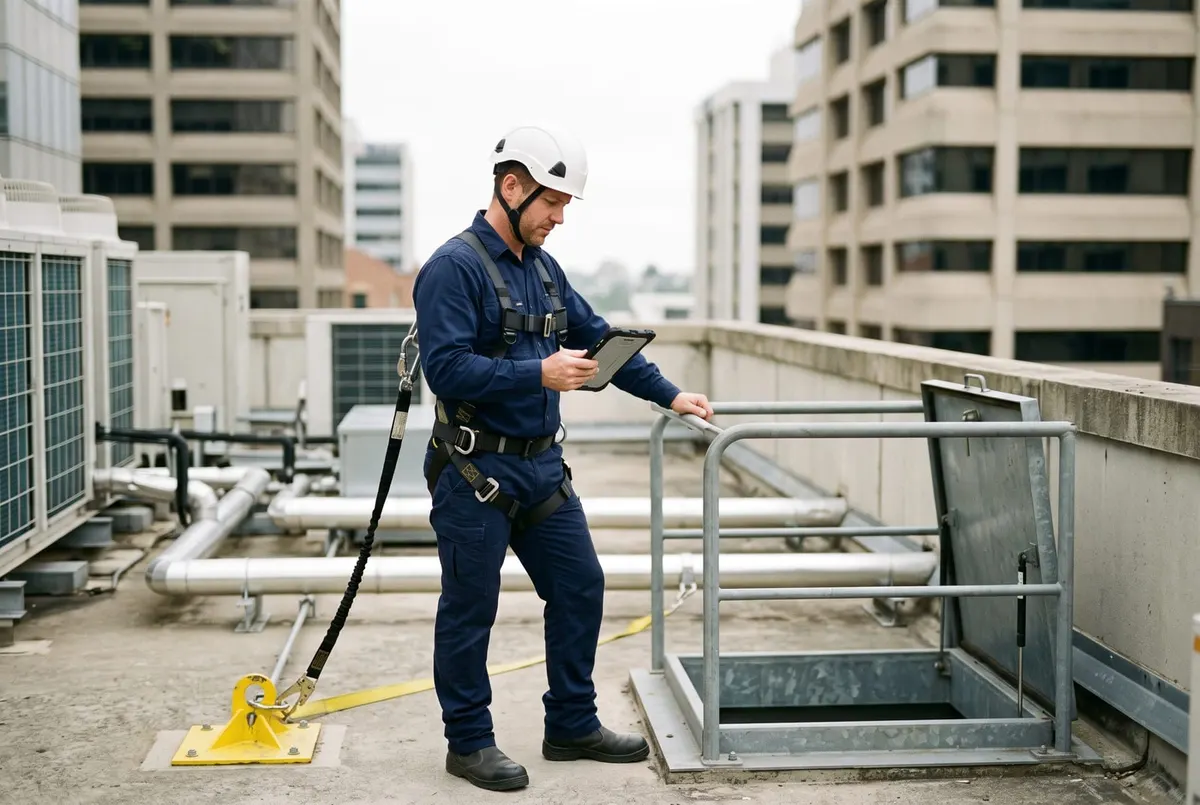
Falls from one level to another that are reasonably likely to cause injury must be managed, and the Regulations set the order. First, so far as is reasonably practicable, the work is done on the ground or on a solid construction. Where the risk of a fall cannot be eliminated, the next controls are a fall prevention device if reasonably practicable, then a work positioning system, then a fall arrest system, so far as is reasonably practicable.3 Where fall arrest is the control, the business must also establish emergency procedures, including rescue procedures.3 That last requirement is the one roof procedures most often leave out: the harness is written in, and the plan for getting someone down from it is not. The record: the access permit, the anchor inspection it relied on, and the rescue arrangement.
5. Permits to Work, and Who Approves Them.
Permits are the procedure most FM providers already run on paper: hot work, isolations, roof access, confined spaces. Of those four, only the confined space entry permit is required by name, and it is the only one whose contents the Regulations set out in full. A worker must not be directed to enter a confined space unless a confined space entry permit has been issued, completed by a competent person, in writing, naming the space, the people permitted to enter, the period of the work, and the risk controls, with space to confirm the work is finished and everyone is out.3 The rest are your own controls, which means their design is yours, including who approves them. The confined space permit must be completed by a competent person; for every other type, the procedure should name the approver by role, such as the site coordinator for routine roof access and the WHS manager for hot work near plant. Safe Work Australia's falls code gives requiring permits for access to areas where restraint or fall arrest systems are used as an example of a permit system.5 The record: the permit, who approved it, and the close-out.
6. Safe Work Method Statements.
This is where maintenance catches FM providers out. Construction work, as the Regulations define it, includes the repair and maintenance of a structure, and excludes, among other things, "testing, maintenance or repair work of a minor nature".3 Construction work that involves a risk of a person falling more than 2 metres is high risk construction work,3 and a SWMS must be prepared before it starts.3 Height is only one of the 18 kinds of high risk construction work the same regulation lists. Others include work on or near energised electrical installations or services, on or near chemical, fuel or refrigerant lines, in or near a confined space, and work likely to disturb asbestos,3 which between them describe a lot of ordinary FM maintenance. A roof membrane replacement is very likely in; changing a light fitting from a stable platform very likely is not. Where the line falls on a given job is a judgement, so the procedure should make someone make it and write it down. Why the review then backs up is covered in why SWMS review becomes a bottleneck. The record: the SWMS, its reviewer, and the decision on whether one was needed.
7. Asbestos Register.
This one is decided by the age of the building. The person with management or control of a workplace must ensure an asbestos register is prepared and kept there, for buildings whenever constructed, unless the building was constructed after 31 December 2003, no asbestos has been identified there, and none is likely to be present from time to time.3 The register must be readily accessible to every worker and every business that carries out, or intends to carry out, work at the workplace, to their health and safety representatives, and to any business that requires work to be done there, and a contractor whose work carries a risk of exposure to airborne asbestos must be given a copy.3 The record: the register, and proof that each contractor who needed it saw it before starting.
8. Plant and Building Inspections.
Lifts, fire equipment, roof anchors, electrical test tags, and plant rooms all need checking on a cycle. Safe Work Australia's risk management code says it is useful to keep information on how and when each control measure was implemented, monitored, and reviewed, and notes that the Regulations set specific record-keeping requirements for some hazards, including plant.6 Running one inspection across dozens of buildings is its own problem, covered in how inspections work across a property portfolio. The record: the inspection, its findings, and the action that closed each one.
9. Incident Reporting and Notification.
A notifiable incident is a death, a serious injury or illness, or a dangerous incident arising from the conduct of a business or undertaking.1 The model Act as amended in December 2025 adds violent incidents, but that is law in a state only once that state enacts it; SafeWork NSW, for example, still lists only the three.13 The regulator must be notified immediately after the business becomes aware of it, a record must be kept for at least 5 years from the day notice is given, and the person with management or control of the workplace must, so far as is reasonably practicable, preserve the site until an inspector releases it.1 On a managed building the FM provider and the contractor can both hold part of that duty, so the procedure should say who calls whom. The December 2025 model amendments add three more notices a procedure may one day need to cover: notice of a notifiable extended absence (15 or more consecutive days) within 14 days, notice of a notifiable suicide, and, in section 39A, a duty to tell the other duty holder immediately after becoming aware, so far as is reasonably practicable.14 Like the violent incident category, they bind a business only once its state enacts them, and the NSW Act as in force on 1 October 2026 carries none of the three. The record: the notification, its time, and what was preserved.
10. Emergency Plans and Consultation.
An emergency plan must be prepared for each workplace, covering emergency and evacuation procedures, notifying emergency services, testing the procedures and how often, and the training workers need to carry them out, and it must be maintained so it stays effective.3 Consultation runs beside it. Where several parties share a duty, as an owner, an FM provider, tenants, and contractors often do in one building, each must, so far as is reasonably practicable, consult, cooperate, and coordinate with the others.1 Safe Work Australia's own example is an office building manager consulting its cleaning contractor to satisfy itself the cleaner has adequate systems in place.7 The record: the plan, its last test, and who was consulted.
Here are the 10 on one page.
| Procedure | What starts it | The record it leaves | Who signs it off | How often |
|---|---|---|---|---|
| Contractor engagement | A new contractor, or a document expiring | The approved contractor file | Contract owner or WHS manager | On engagement, and at every expiry |
| Sign-in and induction | Arriving at a building | Sign-in with that building's induction | Site coordinator, on exceptions | Every visit |
| Hazard reporting | Anyone seeing a hazard | Hazard, assessment, control, owner | Site or area manager | As raised |
| Working at height | Work near an open edge or through a roof hatch | Access permit and rescue arrangement | Site coordinator | Every job |
| Permits to work | Hot work, isolation, confined space | The permit and its close-out | The approver for that permit type | Every job |
| SWMS | High risk construction work | The SWMS and its review | WHS manager or delegate | Before the work, and when controls change |
| Asbestos register | Work that could disturb the building fabric | The register, and proof it was seen | Person with management or control | Before the work |
| Inspections | The schedule | Inspection, findings, actions | Inspector, then the action owner | Set by the risk and the manufacturer |
| Incident notification | A notifiable incident | Notice, and what was preserved | WHS manager | Immediately; kept at least 5 years |
| Emergency plan | A new site, a change, a scheduled test | The plan and the test record | Building or site manager | As often as the plan sets |
Every Procedure Should Leave a Record.
Read down the record column and a pattern shows. Every procedure on the list has the same five parts, whatever it is about:
- A trigger: the event that starts it, such as a contractor arriving, a job being booked, or a date coming round.
- The steps, written as questions: what the person must check or confirm, in order.
- An approver: a named role that says yes or no before the work goes on.
- A schedule: when it recurs, and when it must be reviewed.
- The record: what is left behind, and where somebody will find it in 2 years.
Most manuals are strong on the second part and silent on the other four. The steps are written as instructions, the approver is implied, the schedule lives in one person's calendar, and the record is whatever got emailed. That is how a well-written procedure still fails an audit.
The review trigger is the part most often missing, and the Regulations are specific about it. Control measures must be reviewed, and revised as necessary, when a control does not control the risk it was put in for, before a change at the workplace likely to create a new or different risk, when a new relevant hazard or risk is identified, when consultation shows a review is needed, and when a health and safety representative asks for one.3 A SWMS must be reviewed whenever those controls are revised.3 Written into a procedure, each of those events is a trigger. Left out, each is an obligation somebody remembers after the incident.
The risk management code lists what is useful to keep, scaled to the size of the workplace: the hazards, the risks, and the controls chosen, how and when the controls were implemented, monitored, and reviewed, who was consulted, and the relevant training.6 In the code's own words, keeping those records "demonstrates what you have done to comply".6 That list is the specification for the record column above.
How Long Do WHS Records Have to Be Kept?
There is no single period, which surprises people. A record of a notifiable incident must be kept for at least 5 years from the day notice is given to the regulator.1 A SWMS, by contrast, must be kept until the high risk construction work it covers is completed, and for at least 2 years after a notifiable incident only if one occurs in connection with that work.3 Other records, such as those for plant and hazardous chemicals, carry their own periods in the Regulations.6
So a flat "keep everything for 5 years" rule is safer than the law in some places and simply wrong as a description of it. The better answer is to set the period per procedure, in the procedure, next to the record it applies to.
Roof Access Across 40 Buildings, From Paper to Permit.
Take an illustrative case: an FM provider managing 40 commercial office buildings in one capital city, most with air-conditioning plant on the roof and a mix of fixed anchors and edge protection. Its roof access procedure is a single page of 6 steps.
- The contractor requests roof access from the site coordinator at least a day ahead.
- The coordinator confirms the contractor is approved, holds current working at heights training, and has a SWMS if the job is high risk construction work.
- The coordinator checks that the roof anchors' last inspection is within the interval their inspection regime sets.
- The coordinator issues a roof access permit naming the workers, the area, and the time window, and confirms the rescue arrangement.
- The contractor signs in at the building and completes its roof induction.
- On completion, the contractor closes out the permit, confirms everyone is off the roof, and secures the hatch.
Nothing is wrong with that procedure. On paper, what goes wrong is everything around it. Step 1 arrives by phone. Step 2 is done from memory, because the training record sits in another system. Step 3 is skipped, because the anchor report is a PDF from the anchor contractor, filed by building, and nobody opens 40 folders before a job. Step 6 happens, but nothing records it, so when someone later asks whether a permit was closed, the honest answer is that it probably was.
Now the same 6 steps, digitised. The procedure does not change by a word. What changes is that each step can only be done one way, and each one leaves a record.
- The request is a roof access permit, started by the contractor or the coordinator.
- Step 2 becomes required questions in the permit's first section, with the training record and any SWMS attached as files, and the coordinator as that section's reviewer.
- Step 3 stops being a search. The anchors sit on a scheduled inspection that repeats at their interval, so the coordinator sees whether the last one is current.
- Step 4 is the approval, given or refused from a phone, with a comment.
- Step 5 stays what it was: the sign-in at the building, and the induction that building requires.
- Step 6 is the permit's close-out section, answered by the contractor with a photograph of the secured hatch.
That is how digital permits are built in ComplyFlow. A permit has a type, sites, an expiry, and a permit holder, and is made of sections, each with its own reviewer, which can be a role, a team, or the permit holder, and questions whose answers can trigger further questions.8 Questions come in 13 types, from yes or no and dates to file uploads, and any of them can be made required.9 A reviewer approves or rejects in the app, with a comment, and the person who submitted the permit is notified.10
Inspections can be scheduled to repeat at intervals and assigned to users, a site, or a staff category, and a template can be made available to contractors so they complete it on your checklist.11 An existing paper checklist can be loaded from a CSV of categories, questions, and instructions rather than retyped.12
The record the portfolio ends up with is the one the procedure always asked for: for every job, who asked, who checked, what they relied on, who approved, and when the hatch was closed. Across 40 buildings, those records also start to answer the questions paper can only answer one building at a time: which buildings had roof work this month, which permits were never closed out, and which anchors are overdue for inspection.
How to Digitise a Procedure Without Rewriting It.
The instinct, when a procedure moves into software, is to rewrite it for the software. Resist it. The procedure was consulted on, it reflects your risks, and your people know it. The job is translation, not redesign.
- Start with the procedure that failed most recently. Your incident and near-miss records will name it. It has the most to gain, and your people already know it is broken.
- Mark every "must" in the written document. Each becomes a required question, a required upload, or a sign-off. A "must" that cannot become one of those was never checkable, which is worth knowing on its own.
- Name each approver by role, not by person. "Site coordinator" survives a resignation. A first name does not.
- Write down the trigger and the schedule. What starts the procedure, how often it recurs, and which review events bring it back.
- Decide the record first. Ask what someone would need to see in 2 years, after an incident, and make sure the digital version produces exactly that.
Then run it on one building for a month, beside the paper, with the people who do the work. That is also a legal point: a business must, so far as is reasonably practicable, consult workers who are, or are likely to be, directly affected by a work health and safety matter.1 They will find the question nobody can answer from a roof in the rain, and fixing it before it reaches 40 buildings is cheap.
What Should Stay on Paper?
Some things should. A procedure one person runs twice a year, with no approval and no contractor, rarely earns the setup. Evacuation diagrams belong on the wall, where people will see them in an emergency. A danger tag on an isolator is a physical control; the digital record sits beside it, never in place of it.
Nothing in the model WHS laws read for this guide requires a WHS record to be digital, and nothing requires paper either. The model Act, since its December 2025 amendment, lists electronic and digital records among the evidence to preserve after a notifiable incident, alongside witness details.1 The medium is your choice. The test is whether the record would be there on the day it is needed. If you are weighing whether your current system has reached its limit, when a manual safety management system stops working sets out five tests you can run this week.
Start With the Procedure That Failed Last.
Pick the procedure behind your last incident or near miss on a managed building. Write its five parts on one page: the trigger, the steps as questions, the approver, the schedule, and the record. Wherever you cannot fill one in, you have found why it failed, and the first thing to fix, whether it ever goes into software or not.
For a WHS manager on a portfolio, the payoff is being able to answer one question without a phone call: was the procedure followed at that building, on that day, by that contractor. If you want to see your own roof access procedure built the way it is above, bring it to a demo.
Sources
- Model Work Health and Safety Bill, sections 7, 14, 19, 20, 35, 38, 39, 46 and 47
- Legislation
- Model Work Health and Safety Regulations, regulations 34 to 38, 43, 55A to 55D, 67, 78 to 80, 85, 289, 291, 299 to 303, 317, 422 to 427 and 458
- Contractors and labour hire
- Managing the risk of falls at workplaces: Code of Practice
- How to manage work health and safety risks: Code of Practice
- Fact sheet: WHS duties in a contractual chain
- Permits Concepts and Workflow Examples
- Creating and Editing a Permit Question on a Form
- Approving Permits via Live Access
- Scheduled Inspections
- Adding Inspection Templates
- Incident notification
- Amendments to the model WHS laws
- Industrial Relations and Other Legislation Amendment (Workplace Protections) Act 2025
See It Against Your Own Contractors, Sites & Rules.
Book a 30-minute demo. We will show ComplyFlow working with your kind of sites, your kind of contractors, and your requirements. No slides, no hard sell.
Or Speak to Us
- ISO 27001
- Hosted on AWS
- Microsoft & Okta SSO
- API & MCP
- Data in Australia
Written by
Mitchell BourneManaging Director, ComplyFlow
Mitchell has run ComplyFlow since 2009 and has spent that time inside the contractor, site, and safety problems of Australian operators. He writes about where compliance actually fails, and what the people responsible for it can do about it.
Writes about: Contractor compliance, WHS duty and proof, Running a compliance program
Questions
Questions People Ask About This.
Can you give an example of a WHS procedure?
A roof access procedure is a good one. The contractor requests access ahead of time; the site coordinator confirms the contractor is approved, trained for work at height, and has a SWMS if the job is high risk construction work; the coordinator checks the roof anchors' last inspection is current, issues a permit naming the workers, area, and time window, and confirms the rescue arrangement; the contractor signs in and completes the building's induction; and on completion the contractor closes out the permit and secures the hatch.
Are WHS procedures a legal requirement in Australia?
Not by that name. The model WHS Act requires a business to provide and maintain safe systems of work, and the information, training, instruction, or supervision needed to protect people, so far as is reasonably practicable, and written procedures are how most businesses meet and evidence that duty. Some documents are required by name, including an emergency plan for each workplace, a SWMS before high risk construction work, and a written confined space entry permit. Victoria runs its own Occupational Health and Safety Act rather than the model laws.
How often should WHS procedures be reviewed?
The model WHS Regulations set events rather than a fixed interval. Control measures must be reviewed when a control does not work, before a change at the workplace likely to create a new or different risk, when a new hazard or risk is identified, when consultation shows a review is needed, and when a health and safety representative asks for one. A scheduled review on top of those is sensible, but it does not replace them.
Who is responsible for WHS procedures when a contractor does the work?
Usually both of you. Under the model WHS Act contractors and their employees are workers, a duty cannot be transferred to another person, and where more than one party has a duty for the same matter each must, so far as is reasonably practicable, consult, cooperate, and coordinate with the others. The contractor's safe work method covers how it does the job; your procedure covers the building, the access, and what you check before the work starts.
Can WHS records be kept digitally?
Yes. Nothing in the model WHS laws read for this guide requires paper, and the model Act, since its December 2025 amendment, lists electronic and digital records among the evidence to preserve after a notifiable incident. What matters is that the record exists, holds what the law or the procedure requires, and can be produced when it is asked for.