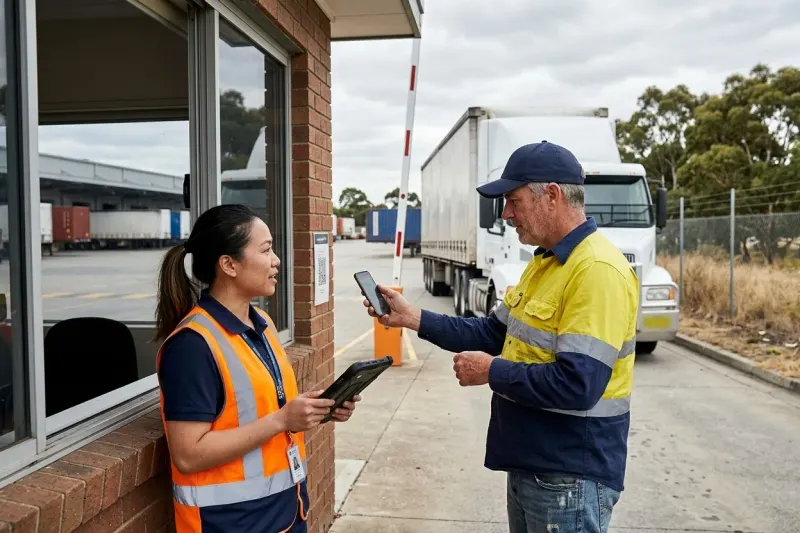
222 Worker Deaths in 2025: What the New Safe Work Australia Figures Mean for Contractor Checks
Safe Work Australia's Key Work Health and Safety Statistics Australia 2026 reports 222 worker deaths in 2025 from traumatic injuries at work, the highest annual count since 2012 and above the 5-year average of 197. Transport, postal and warehousing recorded 61 of those deaths and construction 41. For any business that relies on contractors, the practical response is to check each one before work starts, and keep the evidence.
 Mitchell BourneManaging Director
- Published
- 5 min read
What Did Safe Work Australia Report for 2025?
222 workers died from traumatic injuries sustained while working in Australia in 2025.1 Safe Work Australia calls it the highest annual number since 2012, and it sits above the 5-year average of 197. The fatality rate was 1.5 deaths per 100,000 workers, against a 5-year average of 1.4.1 In Safe Work Australia's previous edition, the count for 2024 was 188, at a rate of 1.3 per 100,000 workers.2
The report was released on 12 October 2026, in the middle of National Safe Work Month, whose 2026 theme is 'Safe work is for life'.3 Safe Work Australia also cautions that annual counts can vary widely and should be read with care.1 That caution is fair. It does not change the fact that 222 people did not come home.
Where the Deaths Occurred.
Safe Work Australia's statistics for 2025 put almost two thirds of worker deaths in three industries: transport, postal and warehousing (61 deaths, 27%), construction (41, 18%), and agriculture, forestry and fishing (38, 17%).1 Transport's rate was 8.3 deaths per 100,000 workers. Construction's count rose from 35 in 2024, though it was lower than the 46 recorded in 2023.1
By occupation, Safe Work Australia's statistics for 2025 show machinery operators and drivers accounted for 77 deaths, 35% of the total, at a rate of 8.7 per 100,000 workers. That is almost 6 times the overall rate.1
By mechanism, Safe Work Australia's statistics for 2025 show vehicle incidents caused 92 deaths (41%), falls from a height 28 (13%), and being hit by falling objects 21 (9%).1 Safe Work Australia notes that falls from a height and being hit by falling objects are both commonly associated with construction, where activity has stayed high while labour shortages continue across many trades.1 Safe Work Australia's own guidance calls working at height a leading cause of death and serious injury in Australia.4
Older Workers and Remote Sites Carried More Risk.
Safe Work Australia's statistics for 2025 show that workers aged 45 and over accounted for 62% of worker deaths, close to two thirds of the total, and workers aged 65 and over had the highest fatality rate, at 5.5 per 100,000 workers.1 Distance mattered too. A separate Safe Work Australia analysis in the same report found that workers in very remote Australia were around 8 times more likely to die from a work-related traumatic injury than the Australian average.1
For a transport or logistics business, that describes a familiar workforce: experienced drivers, regional depots, and sites where a supervisor is not always on hand. Safe Work Australia lists time pressures, shift work and fatigue among the most common road transport hazards.5 Checks that rely on someone being there to look at a card are the checks most likely to slip in those places.
What the Report Does Not Say About Contractors.
The report counts workers by industry, occupation, age, sex, state and remoteness. It does not publish a separate figure for contractors or labour hire workers, so nobody can say from it how many of the 222 were contractors.1
What it does show is where the risk concentrates: on roads, at depots, at height and on building sites. Those are places where many businesses rely on carriers, subcontractors and trades they did not employ directly. For a safety manager in those settings, the useful question is not who employed the person. It is whether anyone checked, before the work started, that they were licensed, insured, inducted and fit for the task.
Five Checks Before a Contractor Starts Work.
What we recommend: make these five checks part of the gate, not part of the paperwork that follows it.
- The company is approved. Prequalification is current, not just completed once. Our guide on how to prequalify a contractor in Australia covers what to verify at the source.
- The person holds the licence for this task. A forklift, heavy vehicle or high-risk work licence, current on the day, for the worker standing at the gate.
- Insurance is current. Certificates expire quietly between jobs.
- The site induction is done for this site. An induction at another site, or last year, is not this one.
- The task's risk controls have been reviewed. For high-risk work, someone has read the method before it is used, not after.
Each check matters less than the record it leaves. If the answer cannot be produced on the day it is asked for, the check effectively did not happen.
A Worked Example at a Distribution Centre.
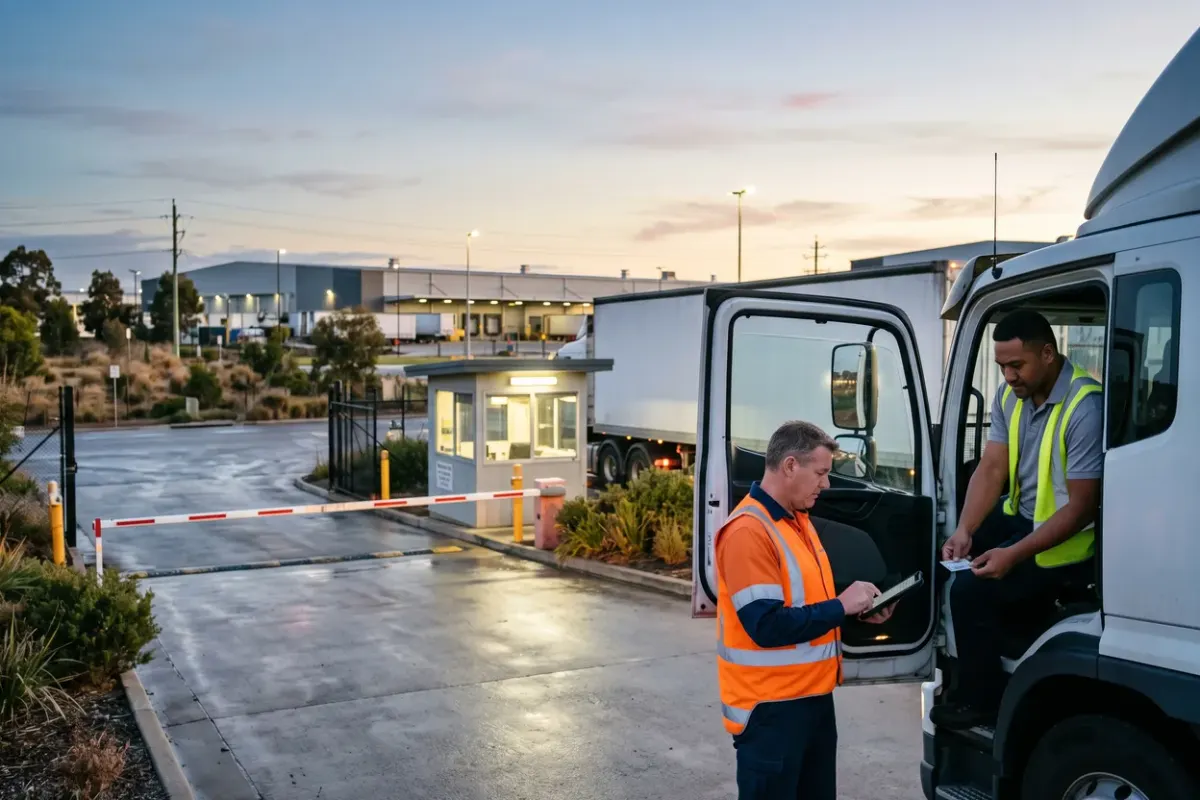
A carrier sends a replacement driver to a distribution centre at 5am. The regular driver is sick. The carrier is approved, but the replacement has never been to this site.
The gate team has three things to confirm before the truck moves past the boom gate: the driver's heavy vehicle licence is current, the carrier's insurance is still in date, and the driver has completed this centre's induction. If any one of those is missing, the driver waits in the induction room, not on the dock.
The record that matters afterwards is simple: who arrived, what was checked, when, and by whom. The contractor management process sets out what each stage should leave behind, and the same logic applies at a property portfolio where a trade arrives after hours.
Where ComplyFlow Fits.
Most businesses can do these checks by hand on a quiet day. The gap shows up at 5am, at the fourth site, or when a certificate lapsed last Tuesday. ComplyFlow's site access checks induction, licence, insurance and permit at the gate where it is set up that way, and keeps the record for each sign-in. The transport and logistics page shows how carriers and drivers are signed in at each depot.
What to Do This Week.
National Safe Work Month runs through October. Pick one site and pull last week's sign-ins. For each contractor, ask whether you could show, today, that the five checks were done before they started.
If you can, you have the record that matters. If you cannot, you now know exactly where to start.
Sources
See It Against Your Own Contractors, Sites & Rules.
Book a 30-minute demo. We will show ComplyFlow working with your kind of sites, your kind of contractors, and your requirements. No slides, no hard sell.
Or Speak to Us
- ISO 27001
- Hosted on AWS
- Microsoft & Okta SSO
- API & MCP
- Data in Australia
Written by
Mitchell BourneManaging Director, ComplyFlow
Mitchell has run ComplyFlow since 2009 and has spent that time inside the contractor, site, and safety problems of Australian operators. He writes about where compliance actually fails, and what the people responsible for it can do about it.
Writes about: Contractor compliance, WHS duty and proof, Running a compliance program
Questions
Questions People Ask About This.
How many workers died at work in Australia in 2025?
222, according to Safe Work Australia's Key Work Health and Safety Statistics Australia 2026, released on 12 October 2026. The count covers deaths from traumatic injuries sustained while working. Deaths from disease, natural causes and suicide are excluded.
Which industry recorded the most worker deaths in 2025?
Transport, postal and warehousing, with 61 deaths. Agriculture, forestry and fishing recorded the highest rate, at 13.0 deaths per 100,000 workers.
Does the report separate contractors or labour hire workers?
No. The 2026 report breaks worker deaths down by industry, occupation, age, sex, state and remoteness. It does not publish a separate figure for contractors or labour hire workers.
Keep Reading