Carrier Compliance Software for Transport and Logistics
Carrier compliance software checks every carrier, owner-driver, driver, and heavy vehicle a transport or logistics business engages against its own requirements before the job is booked, and keeps the proof. Where the Heavy Vehicle National Law applies, every state and territory except Western Australia and the Northern Territory, that proof serves its Chain of Responsibility: contracting a load out does not contract the duty out, so the file has to show what was checked, when, and by whom.
 Bart CrowtherDirector of Sales
 - Published
- Updated
- 14 min read
Search for carrier compliance software from Australia and most of what comes back is American. Those tools vet a trucking company against US federal records: its operating authority, its insurance, and its federal safety data. An Australian carrier is not in those records, and an Australian business that books it answers to a different law.
This post is for the operations manager at a transport or logistics business who engages carriers, subcontractors, and owner-drivers and has to show what was checked. It sets out what a carrier file has to hold here, where the software sits beside a transport management system, a worked example, and six tests to put to any vendor. For the law itself in full, including the penalties and the changes of 1 August 2026, read our Chain of Responsibility guide.
What Does Carrier Compliance Mean in Australia?
It means being able to show that every carrier, driver, and heavy vehicle you engage was checked against your requirements before the job, and that the check still held on the day. Where the Heavy Vehicle National Law (HVNL) applies, the law behind it is the Chain of Responsibility, the part of the HVNL that makes parties other than drivers responsible for the safety of heavy vehicles on the road. Western Australia has its own laws, covered below.1
Who is a party depends on what a business does, not on what it is called. The NHVR lists 10 functions, among them employing a heavy vehicle driver, engaging a self-employed driver under a contract for services (prime contractor), directing the control and use of a heavy vehicle (operator), scheduling, consigning, receiving, packing, loading, and unloading. A business is a party because of a function it performs, not because of a title, a job description, or the words of a contract.2 A person who owns and drives a heavy vehicle is its operator and a party too.2
A heavy vehicle here is one with a gross vehicle mass or aggregate trailer mass of more than 4.5 tonnes, or a combination that includes one.3 So a courier's vans at or under 4.5 tonnes are outside it, while the linehaul partner it hands freight to is inside it.
Why Subcontracting a Load Does Not Transfer the Duty.
Every party in the chain must ensure, so far as is reasonably practicable, the safety of its transport activities relating to the vehicle. That is the Primary Duty in section 26C.3 Three provisions of the law decide what a carrier contract can and cannot do about it.
A duty under the HVNL may not be transferred to another person (section 26B(4)).3 Where more than one person has a duty for the same matter, each keeps responsibility for its own, and must discharge it to the extent it has the capacity to influence and control the matter, or would have had that capacity but for an agreement or arrangement that tries to limit or remove it (section 26B(3)).3 And part of the Primary Duty is to ensure, so far as is reasonably practicable, that a party's conduct does not directly or indirectly cause or encourage a driver, or another person, including another party, to break the law. For that part, the party's conduct includes, for example, entering into a contract, including one that purports to exclude or change the effect of the law (section 26C(2)(b) and (3)).3
The NHVR's advice on shared responsibility, published 22 September 2026, adds that a business that is a party remains one even when its transport activities are contracted, or subcontracted, to another party, and its executives keep their due diligence duty.4 The practical instruction comes from the NHVR itself: find out how another business operates before you enter into a contract with it, and include provisions that give you access to its safety performance information.5 That is the carrier file. It is also why a signed subcontract with a clause saying the carrier is responsible for compliance cannot move your duty to the carrier.
Contracts also carry an offence of their own. Section 26E(2) bars entering into a contract with a driver or a party that you know, or ought reasonably to know, would have the effect of causing a driver, or would encourage a driver, to exceed a speed limit, to drive a heavy vehicle while impaired by fatigue or unfit to drive, or to breach work and rest hours on a fatigue-regulated heavy vehicle, among other things. On 1 August 2026 its base maximum penalty for an individual doubled from AU$10,000 to AU$20,000, and a court may fine a company up to 5 times the individual maximum (section 596(3)). The same change widened two limbs, driving while impaired by fatigue and breaking another law to avoid it, from fatigue-regulated heavy vehicles to any heavy vehicle, and added "unfit to drive" to both; the work and rest hours limb still applies to fatigue-regulated heavy vehicles.3 A rate or a delivery window that only works if the driver speeds is the kind of term this section is written for.
Who Carries the Duty Personally?
Executives are drawn in personally. An executive officer of a corporation is a director, or any person, whatever they are called, who is concerned or takes part in the management of the corporation (section 5), so whether a general manager or an operations manager is one turns on the role, not the title. For a company, the executive in the due diligence duty is its executive officer; for a partnership, a partner.3 Where a legal entity has the Primary Duty, an executive must exercise due diligence to ensure it complies with that duty (section 26D(1A), its own subsection since 1 August 2026). Due diligence includes taking reasonable steps to verify that the resources and processes the entity has to eliminate or minimise its transport hazards and risks, and to comply with its safety duties, are being provided, used, and implemented (section 26D(3)).3 A policy that says carriers are checked is not the same as a record showing they were.
A dock supervisor can carry the duty too. A loading manager is one of the 10 functions, so a supervisor assigned to run the loaders at a dock averaging at least 5 heavy vehicles a day (see the worked example below) is a party with the Primary Duty in their own right, not only through the business.3
The penalties sit in sections 26F to 26H. For a breach of the Primary Duty, the Act's base maximums, as in force from 1 August 2026, run from AU$50,000 for an individual and AU$500,000 for a company, up to AU$300,000 or 5 years' imprisonment or both, and AU$3,000,000, where a person, without reasonable excuse, exposes someone to a risk of death or serious injury or illness and is reckless as to that risk. An executive who fails the due diligence duty faces the individual penalty for the matching category.3 The amounts are indexed every 1 July, and our Chain of Responsibility guide has the current figures.
What a Carrier File Has to Hold.
A carrier file that stands up has four layers, because the duty touches four different things. Keeping them in one inbox is how a lapsed certificate on the third layer goes unnoticed while the first layer looks complete.
The carrier company. Its ABN, its insurances, the contract terms that give you access to safety performance information, and its accreditation where it holds one. Accreditation changed on 1 August 2026: the amended law brought in a new Heavy Vehicle Accreditation scheme,6 with two levels, General Safety Accreditation and Alternative Compliance Accreditation.7 An accreditation in force immediately before 1 August 2026 continues under the law as it stood until it expires or is cancelled (section 761).3 The NHVR says no new accreditation is being granted under the older National Heavy Vehicle Accreditation Scheme (NHVAS), that operators can request extensions to support the move (to an accreditation period of at most 3 years), and that an operator can be accredited in only one scheme at a time.8 So for now the file must accept NHVAS or HVA evidence, each with its own expiry date, and an expiry date can move.
The safety management system, where there is one. The NHVR says an effective safety management system is not a legal requirement for most heavy vehicle businesses, though it is one of the best ways to manage safety risks and demonstrate compliance with the Primary Duty, and operators in the new accreditation scheme must have one.7 Ask for it where it exists, and record where it does not.
The driver. Licence, the documents your customer or your site requires, and how fatigue is managed. Among the NHVR's own examples of fatigue controls are drivers of fatigue-regulated heavy vehicles who know how to use a work diary or electronic work diary, and records of drivers' activities, including work and rest times, that are kept and reviewed regularly.9 An owner-driver is both the carrier company and the driver, which is exactly why the two layers must be kept apart in the file.
The vehicle. Registration and the maintenance and inspection evidence you ask for, held against the prime mover or rigid itself rather than buried in the carrier's paperwork. What a good pre-start and defect record looks like is covered in our post on what a digital vehicle inspection has to record.
A fifth thing is not a layer but a moment: the depot gate. The file only proves something if the driver who arrives is the driver who was cleared, in the vehicle that was cleared.
Does the HVNL Cover a Lane Into Western Australia?
Not inside Western Australia. The HVNL commenced in the Australian Capital Territory, New South Wales, Queensland, South Australia, Tasmania, and Victoria, and it has not commenced in Western Australia or the Northern Territory. It applies to vehicles from those two jurisdictions when they cross into a state or territory where it applies, and in some cases drivers may need to comply with parts of it, such as work diary requirements, before they cross.6
Western Australia has its own Chain of Responsibility laws, which Main Roads Western Australia says are contained in the Road Traffic (Administration) Act 2008 and the Road Traffic (Vehicles) Act 2012.10 We have not covered the Northern Territory's own rules here. For a carrier file, the consequence is simple: requirements have to be set per lane, so a carrier on the Perth run can be asked for what that run needs without asking every metro carrier for it.
A Linehaul Subcontractor Offered at 3pm on a Friday: What Gets Checked and Kept.
Take a 3PL running a distribution centre in Truganina, in Melbourne's west, with a weekly linehaul to Perth through Adelaide. It is peak season. At 3pm on Friday the carrier that normally runs the lane says its own truck is off the road, and offers a subcontractor: an owner-driver with a prime mover and a leased trailer, available for a Sunday departure. The operations manager has a couple of working hours left in the week.
Victoria applies the HVNL through its Heavy Vehicle National Law Application Act 2013.11 The 3PL consigns the freight and loads the trailer at its own dock. If that dock loads or unloads an average of at least 5 heavy vehicles on each day it operates, the business that manages it is a loading manager, and so is a person it assigns to supervise the loaders, such as the dock supervisor (section 5).3 Its regular carrier is subcontracting the job, but on the NHVR's advice the 3PL remains a party even though the work is subcontracted.4 The owner-driver is an operator and a party in its own right.2 Everything the 3PL does between 3pm Friday and Sunday's departure is part of how it meets its own duty, so far as is reasonably practicable.
On paper, the weekend goes like this. The carrier forwards an email with five attachments: an insurance certificate, a photo of one side of a licence, a registration paper, an accreditation number, and a signed subcontract. The dispatch coordinator saves them to a shared folder and adds a line to a spreadsheet. Nobody checks whether the accreditation number is current, whether it sits under NHVAS or the new scheme, or when the insurance runs out. On Sunday the weekend supervisor at the gatehouse writes a name in the book. If anyone later asks what the 3PL checked before loading, the answer is a folder of PDFs with no record of who looked at them.
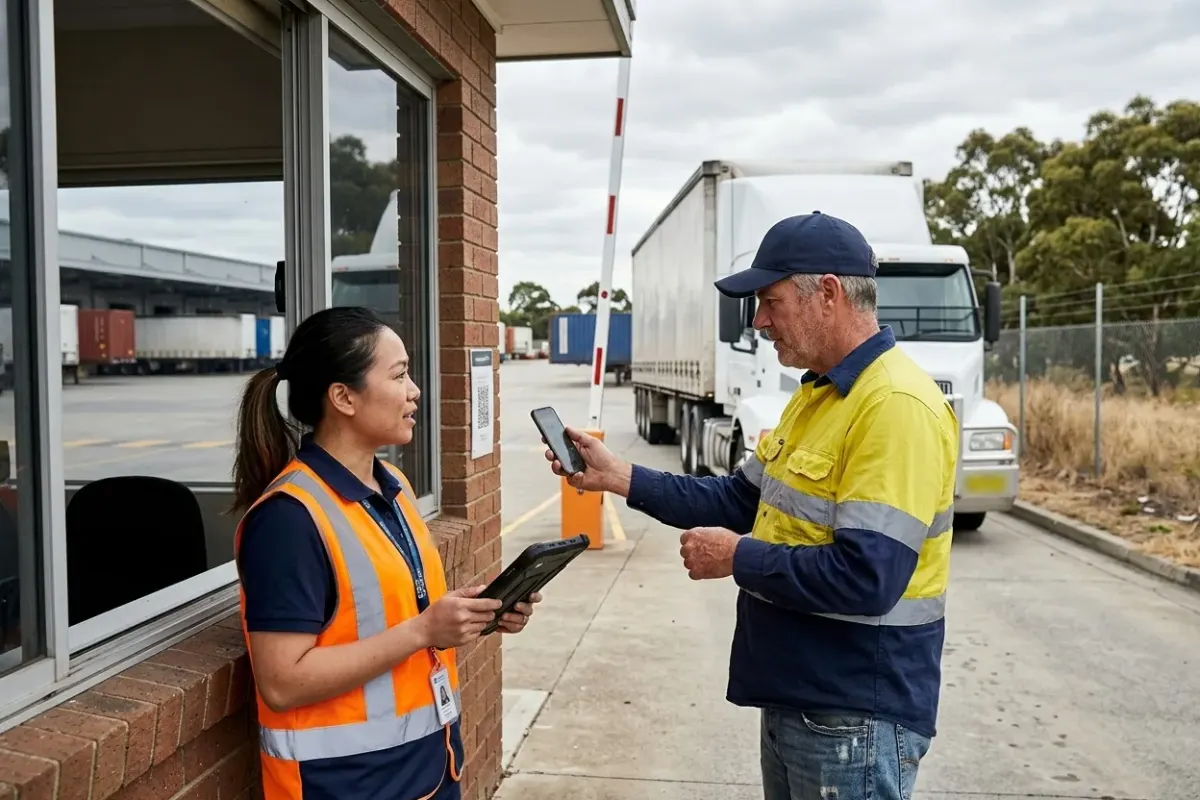
With a system, the subcontractor registers against the 3PL's client code, and the requirements for the Perth lane appear on its dashboard: company insurance, accreditation under either scheme with its expiry, how fatigue is managed on a run of that length, and anything the WA leg adds. The driver uploads the licence, front and back. The prime mover's registration and service evidence go on the vehicle's own record. The 3PL's approver reviews each document on Friday evening, rejects the one-sided licence with a reason the driver receives by email, and approves the rest. On Sunday the driver scans the QR code at the gatehouse, is shown the depot's traffic management plan, and appears on the live list.
What gets kept is the part that matters months later: what was asked for, what was supplied, who approved it, when, and what the driver was shown at the gate. That record is the difference between saying the carrier was checked and showing it.
Where Carrier Compliance Software Sits Beside a TMS and Telematics.
A transport management system books the load, plans the run, and prices it. Telematics and an electronic work diary record what the vehicle and the driver actually did. Neither answers the question a carrier file answers, which is whether this carrier, this driver, and this vehicle were cleared for this job before it started, and whether they still are.
The three should be connected, so the booking screen can see a lapsed certificate before the load is allocated, but none of them does the others' work. When reading lists of the best transport software, most rank planning, routing, and telematics tools, and carrier onboarding gets a line. An operations manager usually needs both kinds, and should judge the contractor side on the tests below rather than on a TMS feature list. For the broader questions to ask any contractor management vendor, 10 questions for contractor management software, and the answers that should worry you covers the ground.
Six Carrier Tests to Run in Any Demo.
A generic demo shows one contractor arriving at one site. A transport operation needs to see these six, on its own lanes and depots, with the vendor driving.
- The Friday afternoon test. A new owner-driver, offered by a subcontracting carrier, for a Sunday departure. How long until the first document is uploaded, what does the driver see as missing, and who at your end is told when it is ready to approve?
- The two-scheme test. One carrier with accreditation granted before 1 August 2026 and still in force, one under the new scheme. Does the file take both, with their own expiry dates, without a workaround?
- The lapsed insurance test. A carrier booked for Wednesday whose insurance runs out on Tuesday. Who is reminded, how far ahead, and what does the person allocating Wednesday's loads see?
- The Perth lane test. Add a requirement that applies only to carriers on a Western Australian lane. Do metro carriers stay untouched?
- The 2am gatehouse test. A driver arriving at an unattended gatehouse. Is the check made at the gate, is the depot's traffic management plan shown, and does the driver appear on a live list?
- The executive test. Ask for every carrier, driver, and vehicle document due to expire in the next 30 days, and every rejection in the last quarter with its reason. Time it. This is the report that shows the process is used, not only written.
A system that passes all six on your own data is worth a trial. If a vendor would rather show a different scenario, that is worth noting too.
How ComplyFlow Handles Carriers, Drivers, and Vehicles.
ComplyFlow is contractor management software, and the four layers of a carrier file map onto its requirements. A Requirement Set bundles what someone must provide, and ComplyFlow sends the invitations, the reminders, and the renewals when a document expires. Sets exist for suppliers (the carrier company), workers (the driver), sites (the depot), and plant and operators (what the operator and the machine each need, per plant category).12 A carrier registers with its ABN and a client code, and the client's requirements then show on its dashboard.13
Vehicle documents sit on the vehicle's own record with expiry dates, approved by that category's approvers.14 An approver reviews every document before it is accepted, and a rejection reaches the uploader by email with its reason.15 Each sign-in point has its own QR code and can show site documents, traffic management plans among them, as the last step of sign-in, with what was displayed logged in the sign-in book export.16 The site access dashboard shows who is signed in across sites on a map or a list.17 One report shows every document for the life of the account, filtered to anything due to expire within a set number of days, and exports to CSV.18 Data is hosted on AWS in Australia, and ComplyFlow has been ISO 27001 certified since 2019.19
Auckland Transport, where most locations are unmanned, uses ComplyFlow for digital prequalification, its Authority to Work process, and real-time tracking of contracted workforce compliance, so activity at unmanned sites is no longer a blind spot. Read the Auckland Transport story. SYDTRAC (Acciona and Alstom), which built Sydney Light Rail, has engaged ComplyFlow since February 2015, with contractor prequalification, work authorisation and permits, fatigue management, and plant and equipment among what was delivered. Read the Sydney Light Rail story.
Run the Friday Afternoon Test on Your Own Lanes First.
Pick the lane most likely to be subcontracted at short notice, usually the longest one. Ask what would happen this Friday if the regular carrier offered an owner-driver you have never used, for a Sunday departure. What would you ask for, who would check it, and what would the record show on Monday?
If the honest answer is a folder of attachments and a line in a spreadsheet, that lane is where carrier compliance software earns its keep first. It is also the scenario to hand every vendor you talk to, because it is the one a transport operation lives with every peak season.
Sources
- Chain of Responsibility (CoR)
- Parties in the CoR
- Heavy Vehicle National Law (Queensland), current reprint
- Regulatory Advice: Shared Responsibility
- Primary duty scope
- Heavy Vehicle National Law and Regulations
- CoR resources
- NHVAS transition to HVA scheme
- Complying with your Primary Duty obligations
- Chain of Responsibility
- Heavy Vehicle National Law Application Act 2013
- Onboarding Requirements
- Registration Page
- Plant & Vehicle Documents
- Check Why Your Document Was Rejected and Find the Solution
- Live Access Sign-In Options: Confirmation Sets, Site Inductions and Site Documents
- Live Access Dashboard
- Reporting on all documents in the system
- Platform Architecture and Hosting
See It Against Your Own Contractors, Sites & Rules.
Book a 30-minute demo. We will show ComplyFlow working with your kind of sites, your kind of contractors, and your requirements. No slides, no hard sell.
Or Speak to Us
- ISO 27001
- Hosted on AWS
- Microsoft & Okta SSO
- API & MCP
- Data in Australia
Written by
Bart CrowtherDirector of Sales, ComplyFlow
Bart leads sales at ComplyFlow and spends his week with the safety, procurement, and facilities teams deciding how to manage contractors. He writes about what buyers ask, and what separates a system that gets used from one that gets ignored.
Writes about: Choosing a compliance system, Rollout and adoption, What buyers ask
Questions
Questions People Ask About This.
Is an owner-driver a party in the Chain of Responsibility?
Yes. The NHVR says a person who owns and drives a heavy vehicle is its operator and a party in the chain. A business that engages a self-employed driver under a contract for services performs another of the 10 functions, prime contractor. An employed driver is not a party because they drive, though drivers carry their own duties under the law.
If a carrier is accredited, do we still need our own checks?
Yes. Under the Heavy Vehicle National Law a duty cannot be transferred to another person, and the NHVR tells businesses to find out how another business operates before contracting with it. A current accreditation is strong evidence about the carrier's own systems. It does not replace your record of what you checked before you booked it.
Does every carrier need a safety management system?
No. The NHVR says an effective safety management system is not a legal requirement for most heavy vehicle businesses, though it is one of the best ways to manage risk and demonstrate compliance with the Primary Duty. Operators in the Heavy Vehicle Accreditation scheme must have one.
What happens to NHVAS accreditation after 1 August 2026?
Section 761 of the amended Heavy Vehicle National Law says the amendments do not apply to a heavy vehicle accreditation in force immediately before they commenced. The law as it stood continues to apply to that accreditation until it expires or is cancelled. The NHVR is granting no new NHVAS accreditation, operators can request extensions during the transition, and an operator can be accredited in only one scheme at a time.
What should an operations manager ask to see in a first demo?
Your own lanes and depots, not the vendor's example. Ask to see a new owner-driver cleared before a weekend departure, one carrier on NHVAS and one on the new scheme, a lapsed insurance certificate on a carrier already booked, a lane into Western Australia with its own requirements, a driver signing in at an unattended gatehouse, and a report of every carrier document due to expire in the next 30 days.